
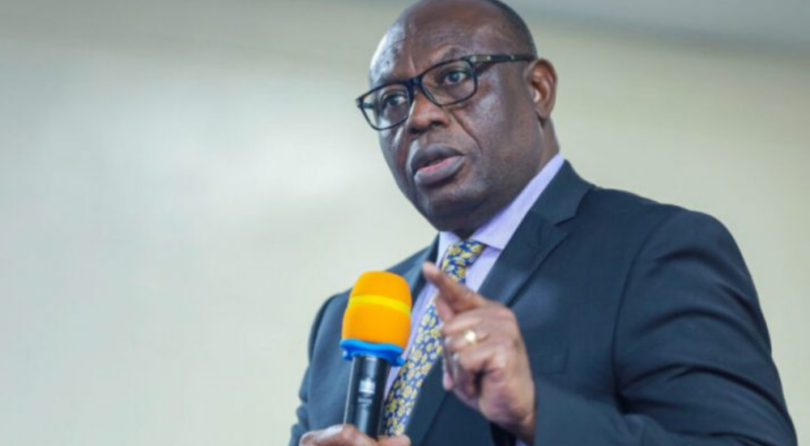
Former National Commissioner of the Independent National Electoral Commission (INEC) for Voter Education and Publicity, Festus Okoye, has explained how logistical and technical challenges encountered during preparations for the 2019 general election contributed to the postponement of the presidential election.
Okoye said the commission faced difficulties transporting sensitive election materials, including ballot papers, as well as reconfiguring election equipment, leaving it with no option but to reconsider the scheduled date of the election.
He spoke while delivering a paper presentation during a training programme for staff of THE WHISTLER newspaper ahead of the 2027 general elections.
Recounting his experience as an INEC official involved in preparations for the 2019 general election, Okoye said the commission took extraordinary security measures to prevent politicians from discovering where ballot papers were being printed.
He explained that the ballot papers contained security features and were printed by specialised security printers in different countries, adding that INEC divided its officials into teams and deployed them to various locations.
“We divided ourselves into teams, and I was among those who travelled to countries whose names I did not even know before then. I went to Romania. I went to Lithuania. I went to four Eastern European countries where we were printing ballot papers,” he said.
“One team went to South Africa. Another team went to the United Kingdom, and so on and so forth. We did all this to conceal the locations where the ballot papers were being printed so that politicians would not know.”
Okoye recalled that after the ballot papers were printed, the commission encountered transportation difficulties while moving some of the materials to Sokoto State.
He said INEC chartered a Nigerian Air Force C-130 aircraft to transport the ballot papers to Sokoto, but the aircraft could not discharge its cargo because there was no forklift available to offload the pallets.
“There was no forklift to bring the pallets down from the aircraft. There was no forklift. So, we diverted the plane back to Abuja and then diverted it to Kano,” he said.
According to him, the commission subsequently arranged Danfo trucks to transport the ballot papers from Kano to Sokoto, but the trucks encountered difficulties along the route.
“We chartered Danfo trucks to transport them to Sokoto. They drove off, but somewhere along the way, the trucks broke down in the forest,” he said.
The former national commissioner also narrated how technical challenges involving the reconfiguration of election equipment contributed to the difficulties facing the commission.
He recalled encountering an official from INEC’s Information and Communication Technology department during the preparations, who warned that reconfiguring equipment located in Lagos and Kaduna would require about three weeks.
According to Okoye, the official approached him while he was returning from a meeting with the commission’s chairman and expressed concern about the time required to complete the reconfiguration.
“He said, ‘Hi, Chief, I heard that you people are trying to postpone the election.’
“I said, ‘Yes, we have challenges.’
“He said, ‘I heard that people are proposing one week.’
“I said, ‘Something like that.’
“He then warned that the equipment in Lagos and Kaduna would require about three weeks to reconfigure,” Okoye recounted.
He said he immediately returned to the meeting and informed the chairman about the warning.
“I said, ‘Chairman, as I was coming, see what this guy is saying.’ He said, ‘Okay, go and ask him whether two weeks will be sufficient.’
“We started negotiating with him,” he said.
Okoye further disclosed that as the possibility of postponement became increasingly clear, some journalists positioned cameras outside his office at the commission’s headquarters around 2 a.m. to monitor his movements.
“When it became very clear to us that the election would not take place that day, at about 2 a.m., some very mean journalists, very mean guys, focused their cameras on my office, outside the commission’s gate, to monitor my movements in and out,” he said.
He added that the commission’s chairman initially opposed the idea of postponing the election, despite the operational difficulties confronting the electoral body.
Okoye also explained the importance of statutory timelines in election administration, particularly the constitutional provisions governing pre-election and post-election litigation.
He said Section 285 of the 1999 Constitution prescribes timelines for election-related cases, stressing that parties involved in electoral disputes must comply with the periods stipulated by law.
“If you have a problem with a party primary, for instance, a primary was conducted, you won, but the ticket was given to someone else, you have 14 days from the date that event occurred to file your complaint,” he said.
He added that candidates who challenge election results also have a prescribed period within which to approach the appropriate tribunal.
“The point I am making is that when lawmakers make a law and include a specific timeline in it, that timeline is like the Rock of Gibraltar. It cannot be moved,” he said.
Explaining how the timelines are calculated, Okoye said Saturdays and Sundays are included in the counting of days for election-related matters, noting that this was why election tribunal registries remained open during weekends.
He recalled an experience while reviewing an election petition in Kaduna on a Sunday, when he attempted to attend church.
“I told Joseph, ‘I want to go to church.’ He said, ‘You at church now, which time?’ I said, ‘My head.’ He asked, ‘Now, which time they go finish?’ I said, ‘Maybe 10 or 11,’” he recounted.
Okoye said the exchange illustrated the pressure associated with complying with strict electoral timelines.