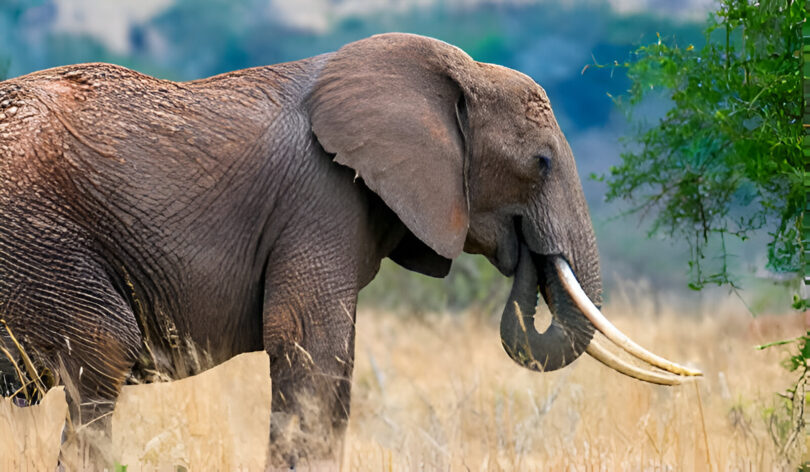
Police say a wild elephant invaded an Oyo community, killing one person and leaving another missing, as authorities move to contain the situation.
The Oyo State Police Command has confirmed a fatal elephant attack in Innayin Community, Oyo State, South-west Nigeria.
“The Oyo State Police Command wishes to inform members of the public of an unfortunate incident that occurred on Thursday, 23 April 2026, at about 1530HRS, involving the invasion of Innayin Community by a wild elephant,” the statement said.
Mr Olayinka said police operatives, working with local vigilantes and hunters, responded swiftly after receiving a distress call. However, upon arrival, they discovered the lifeless body of Ibrahim Tijani, 45, in a nearby bush with injuries consistent with an animal attack.
His remains have been deposited at the General Hospital, Iwere-Ile, for examination and preservation.
During ongoing search operations, another resident, Muhammadu Bingin, 50, was reported missing following an encounter with the animal.
“Intensive efforts are currently underway to locate him,” the police added.
The command reassured residents of Innayin and neighbouring communities that the situation is under control, urging them to avoid the affected area and promptly report any sighting of the animal.
Authorities also said relevant agencies, including the National Park Service, are being engaged to provide expert guidance on managing the situation in line with wildlife conservation laws.
The Commissioner of Police in the state, Abimbola Ayodeji Olugbenga, urged calm.
“We understand the concerns this incident has generated within the community. Our officers are fully on ground working with relevant stakeholders to secure the area and prevent further casualties,” he said.
“We appeal to residents to remain calm, avoid the affected locations, and continue to cooperate with the police and other authorities.”
The National Park Service had yet to issue an official statement as of the time of filing this report. Calls and messages sent to its Conservator-General, Ibrahim Goni, were not returned.
However, a senior park official, who requested anonymity because he was not authorised to speak, said preliminary information suggests the elephant may have been moving along a migratory route.
“We don’t have elephants stationed in Oyo State, but there are populations passing through migratory routes in the state. Farmers are now cultivating along those routes, often planting crops that attract elephants,” the official said.
He added that elephants sometimes destroy crops and may become aggressive when confronted.
“Elephants do not forget when they are attacked, which can lead to retaliatory behaviour,” he said, noting that officials plan to visit the community next week to assess the situation and determine the migratory pathways.
Incidents involving human-elephant conflict have increased across Nigeria’s ecological zones in recent years, posing risks to both rural livelihoods and wildlife conservation.
Last year, PREMIUM TIMES investigation revealed how these elephants’ activities are fueling hostile behaviours among locals and posing significant threats to the population of the elephants.
Crop destruction by elephants has become a major concern for farmers in rainforest and savanna regions, often fuelling tensions and retaliatory attacks.
Nigeria’s elephant population has declined sharply over the past three decades, from about 1,500 to an estimated 200–400, due to poaching, habitat loss, and conflict with humans.
The country hosts both forest and savanna elephant species—Loxodonta cyclotis and Loxodonta africana. About 90 per cent of the remaining population is found within or near protected areas, while the rest roam outside, increasing the likelihood of encounters with humans.
Communities around protected areas such as Cross River and Yankari, as well as Okomu National Park in Edo State, have reported repeated cases of elephant crop raids.
A senior National Park Service official said the agency does not compensate farmers for losses caused by elephants but instead advises them to avoid farming along migratory corridors.
“We can support farmers with seedlings and inputs, but we do not provide cash compensation,” the official said.
Experts attribute the growing conflict to factors including agricultural expansion, illegal logging, habitat fragmentation, and climate-related pressures.
The Natural Resources Conservation Council lists poaching, illegal ivory trade, habitat loss, livestock grazing, and weak institutional frameworks among the major threats to Nigeria’s elephant population.