A total of 80,000 people have fled to safety in both countries, as smoke and fire close in on resort towns
Tens of thousands of people have been evacuated from resorts on France’s southwestern coast, while the Spanish capital of Madrid is battling its worst wildfire in history, as southern Europe burns in one of its hottest summers on record.
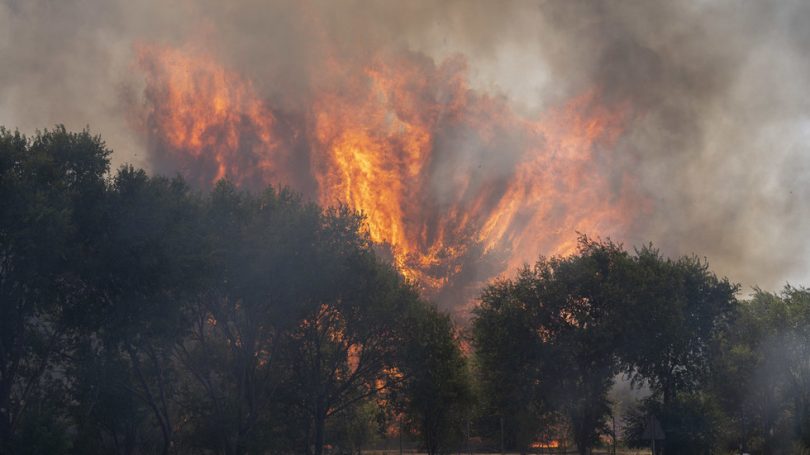
Authorities in France ordered the total evacuation of Cap Ferret on Friday, commanding around 40,000 people to leave the popular resort area. The peninsula had been blanketed in a thick orange haze since Wednesday, when a fire that broke out inland near Saumos began spreading westward to the Atlantic coast.
While thousands of residents and tourists fled Cap Ferret and surrounding areas on Thursday, boats ferried hundreds of remaining holidaymakers off the peninsula on Friday morning, as flames encroached on the only road leading to the mainland.
Some 800 firefighters, backed by multiple water-bombing planes deployed by the European Commission were battling the blaze as of Friday afternoon. More than 12,500 hectares of forest have been burned.
The sky is now completely engulfed by massive, billowing clouds of dark brown and orange smoke as the wildfire in the Lège-Cap-Ferret area sends a thick plume of smoke across nearby Lacanau, Gironde Department, France.
The wildfire has already scorched around 10,000 hectares. pic.twitter.com/8aENqmWYY4
— Weather Monitor (@WeatherMonitors) July 24, 2026
French Interior Minister Laurent Nunez said that 32 wildfires of varying size were burning across France on Friday, while 45 km south of Cap Ferret, one of these fires approached the beach town of Biscarrosse, where around 23,000 people have been evacuated.
🔥 ALERTE – Un monstre. Le mégafeu hors de contrôle en #Gironde prend des proportions phénoménales et a maintenant parcouru près de 5000 hectares depuis hier ! L’incendie a atteint Lège-Cap-Ferret où des maisons sont en flammes, des explosions sont entendues, la mairie et des… pic.twitter.com/DRMpwNlZsM
— Infos Françaises (@InfosFrancaises) July 23, 2026
While temperatures in southwestern France have dropped from an all-time high of 42.9 degrees Celsius in Biarritz last month to 28C in Biscarosse on Friday, the heatwave of the past six weeks has left the region’s forests unusually dry and vulnerable to fire. According to Nunez, 50,000 hectares across France have been burned so far this year – nearly four times as much as by this time last year.
In central Spain, where temperatures reached 44C last month, 19,000 people were ordered to evacuate areas near Madrid and the neighboring region of Avila. Two fires near Madrid and a third in Avila have since merged, prompting Spain to declare a national emergency.
“This is the worst fire in the history of the Madrid region,” regional president Isabel Diaz Ayuso said on Friday. Ayuso blamed the catastrophe on “a perfect storm, with extremely high temperatures, a relentless wind and the misfortune of having several fire fronts join together.”
Spanish Prime Minister Pedro Sanchez has blamed the fires on climate change. “I’ve said it many times before, but the climate emergency kills. We’re seeing that across Europe and we’re seeing that in Spain,” he said earlier this month. On Wednesday, Sanchez called on his political rivals to back a “state pact” to tackle climate change.

Spain’s right-wing Vox party pushed back against Sanchez. “It’s not climate change, it’s the lack of clearing of the woodlands and the means to combat the fires,” the party claimed in a social media post.
Western Europe recorded its hottest June on record last month, according to the EU’s ‘Copernicus’ Earth observation program. France’s late June heatwave was the most intense in the country’s history, according to Meteo-France, while June was the second-hottest in Spanish history.
You can share this story on social media: