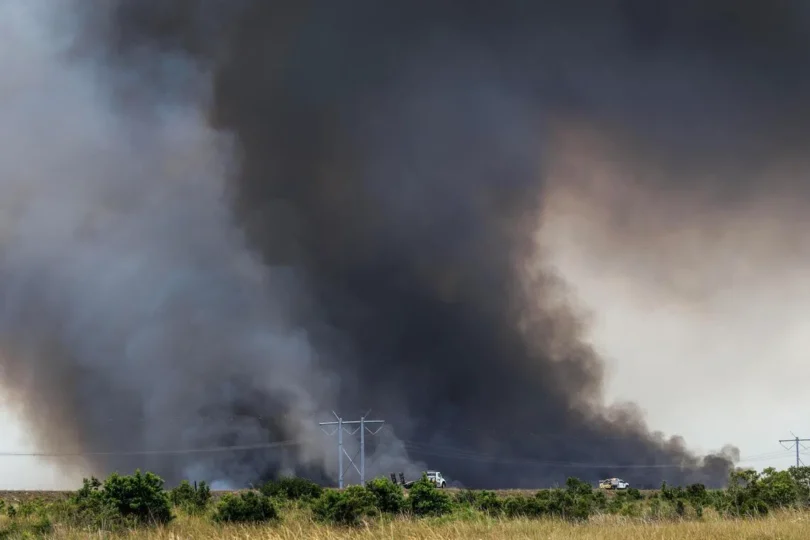
PARIS – The world could face a year of “particularly severe” wildfires, fuelled by climate change and a potentially strong El Nino weather phenomenon, after a record-breaking start to 2026, researchers warned on May 12.
“This year the global fire season has got off to a very fast start,” said Theodore Keeping, a researcher at Imperial College London.
The area scorched by wildfires so far is 50 per cent higher than average for this time of year, Keeping said in a press briefing.
And this is before El Nino has even formed.
El Nino is the warm phase of a natural climate cycle in Pacific Ocean temperatures and trade winds, which influences global weather patterns and increases the likelihood of droughts, heavy rainfall and other climate extremes.
It also adds heat to a planet already warmed from burning fossil fuels. The last El Nino helped make 2023 and 2024 the top two hottest years on record.
Some weather agencies forecast the coming event will be even stronger – possibly rivalling a “super” El Nino three decades ago.
“The likelihood of harmful extreme fires potentially could be the highest we’ve seen in recent history if a strong El Nino does develop,” said Keeping, who is part of World Weather Attribution (WWA), a network of climate scientists.
Fires have already burnt a total area exceeding 163 million hectares between January and the first week of May, according to data from the Global Wildfire Information System (GWIS).
The total burnt area is around 20 per cent higher than the previous record since global tracking began in 2012, Keeping said.
Records were broken in several countries in west Africa and the Sahel region, as well as Sudan and South Sudan, he said.
The burnt area from Asian wildfires has thus far been nearly 40 per cent larger than the previous record in 2014, Keeping added.
The United States and Australia have also seen unseasonably large areas burnt in 2026.
WWA co-founder Friederike Otto, a climate science professor at Imperial College London, also warned that “there is a serious risk” that the combination of climate change and El Nino could result in “unprecedented weather extremes” in 2026.
But she said El Nino is “not the reason to freak out” as it is a natural weather phenomenon that “comes and goes”.
“Climate change is the reason to freak out,” she said, as “it gets worse and worse and worse.” AFP