
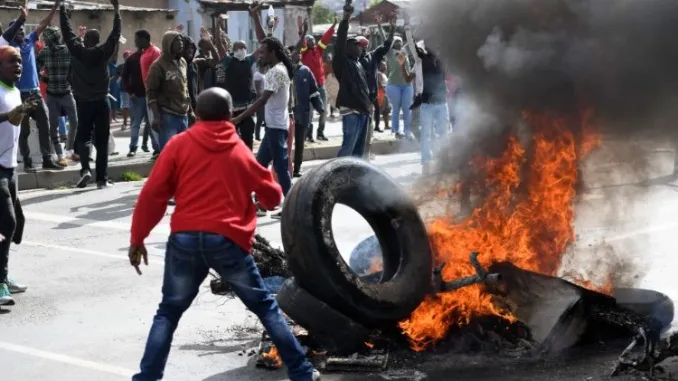
At least five African countries have repatriated citizens or are working towards repatriation from South Africa.
Relations between South Africa and other African countries, including Ghana, Nigeria, Kenya, and Malawi, have been tense over the past weeks due to xenophobic attacks. The latest round of violence started in April with online videos showing South Africans holding sticks as they chased and beat Black foreigners, telling them to leave their country.
The violence and anti-immigrant protests in different parts of the country reignited the worrisome trend that has persisted for decades. Attacks on African migrants, refugees, and asylum seekers made the UN predict that South Africa was “on the precipice of explosive xenophobic violence” in 2022.
The global body called for concrete government action against racism, racial discrimination, xenophobia, and related intolerance directed at migrants and minority groups.
These attacks are often led by groups that make scapegoats of African foreigners and attribute the country’s economic woes, poor service delivery, and high crime rates to their presence, although studies have disproved these claims.
The latest round of violence continues a pattern in South Africa.
PREMIUM TIMES reports that attacks on foreign-owned businesses and migrants led to diplomatic tensions between South Africa and other African countries in 2019 and also in 2015.
One of the most gruesome bursts of xenophobic violence in the country occurred in May 2008 when South Africans targeted foreign migrants from Zimbabwe, Mozambique, Malawi, and Somalia who resided in areas such as Johannesburg, Durban, Cape Town, the Free State, and the Eastern Cape. Shops, homes, and businesses owned by foreigners were looted, burned, or destroyed. At least 60 people were killed in the violence that year, and hundreds were injured. It also led to the displacement of thousands of migrants who fled out of fear for their lives.
The deaths of two Nigerians, five Mozambicans, and five Ethiopians have also been linked to the newest wave of this trend. It implies that at least 12 African immigrants have been killed due to suspected xenophobic attacks over the last three months.
This paper reports that the Nigerians were reportedly beaten to death by officials of the South African National Defence Force (SANDF) in Port Elizabeth in April, while the Mozambicans were reported dead in June.
PREMIUM TIMES has extensively reported the various reactions of African countries to the violence in Pretoria. State authorities across the continent, at different times, issued security advisories warning citizens to be cautious or advising those at home to suspend non-essential travel to any South African city. Countries that have issued such guidelines include Ghana, Nigeria, Kenya, Malawi, Zimbabwe, and Lesotho.
In April and May, Ghana and Nigeria summoned South Africa’s High Commissioners to their respective countries to indicate their displeasure with the violence against Africans in South Africa. Nigeria demanded a thorough investigation into the deaths of two citizens allegedly killed by security operatives.
Yet the most prominent diplomatic reaction has been the repatriation of citizens from the country, a decision that led to a televised address by South African President Cyril Ramaphosa, who hammered on the state’s intolerance towards groups inciting tension and “taking laws into their own hands.”
He declared that while the people’s concerns over illegal migration remain valid, “only authorised government officials can act against violations of our law.”
Repatriations by African states
At least five African countries have repatriated citizens or are working towards repatriation from South Africa.
Ghana became the first African country to organise evacuations due to xenophobia in May with the repatriation of around 300 citizens from Johannesburg to Accra. On Monday, the country announced that it had evacuated about 1,000 Ghanaians—an exercise the government described as fulfilling its pledge to protect citizens from violence.
“We kept our promise. No Ghanaian has been abandoned in harm’s way,” Ghana’s Foreign Affairs Minister, Samuel Ablakwa, wrote in a statement.
This paper reports that the Ghanaian authorities also introduced a job initiative to provide employment opportunities for returnees.
Ghana has been vocal about its stance on the harassment of Africans in South Africa. The state authorities say these attacks run counter to the Pan-African ideals of African unity and solidarity.
Mozambique has repatriated about 700 of its citizens. It began the exercise last week after five Mozambicans were killed in the anti-immigrant attacks. Local media reported that around 169 citizens, including 16 minors, were repatriated on Tuesday. The state still expects to receive more returnees as it intensifies its repatriation operation.
The country has also commenced diplomatic procedures to bring home the corpses of Mozambicans lost in the violence. Earlier, it was reported that about 300 citizens had already returned home on their own, and that preparations were underway to repatriate other displaced Mozambicans.
“Those remaining in South Africa are sheltered in a safe location in the Western Cape Province, and the process of their repatriation to Mozambique is already underway. Given the volatility, a worsening of the current situation is expected,” Mozambique’s government had said.
Around 171 Malawians arrived in Lilongwe on Tuesday as the first group of returnees. They included 115 men, 43 women and 13 children who had sought refuge in temporary shelters in Mossel Bay after the violence and door-to-door harassment in parts of South Africa forced them out of their homes.
The trip to Malawi was by road. Malawians who obliged the call for voluntary exit travelled from the Western Cape province, through Zimbabwe and Mozambique, and arrived in the country through the Mwanza Border Post. Afterwards, they proceeded to Kamuzu Stadium in Blantyre, where they had their visas processed before travelling to their respective local destinations, according to the authorities.
Pictures shared by Malawi’s government on X show a long line of people queuing in an empty stadium. They appear to be waiting to be registered.
The government declared that it “will continue providing transit and consular support to Malawians displaced in South Africa.”
Zimbabwe, South Africa’s neighbour, has also repatriated citizens. Local media reported that the Zimbabwean government evacuated around 139 nationals in recent days. The first set of returnees arrived in the country from South Africa on Sunday. The second, a group of 35 adults and 30 children, arrived a day after.
According to media reports, the group recounted experiences of violence and intimidation from South African citizens, noting that these attacks targeted everyone irrespective of legal status.
The Nigerian government will commence the repatriation of over 1,000 citizens from South Africa on Wednesday evening. The first batch is expected to arrive in Lagos on Thursday morning.
Authorities indicated a readiness to facilitate the return of citizens in May after the two Nigerians, identified as Amaramiro Emmanuel and Ekpenyong Andrew, were killed. Citizens began registering for voluntary exit immediately after the announcement, according to the Ministry of Foreign Affairs.
More details here…