
“My own brothers were kidnapped in 2019, and these criminals were demanding at the time about N300 million. And I said, ‘Look, I’m not going to pay a dime.’ If you like, go and kill them.”
The Governor of Zamfara State, Dauda Lawal, on Thursday revealed that he refused to pay a ransom of N300 million demanded by bandits who kidnapped his brothers seven years ago.
Mr Lawal, whose state is plagued by bandits’ activities, said he refused to pay ransom because it would embolden the kidnappers to continue with the crime.
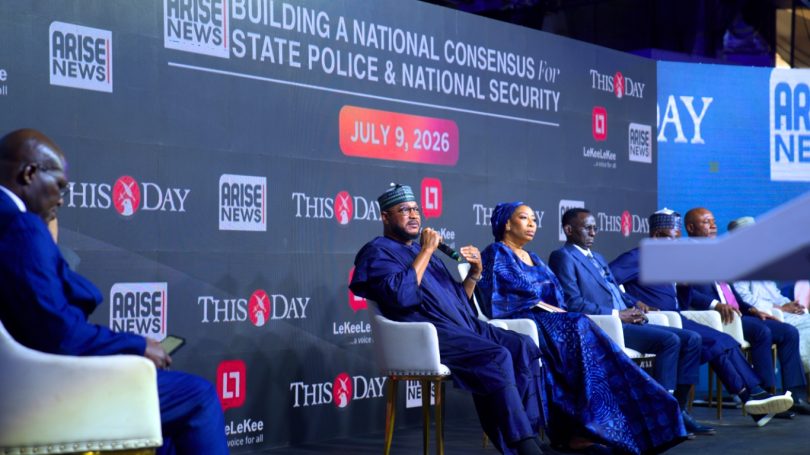
He spoke at the National Town Hall Meeting organised by ARISE TV in Abuja. The event was themed, “Building National Consensus for State Police and Security.”
The governor, who was a member of the panel of discussants, vowed never to negotiate with bandits or criminals from a position of weakness.
“I will not negotiate from the place of weakness, and I will not pay ransom to any criminal, no matter what happens.
“By the time we continue to pay ransom to these people, we are encouraging them to be kidnapping people more and more.
“My own brothers were kidnapped in 2019, and these criminals were demanding at the time about N300 million. And I said, ‘Look, I’m not going to pay a dime.’ If you like, go and kill them,” the governor said, adding that he believed criminals would think twice about abducting people if ransom payments stopped.
While advocating for the creation of state police, Mr Lawal maintained that governors must possess operational control over security within their domains to be properly held responsible for protecting citizens and their property.
He noted that a major source of frustration for him is that he and other governors are the chief security officers of the states without holding any real command over the security apparatus.
“It is important to know that Zamfara State has been facing insecurity in the last 13 years. And we are being called the chief security officers of our respective states. However, the command and control structure is not under the governors.
“I am happy about the latest development about the state police because it allows us to keep our responsibilities and for our people also to hold us responsible as far as the security situation is concerned in our respective states.
“And that is why I have been part and parcel of the process and I strongly believe that by the time we have this state police in place, it will go a long way in solving the security challenges and we can now bear our name as proper chief security officers of our respective states. So, I am, for this,” he said.
For fear that it would be abused, Mr Lawal said there is no perfect system and all that needs to be done is to strengthen the legal framework for state police.
He said some states, including Zamfara, already have security outfits, and there are no reports that their governors use them to hunt opponents.
He said his administration created the Community Protection Guard (CPG) upon assuming office in 2023 and had never used it against anybody but to fight criminals.
“I don’t think there is any reason to fear that governors will abuse the process,” he stated.
The Deputy Speaker of the House of Representatives, Ben Kalu, underscored the need to have state police in the country, noting that the laws that authorise the centralisation of policing in the country have failed its citizens.
“As parliament, which is the people’s house, we have consulted and we have found that there is a general consensus among Nigerians in the course of our public hearings that it is an issue that must be attended to.
“We must retool what we have currently as a structure that protects lives and property. So, we started with – how do we do it? Is it by unbundling it? Is it by taking it closer to the people? Is it by funding it more? What are the issues with the current structures that we have?” he said.
Mr Kalu, who chairs the House Committee on Constitution Review, said the legislature considered the issue of proximity of the police to the Nigerian people, hence it is considering the creation of state police.
On possible abuse, the deputy speaker said some safeguards have been put in place to ensure the governors or officials at the subnational level do not abuse it.
He added, “But many have argued that it will be abused, that the governors are going to abuse it. And the question I always ask – we currently have state high courts in various states of the federation. How many of these high courts have been used by the governors to jail those who are against them, maybe the opposition?”
The Senate Leader, Opeyemi Bamidele, said funding is key to sustaining state police once created. According to him, the institution must have fiscal independence because
He said, “If the state police is not well funded, it may as well be a highway to nowhere.
“It’s not only state actors or politicians that can abuse this. Business class, some other organisations, even criminals can abuse it, because he who pays the piper dictates the tune.
“We must have a situation where there will be some first-line provisions in our law. The police chief and the police service commission must have a guaranteed source of income in a way that it will not be subject to the whims and caprices of a sitting governor,” Mr Bamidele said.
Another panelist, Lucky Irabor, a former chief of defence staff (CDS), said there is a need to address some salient issues as soon as the state police comes on stream.
He said, “But then when they fully come on stream, the disease that has affected the federal police, we must do well to address the root causes of that disease so that it will not affect the state police. It is necessary for us to look at how the federal police is currently structured, the logistics, the equipment, the training and such other indicators.
“And for state police, I think training institutions have to be established; the protocols of training, among several other details, need to be specified. Otherwise, we will be having disparity on state police from state to state. So, for us to have a uniform structure for training as well as policing principles, it is good for us to have a designated establishment where, irrespective of the states, the troops will be trained and they go back to their states to implement what they have learnt.
“Also, within individual states, the recruitment within the state itself- how do we ensure that there will be adequate representation from each of the local government areas? What kind of individual will be recruited, and how do we ensure that we are not going to be recruiting criminals into the state police, among several other things?