‘WHEN WORDS FALL SILENT, CINEMA SPEAKS …” announces a giant sign. “CINEMA AS A WEAPON” is among the slogans pinned to a board. So it is clear from the start that Zineb Sedira’s exhibition at Tate Britain is intended as a manifesto as much as an aesthetically pleasing arrangement of films and sculptures. And these phrases raise questions: if art is a weapon, then who gets to use it, what war is being fought, and is it any longer effective? What silence is being maintained, and who is speaking out against it?
To answer these questions, Sedira presents a case study of La Cinémathèque Algérienne, which became a mecca for leftist African film-makers after its foundation in 1965. Screened in a model movie theatre complete with flip-down seats, this short documentary film revolves around the cinema’s director, Boudjemaâ Karèche. That he wears a beret very well might tell you something, and this something is confirmed by his accounts of the cinema during its heyday in the 1970s. Here was a place in which clever and idealistic young people could meet to watch important works of revolutionary art, argue about how to construct a better world, and hope to sleep with other clever and idealistic young people.
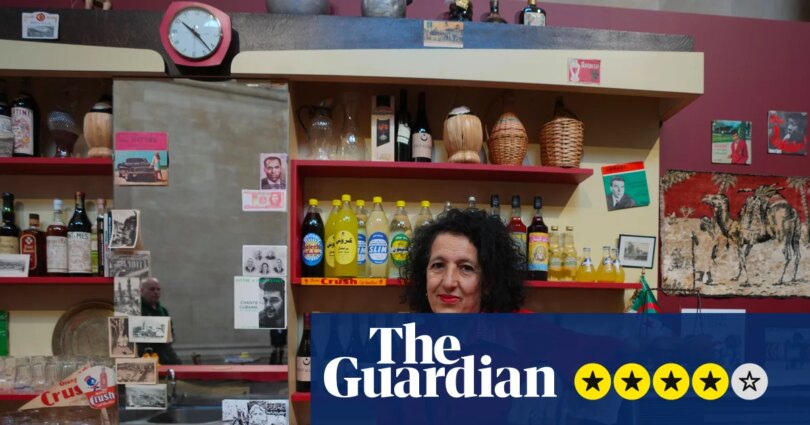
That isn’t meant to sound flippant. The artist’s recreation of an Algerian cafe in Paris, circa 1974, makes an argument that those aspirations need not be mutually exclusive. Music plays through a jukebox, the bar serves wine and couscous, and the tables are scattered with books about leftist cinema. Enjoying the heady atmosphere, I take the point to be that intellectual life should not be separated from the pursuit of pleasure, and that there is no contradiction in talking about injustice while in the process of drinking with friends. This is a very Francophone point to make, for all that I agree with it, and the phrase “radical chic” might at this point be taking shape in readers’ minds.
But Sedira’s installation works. You want to learn more about the story she is telling, because it is delivered with a charm substantiated by technical skill and deepened by personal feeling. In this respect it fulfils Karèche’s insistence that, however important a film’s political message, it must function as cinema first. If it is not to be propaganda, then any work of art with a political conscience must also excite the senses and should never pretend to be impartial. And it becomes clear that Sedira, who was born in Paris to Algerian parents and has lived in London since 1986, makes no claim to be a disinterested observer. This is not only a history lesson, but an attempt to reconstruct a place that the artist might call home out of the brutal history of Algeria’s liberation from France, and from which she might derive her own identity as a member of its diaspora and a socially engaged artist.
A great deal of care has been put into its detail. The monitor on the vintage jukebox plays clips from Agnès Varda’s Salut les Cubains; still images in the films are animated; the interior of a mobile cinema has been painstakingly recreated; a photograph of James Baldwin in Paris and a Palestinian pennant suggest the solidarity that art might express. This paean to romantic intellectualism is so seductive that, after a while, you come to wish that the bar was serving, that the crowd was a little more lively. Indeed, you come to wish that you were not in Tate Britain on a Tuesday morning but rather at a cinema in Algiers at night, ideally in the late 1960s.
Here is the difficulty that is stated explicitly in the exhibition’s final film. When the Pan-African cultural festival of 1969 (a touchstone for Sedira) was restaged 40 years later, its revolutionary energy had dissipated. Artists who had once shared dormitories with their comrades now wanted hotels and limousines. At the opening William Klein, whose documentation of the first festival preserves it, had a question for the organisers. “We were revolutionaries,” he said, “that’s why we created the festival. Why are you creating this one?”
We are told that the question “chilled the room”, and it casts a pall over this exhibition, too. The restaging of revolutionary moments in museums can often seem to preserve them in aspic, to consign them to history. And if the revolution is coming, after all, it will be screened on our phones and not in cinemas. Is this exhibition merely basking in a reflected glow, or might it catalyse some of the same changes effected by the filmmakers it celebrates?
Here again, the Cinémathèque Algérienne offers a lesson: you don’t become a revolutionary artist by watching films or even by making them yourself, but rather by opening up that possibility for others. A truly revolutionary art, then, consists in making members of the general public feel more able to express themselves. It does so by offering people models, by exciting people, by insisting that art is not the preserve of those with money or degrees, and above all by making it look like something you might actually want to spend your time doing and that might in some small way make your life richer and more interesting and more connected to other people. By these measures, Sedira’s show is a success.