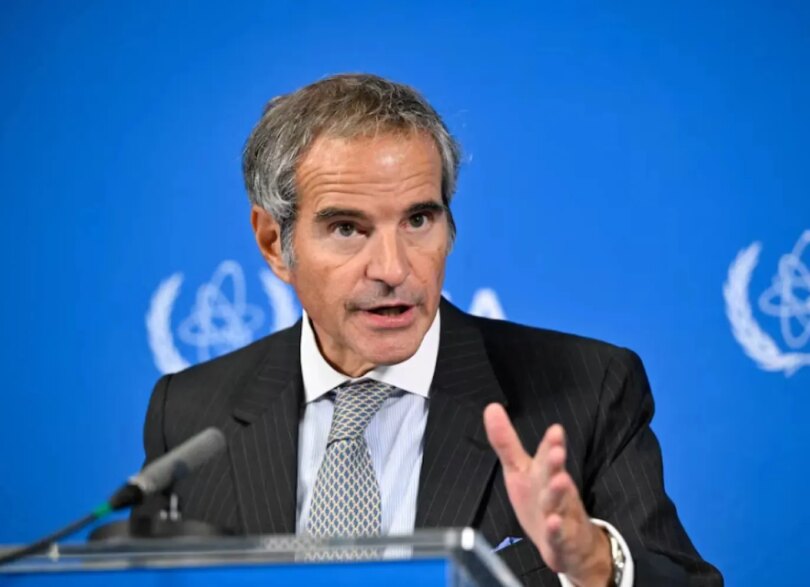
The head of the International Atomic Energy Agency, IAEA, Rafael Grossi has said the 2015 nuclear accord with Iran cannot be the starting point for a new agreement with the country.
Mr Grossi said this at a news conference on Wednesday at UN Headquarters in New York held on the margins of the latest international review of the nuclear non-proliferation treaty, NPT.
He said the Joint Comprehensive Plan of Action (JCPOA) – agreed by Iran and the five permanent members of the Security Council plus Germany and the European Union – “could not constitute a basis” for a new deal.
He added that “we need to look into something different” as Iran’s nuclear programme has changed too much.
Grossi was also asked about enriched uranium which is reportedly now buried under rubble following recent U.S.-Israeli airstrikes in Iran.
He said that IAEA was inspecting highly enriched nuclear material up until June 2025, and teams sealed some 440 kilogrammes of uranium during their last visit.
“So, we need to check that that is the case,” he added.
Grossi stressed that until inspectors can return, the agency “cannot confirm that this is the situation.”
Addressing the NPT meeting, Grossi called for renewed commitment to non-proliferation, warning that “a world with more countries with nuclear weapons would not be a safer world.”
Robert Floyd, Executive Secretary, Comprehensive Nuclear-Test-Ban Treaty Organisation (CTBTO), said “at a time when global tensions persist and multilateralism is under attack, efforts to prohibit nuclear testing remain crucial.”
“We see multilateralism under intense pressure, various elements of treaties that are important for international security under pressure…rhetoric about threats of nuclear testing, returning to testing, and even concerns about possible use,”
“This is why the work of organisations such as the CTBTO to seek to limit the spread of nuclear weapons and the further development of them is so critically important,” Floyd said.
The test-ban treaty forbids all nuclear explosions on the planet – whether above ground, underwater, or underground.
The CTBT opened for signature 30 years ago this year and “has almost turned off the tap when it comes to nuclear weapon testing,” as fewer than a dozen tests have taken place since then.
Floyd described it as “a treaty that has almost universally supported a ban on nuclear testing, no matter what size” with “a verification system that gives nations confidence, so that there is a powerful norm against testing.”
Although 187 countries have signed the treaty, with 178 ratifying, it has not yet entered into force as this requires ratification by nine key countries with nuclear technology.
They are China, Egypt, India, Iran, Israel, North Korea, Pakistan, Russia, and the United States.