The former chairman claimed the ADC has built significant political strength to challenge President Tinubu in 2027, while alleging that some serving senators are in talks to join the party.
Former National Chairman of the African Democratic Congress (ADC), Ralph Nwosu, has declared that the 2027 general elections may not be credible without the participation of his party.
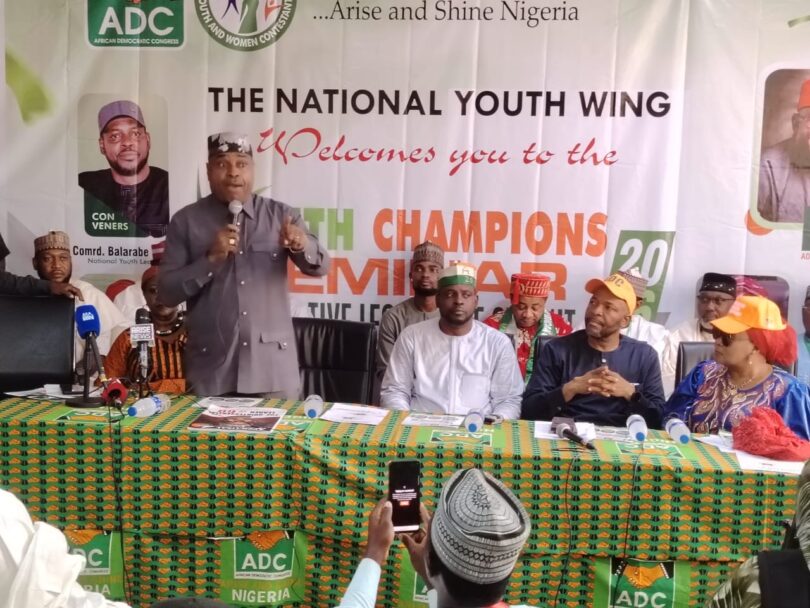
The event, organised by the office of the National Youth Leader, drew young aspirants from across the country alongside senior party figures.
It was held on the same day the Federal High Court asked INEC not to recognise the congresses conducted by the David Mark-led faction.
Addressing participants, Mr Nwosu expressed confidence that the party is building sufficient momentum to unseat President Bola Tinubu in 2027.
He said that neither President Tinubu nor the Chairman of the Independent National Electoral Commission (INEC), Joash Amupitan, would be able to conduct any election in the country if the ADC is excluded from the ballot.
“All I know is that Tinubu and Amupitan cannot conduct any election in this country if ADC is not on the ballot,” he said.
He said internal data available to the party suggests a surge in membership, with millions already indicating interest in joining.
The former chairman said the ADC could record up to 11 million registered members by the close of the exercise, noting that many prospective members are willing to make financial contributions to support the party.
“The statistics are already there in our portal. I think we’re already recording over five million people who are willing to pay and become members of ADC. By the time the registration will close down, we will have a minimum of 11 million people that are ready to contribute money,” he maintained.
He also disclosed that some serving senators across parties, including those in the ruling All Progressives Congress (APC), are in talks with ADC leaders over possible defection.
Mr Nwosu attributed the party’s current challenges to what he described as entrenched impunity in Nigeria’s political system. He argued that fears of losing influence drive resistance from those in power.
“The culture in place is dirty. It’s very difficult to change the culture, but we will continue working very hard to do so once we are determined. You don’t need a million people to do it you just need a few determined minds,” he said.
He further criticised Senate President Godswill Akpabio and Mr Tinubu, insisting that both leaders have outlived their political relevance.
“The time is over for Tinubu politically, and he must go. The time is over for Akpabio (Senate President), and they must go,” he said.
Despite these concerns, he urged party members to remain steadfast, maintaining that ADC’s internal structures and strategies are strong enough to withstand political pressure.
A major highlight of the summit was the emphasis on youth and women’s participation in politics. Mr Nwosu reiterated that the party’s constitution reserves 50 per cent of opportunities for these groups.
Earlier, the ADC National Youth Leader, Balarabe Rufai, called for the strict implementation of the party’s affirmative action provisions. He stressed that youth inclusion must move beyond rhetoric to actual enforcement, especially as the party prepares for its primaries.
Mr Rufai outlined specific allocations for young aspirants, including governorship, Senate and state assembly tickets, insisting these provisions are binding and not negotiable.
“By the binding authority of our party constitution, 12 governorship tickets are reserved for the Youth Constituency. At least one Senate ticket in every state belongs to the youth.
“Ten to 15 State Houses of Assembly slots per state are designated for young people. These are not promises, they are not political conveniences, they are enforceable commitments,” he added.
He also announced plans to establish internal structures, including a youth screening committee, an opinion poll unit, and an advisory body on electoral compliance and litigation, to strengthen participation and credibility.
In her goodwill message, former Special Assistant on Digital and Social Media to ex-President Muhammadu Buhari, Lauretta Onochie, said Nigerian youth have long been relegated to the margins of political decision-making. She described the ADC’s affirmative action as a deliberate effort to rebalance power and enable a new generation of leaders.
Ms Onochie urged aspiring politicians to develop key competencies, including legislative knowledge, negotiation skills, accountability and strategic thinking, noting that effective governance requires both technical expertise and political acumen.
She added that Nigeria’s youthful population makes it imperative to bring in leaders who understand contemporary challenges such as unemployment, digital transformation and insecurity from lived experience.
Legislators are not just lawmakers; they are strategists, negotiators, and public trustees. If the National Assembly of Nigeria is to function effectively, its members must combine technical competence with political intelligence.”
She listed legislative & policy competence, Communication & Persuasion, Negotiation & Coalition Building, Oversight & Accountability, Constituency Engagement, Ethical Judgment & Integrity, and Strategic Thinking & Political Intelligence as skills political aspirants must possess to thrive in public office.
The summit concluded with a broader call for sustained youth engagement, as party leaders and participants emphasised the role of a strong opposition in deepening Nigeria’s democracy.
The ADC, one of the largest opposition parties, has some prominent politicians as its members. They include former Vice President Atiku Abubakar, Peter Obi, and Mr Kwankwaso, who came in second, third, and fourth places, respectively, in the last presidential election.
The ADC is currently involved in a leadership dispute, stemming from the resignation of the party’s former executives, led by Mr Nwosu and the emergence of a new National Working Committee led by David Mark on 29 July, 2025.