Links Former Governor Sylva Through Financial Trails, Reveals N780 Million Disbursed Through Conduit Company
The Nigerian Army has confirmed before the Federal High Court in Abuja that there was a plot to overthrow the administration of President Bola Tinubu through a coup d’état, presenting detailed testimony from a military police investigator who told the court that a jotter recovered from an arrested colonel contained operational plans, names of government officials to be assassinated, political and structural changes planned for after the coup, and that financial trails linked the alleged plotters to former Bayelsa State Governor Timipre Sylva, who is said to have fled the country before the plot was exposed.
The testimony was delivered on Wednesday by the fourth prosecution witness, a soldier from the Nigerian Army Corps of Military Police whose identity was shielded by a court order and who was identified in proceedings only as “AAA.” The witness appeared behind a protective screen after Justice Joyce Abdulmalik granted a prosecution application to mask the identities of military witnesses, ruling that the sensitive nature of the case, which touches on terrorism, justified the protective measures.
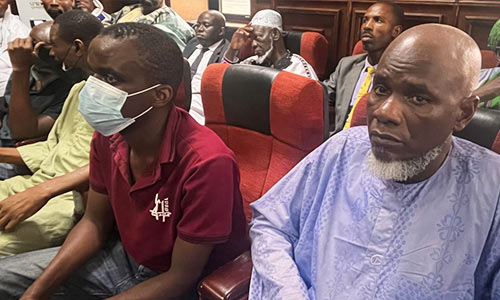
The case, marked FHC/ABJ/CR/206/2026, is being prosecuted by the Office of the Attorney-General of the Federation through the Director of Public Prosecution of the Federation, Rotimi Oyedepo SAN, against six defendants: retired Major General Mohammed Ibrahim Gana, retired Naval Captain Erasmus Ochegobia Victor, serving Police Inspector Ahmed Ibrahim, Zekeri Umoru, Bukar Kashim Goni, and Abdulkadir Sani. All six pleaded not guilty to a 13-count charge upon their arraignment on April 22 and are remanded in DSS custody.
The witness testified that the investigation commenced after the then Chief of Army Staff, General O.O. Oluyede, received an intelligence report that one Colonel M.A. Ma’aji and some others were plotting to overthrow the democratically elected government of President Tinubu.
According to the witness, after his team received the intelligence report, it was “analysed, processed and found to be credible.” The then COAS subsequently directed the team to thoroughly investigate the allegations and report back.
Following the instruction, the team proceeded to arrest Colonel Ma’aji, during which a Samsung Galaxy phone was retrieved from him. The team also searched his residence and recovered a jotter and other items.
The jotter recovered from Colonel Ma’aji proved to be one of the most significant pieces of evidence presented to the court.
The witness told the court that the jotter contained operational plans for the execution of the coup, names and designations of ranking members of the current regime, and the identities of officers who were to be assassinated in the course of the overthrow.
“Inside the jotter, we also found information about political and structural changes that were to be made upon the execution of the coup,” the witness stated.
The testimony suggests the alleged plotters had moved beyond abstract discussion of regime change and had developed specific plans identifying who would be targeted, how the government would be restructured, and what political changes would follow the coup.
When the Samsung Galaxy phone recovered from Colonel Ma’aji was sent for forensic analysis, the witness said the results revealed “elaborate plans” that linked the Colonel, some serving military officers, and the defendants in the case.
“We also found financial trails between Ma’aji, former Governor Timipre Sylva and some of the defendants here before the court,” the witness stated.
“Inside the phone, we found code words known among the plotters, including some of the defendants before this court,” the witness added.
The use of code words suggests an organised conspiracy with established communication protocols designed to conceal the nature of discussions from outside observers.
“We also observed financial trails between some of the defendants and Colonel M.A. Ma’aji. Monies were paid to some of the defendants in pursuit of the coup plot,” the witness testified.
Extracts from the phone were tendered in evidence and admitted by the court.
The testimony directly implicated former Bayelsa State Governor Timipre Sylva, who also served as Minister of State for Petroleum Resources under the late former President Muhammadu Buhari.
Sylva was mentioned in the charge filed by the Office of the Attorney-General and is said to be at large after fleeing the country before the alleged coup plot was exposed.
The witness testified that financial trails found in the phone analysis linked Ma’aji and the defendants to Sylva, suggesting the former governor played a role in financing the alleged plot.
The witness revealed that in the course of the investigation, his team came across a company called Purple Wave, which he said “was used as a conduit to sponsor the coup plot.”
Financial records of the company were provided by the Economic and Financial Crimes Commission, which also investigated the transactions.
When shown the company’s financial records in court, the witness identified a series of transactions that he said were disbursed for the purpose of the alleged coup, totalling approximately N780 million over a two-week period.
The transactions, as identified by the witness, were as follows.
On September 19, 2025, there were two debit transactions: N100 million and N50 million. On September 22, 2025, two further debit transactions: N100 million and N50 million. On September 24, 2025, N100 million and N50 million. On September 26, 2025, N80 million. On September 29, 2025, N70 million. On September 30, 2025, N90 million. And on October 2, 2025, N90 million.
The witness stated that although the transactions carried narrations describing what the funds were ostensibly meant for, investigation revealed that the money was actually used for the coup plot.
Specifically, the witness told the court that the first debit entry of N100 million was described as “part payment for clearing of debris along the coastal corridor to Purple Wave,” but investigators found that the money “was not used for that purpose, but dispensed in pursuit of the coup plot.”
The witness testified that several meetings were held at locations including Green Land Apartment and BrookVille Hotel in Abuja, where discussions centred on the planned coup.
“They discussed negative things about the government and concluded that there was the need for a regime change,” the witness stated.
According to the testimony, the alleged plotters drew up a plan that identified key government officials and designated officers who would assassinate them. Major targets to be attacked were also pinpointed by the masterminds.
Among the targets, the witness said, were the Niger Barracks, where senior military officers reside, a detail that suggests the plotters planned to neutralise the military’s senior leadership as part of the operation.
The plotters also planned to take over key highways and streets while the coup was being executed, the witness stated.
The witness revealed that the alleged plotters had made detailed plans for the period after the coup.
“The plotters shared appointments among themselves, including agencies to be set up and those to be merged after the coup,” the witness testified.
This testimony suggests the alleged conspiracy had advanced to the stage of distributing positions of power and planning the restructuring of government agencies, indicating a level of organisation and confidence that went beyond speculative discussion.