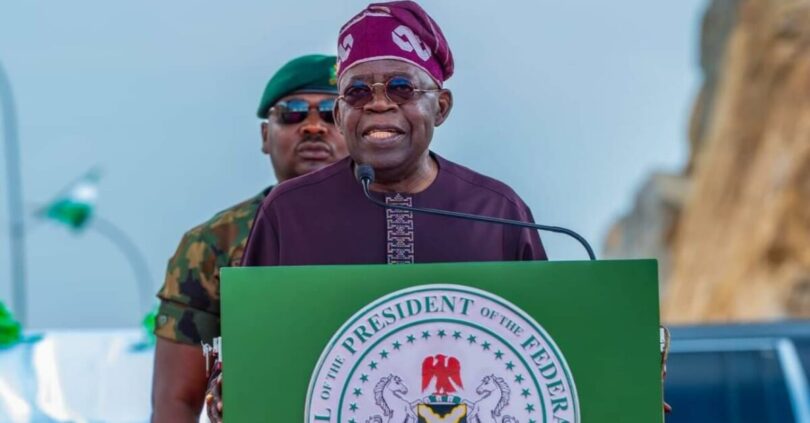
Ahead of the 2027 general elections, the Igbo Leaders of Thought (ILT), an assembly of Southeastern Nigerian intellectuals, traditional rulers and stakeholders, has warned President Bola Tinubu and the Federal Government against any attempt to manipulate the electoral process.
The group declared that Nigerians would not accept flawed election results, while calling for free, fair and credible elections in 2027.
The position was contained in a communiqué issued after a meeting of the ILT at its headquarters in Enugu and jointly signed by its President, Prof. Elo Amucheazi, and Secretary, Prof. Dozie Chukwuokolo.
The group accused the presidency of encouraging what it described as anti-democratic tendencies, including efforts to weaken the opposition ahead of the 2027 elections.
It also expressed concern over what it described as evidence of widespread genocide against Christians in Nigeria, alleging that the attacks were part of an agenda to Islamise the country.
The ILT questioned the rationale behind the ruling All Progressives Congress’ Muslim-Muslim presidential ticket, asking whether it was connected to an Islamisation agenda in a country where Christians, according to the group, are more populous than Muslims.
The group called for the intervention of the United States to address the worsening security situation and help ensure that the 2027 elections are free, fair and credible.
The communiqué stated that certain comments attributed to the presidency, including “there is no vacancy in Aso Rock” and the President’s remark to the Catholic Bishops Conference of Nigeria that “all is fair in politics”, had raised concerns about the government’s commitment to democratic competition.
The group said such statements had been interpreted by some Nigerians as suggesting that the presidency could not be changed through the ballot.
It therefore urged the government to ensure that election results were transmitted appropriately and in real time.
“World powers are on the watch over the 2027 elections and demand that election results must be transmitted appropriately and in real time. Nigerians are not ready to accept flawed election results,” the group stated.
On restructuring, the ILT rejected any attempt to balkanise or cede any part of the Southeast, following discussions at the Abuja Restructuring Summit organised by the Concerned Citizens Assembly.
The group said it had been briefed by three participants at the summit, Prof. Obasi Igwe, Ambassador Uche Ajulu-Okeke and Prof. Chidozie Chukwuokolo before resolving that the Igbo people would not allow any portion of their territory to be balkanised.
It commended the 25-member delegation that represented the Southeast at the summit and warned against actions capable of provoking the Igbo people.
The ILT acknowledged proposals for regionalisation based on ethno-linguistic considerations, citing the United Kingdom, where the Welsh, English and Scots coexist within a broader political structure.
While acknowledging historical changes to Igbo boundaries, the group expressed optimism that the issues could be resolved through dialogue.
The group also renewed its call for the release of the detained leader of the Indigenous People of Biafra, Nnamdi Kanu, describing him as a prisoner of conscience.
The ILT criticised the circumstances surrounding Kanu’s rendition from Kenya and his continued detention, arguing that his treatment reflected what it described as the marginalisation of Igbo people.
It urged President Tinubu to order Kanu’s immediate release.
The group also raised concerns over what it described as the political and economic marginalisation of the Southeast, citing inadequate infrastructure, the absence of a standard-gauge railway in the region, poor roads, the concessioning of Akanu Ibiam International Airport, Enugu, and what it described as the stifling of seaports in the region.
It further alleged widespread confiscation of Igbo properties in Lagos, Abuja and other parts of the country.
On federal appointments, the ILT claimed that Igbos had been excluded from key positions, alleging that out of 34 major federal appointments, the Southeast had not secured any.
The group also criticised what it described as inconsistencies in the application of seniority in federal appointments.
The ILT further complained that despite the presence of oil resources in the Southeast, Igbo communities had not benefited adequately from oil exploration and production.