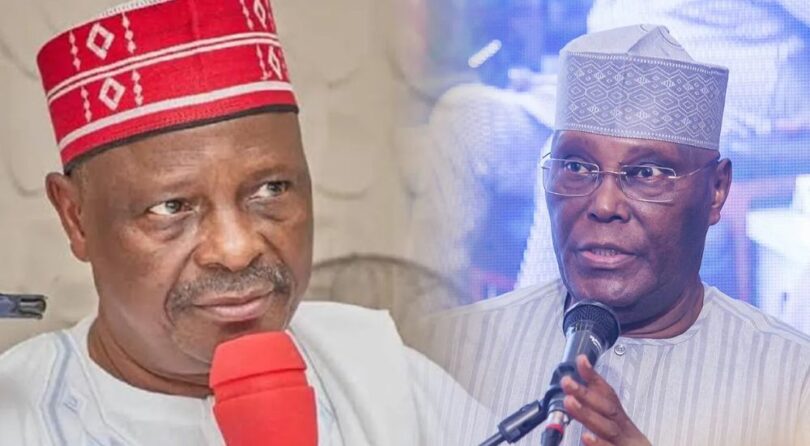
The Vice Presidential candidate of the Nigeria Democratic Congress (NDC), Rabiu Kwankwaso, has backed the targeted fuel subsidy proposal attributed to the African Democratic Congress (ADC) presidential candidate, Atiku Abubakar, while proposing measures to make petrol affordable to Nigerians.
Kwankwaso, however, said the approach being proposed by the NDC would involve government investment in refineries and other measures aimed at reducing the price of petrol, distinguishing it from the position of the NDC presidential candidate, Peter Obi, who has said there would be no fuel subsidy under his administration.
Atiku, who is the ADC presidential candidate, has said his administration would introduce a targeted subsidy to cushion the effect of inflation and reduce the burden of rising living costs on Nigerians.
Kwankwaso, a former Kano State governor, stated his position in an interview with Arise TV on Tuesday while discussing the fuel subsidy policy of the President Bola Tinubu-led administration and the positions of presidential candidates ahead of the 2027 election.
Asked whether it would be difficult for the NDC to campaign in the North-West, where there is support for the return of subsidy, Kwankwaso said the party had its own approach to subsidy.
“No, no, no, look. We are bringing subsidy in our own way,” he said.
Asked how the party would achieve this, Kwankwaso said the government could invest in refineries to increase domestic production and make petrol available to Nigerians at what he described as a reasonable price.
“Of course, there are many ways. One, I can tell you: now we have a refinery built by a businessman, and I’m sure more refineries would be built.
“Now, if individuals in this country could build refineries, I see no reason why government, under certain circumstances, will not build a refinery or refineries to the extent that we achieve the minimum requirement.
“What is the minimum requirement? The minimum requirement is for the people across the country to go to the filling stations and buy fuel at a reasonable price.
“We, in the NDC, will do whatever it takes, really, to put the price of oil down,” he said.
The NDC position differs from that of its presidential candidate, Obi, who has said his administration would not operate a fuel subsidy regime.
Obi has instead argued for measures that would address the structural factors affecting the price of petrol, including domestic refining and efficient management of public resources.
Atiku’s position, as stated in his proposal, is also different from Obi’s no-subsidy position, with the former Vice President advocating a targeted subsidy as a measure to reduce inflation and ease the pressure on households.
Kwankwaso’s latest comments therefore place his proposed NDC approach closer to Atiku’s targeted-subsidy position, although he also emphasised government investment in refineries as part of the strategy to reduce petrol prices.
Kwankwaso also said the three major presidential candidates in the 2023 election, including Atiku, had campaigned on removing fuel subsidy, but criticised Tinubu for implementing the policy immediately after taking office.
He said, “No, that’s what I know. Of course, among the three of them, Bola Tinubu decided to do so and removed the subsidy. And the consequences that we thought would happen, certainly happened.
“And not only he decided to remove the subsidy, what he did was to remove it immediately – in fact, day one – without looking at all those possible issues that were associated with that. And that’s how we find ourselves in this total mess, economically.”
Tinubu announced the end of the petrol subsidy in his inaugural address on May 29, 2023, saying, “subsidy is gone.”
Petrol prices subsequently rose from below N200 per litre to more than N500 in many parts of the country, while the increase also contributed to higher transport and other costs.