The parties represented included the African Democratic Congress, ADC, Nigeria Democratic Congress, NDC, a faction of the Peoples Democratic Party, PDP, Social Democratic Party, SDP, Allied Peoples Movement, APM, Peoples Redemption Party, PRP, and Democratic Leadership Alliance, DLA.
The G100 convener, Salihu Mohammed Lukman, had argued that opposition parties needed to establish clear rules before negotiating personalities and political positions.
His message, summarised in the phrase, “Rules before outcomes. Table before seats,” reflects the need for a credible process that would allow rival political interests to negotiate without assuming that any individual should automatically emerge as the candidate.
Analysts, however, believe that a coalition seeking to produce one presidential candidate must eventually go beyond general commitments to cooperation. It needs an agreed procedure for selecting the candidate, a mechanism for resolving disputes and guarantees that parties whose aspirants lose the contest will remain committed to the agreement.
The G100 initiative has, therefore, opened a conversation, but the more difficult negotiations concern who will lead the proposed arrangement, how that person will emerge and whether the other aspirants will accept the outcome.
The most visible obstacle to a single opposition candidate is the question of how to reconcile the ambitions of prominent politicians who command different political constituencies and have their own electoral strategies.
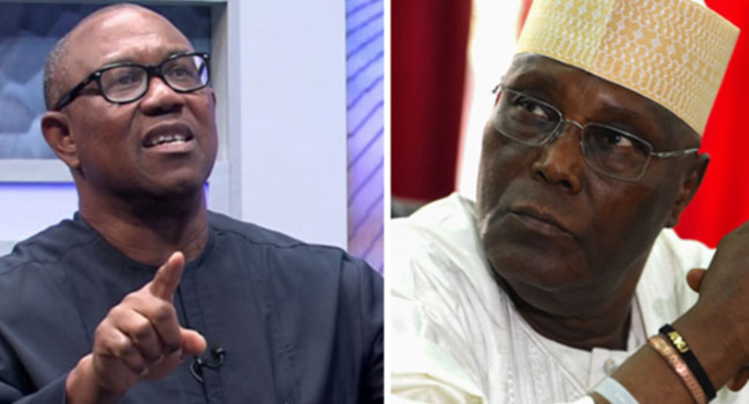
Former Vice-President Atiku Abubakar, ADC’s presidential candidate, and former Anambra State governor, Peter Obi, NDC’s presidential candidate, are central to the debate. Former Kano State governor Rabiu Kwankwaso also adds another dimension to the negotiations because of his political base and alliance with Obi.
These are not merely differences between party organisations. They concern the presidential ticket itself: who should lead, what process should determine the choice and what political concessions would make the arrangement acceptable to those who do not get the ticket.
The body language of these leaders and their support teams has indicated that none is willing to step aside and throw their weight behind another aspirant.
A recent report suggested that G100 stakeholders were considering a possible second-round voting arrangement as they continued efforts to persuade Atiku and Obi to support a single candidate. Further reports claimed that the group was considering alternative forms of cooperation if a consensus candidate could not be agreed upon.
That development illustrates the central dilemma facing the initiative. If the negotiations insist on a single candidate from the outset, the process could stall over competing ambitions. If the coalition instead develops a wider framework for cooperation, it might preserve the possibility of collaboration even without immediate agreement on one presidential aspirant.
The warning from previous coalition efforts
Nigeria’s political history provides a useful reference point for assessing the G100 initiative, although history does not determine the outcome of the current negotiations.
Before the 2015 presidential election, opposition forces came together under the All Progressives Congress, APC, bringing together political interests that had previously operated separately. The alliance helped create a common platform for the contest against the incumbent administration of President Goodluck Jonathan.
That experience demonstrated that political rivals could cooperate when they saw sufficient value in a shared platform. It also showed the importance of organisational negotiations, party structures and a candidate acceptable to the coalition’s major components.
But the circumstances of 2015 cannot simply be reproduced in 2027. Today’s opposition landscape includes competing parties, established presidential aspirants, disagreements over political strategy and the consequences of previous attempts at unity.
Recall that in May 2026, Peter Obi and Kwankwaso left an earlier ADC-led coalition and joined the NDC amid internal disagreements and legal disputes. Their departures complicated an earlier agreement to present a single presidential candidate.
The episode is significant because it demonstrates that a public declaration of unity is not the same as a durable political agreement. A coalition may attract prominent names and generate public enthusiasm, yet still struggle when its members must resolve questions of leadership, party control and presidential ambition.
There is a general belief that, for the G100, the lesson is not that opposition unity is impossible. Rather, it is that unity requires arrangements capable of surviving disagreements, including a clear process for selecting a candidate and a commitment to honour the outcome.
According to analysts, the G100 initiative must establish whether its participants are negotiating towards a common presidential ticket or a broader agreement that allows them to retain separate candidates while cooperating on selected electoral matters.
Without clarity on this question, the coalition could announce progress while leaving its most contentious issue unresolved.
One of the big questions on the minds of many Nigerians is who will step down and what they will receive in return. The issue of political concessions may ultimately prove more difficult than drafting a declaration of unity.
What political leaders say
Speaking on Arise News on Sunday, APC chieftain and former presidential aide, Okoi Obono-Obla said that an opposition coalition behind one candidate was not legally attainable.
Describing Nigerian politicians as dramatic, he noted that the opposition’s proposal to unite behind a single candidate was comic relief, insisting that neither the Constitution nor the Electoral Act provided for political parties to come together behind one candidate.
He said: “INEC has already cleared the list of candidates, and any changes must go through the commission. What is being proposed is therefore not legally attainable.”
Meanwhile, the founder and pioneer National Chairman of the All Progressives Grand Alliance, APGA, Chief Chekwas Okorie, pointed out that opposition alliances could be activated during a possible presidential runoff.
He said pre-election alliances among political parties could become effective during a presidential runoff if no candidate secured a clear victory in the first ballot.
He explained that such an arrangement would allow the leading candidates to consolidate their support ahead of a second round of voting.
According to him, “The pre-election alliance that is possible is after the first ballot, and there is no clear winner, and the runoff is called.”
The President of the Igbo Agenda Dialogue, IAD, also highlighted the importance of post-election alliances, citing examples from Nigeria’s First and Second Republics.
He said such alliances could help a party that wins the presidency but lacks a sufficient majority in the National Assembly to form a stable government.
“Without that majority there, even ministers to be cleared will be a problem. Budget will be a problem. Things will be a problem,” he said, stressing the importance of cooperation among political parties in governance.
Citing historical examples, he recalled how political alliances facilitated the sharing of key government positions, including the vice-presidency and speakership of the National Assembly.
He noted that such arrangements could promote inclusion and strengthen cooperation among political parties.
He, however, cautioned against proposing political arrangements without examining previous experiences, arguing that some of the ideas being discussed had already been tried in the past. He said he had avoided joining certain discussions because he did not want to engage in what he considered an unnecessary debate.
Also speaking to DAILY POST, a lawyer and spokesman for the presidential candidate of the ADC, Kenneth Okonkwo, said opposition leaders must rally support for Alhaji Atiku Abubakar to defeat the incumbent President and candidate of the All Progressives Congress, Bola Tinubu, in 2027.
He noted that the issue was no longer about any individual but a call to rescue the country from its current economic and security challenges.
Okonkwo said opposition leaders must put their interests aside and focus on what would benefit everyone.
“Atiku believes that if he dies without making Nigeria better than he met it, God may ask him some questions.
“That is why he is continually presenting himself. Nigeria must not lose this chance again.
“We must unanimously, whether from the South-West, South-East, South-South or North-Central, North-West or North-East, no matter the party you belong to, even if you’re a member of the APC, what matters now is the survival of Nigeria,” he said.