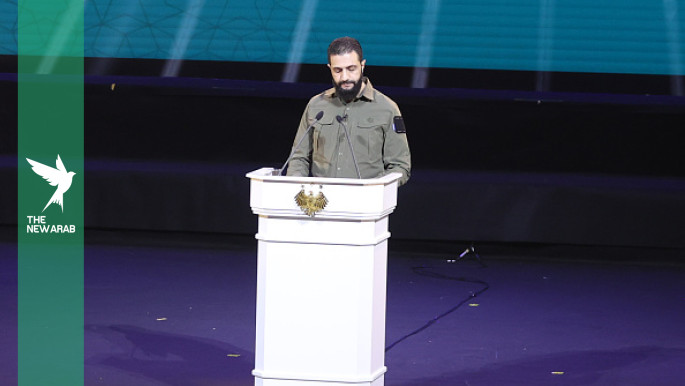
The report is based on an eight-month consultative process involving Syrian and international legal experts, civil society organisations, and associations representing victims and survivors. [Getty]
A new report titled Criminal Accountability Pathways in Syria was released on Wednesday, 13 May, outlining a proposed roadmap for transitional justice and criminal accountability in a country emerging from more than five decades of authoritarian rule and 14 years of war and widespread abuses.
Several researchers prepared the report in consultation with 27 Syrian civil society organisations, including the Syrian Network for Human Rights, the Syrian Centre for Media and Freedom of Expression, the Syrian Legal Development Programme and The Day After.
It presents what it describes as “a practical roadmap for establishing a credible and inclusive criminal justice mechanism within the broader framework of national recovery”.
The report is based on an eight-month consultative process involving Syrian and international legal experts, civil society organisations, and associations representing victims and survivors, as well as representatives from the National Transitional Justice Commission and the National Commission for the Missing.
It starts from what it describes as Syria’s legacy of “mass atrocities and entrenched impunity”.
The report argues that criminal accountability is a central pillar of any political transition or national recovery process, not only to address past crimes but also “to deter future violations, rebuild trust in institutions and reinforce the rule of law”.
While stressing that it does not impose a single model for criminal justice, the report reviews several possible approaches and assesses the advantages and disadvantages of each within the Syrian context.
These include domestic accountability mechanisms, ordinary national courts, special courts with an international character and international judicial pathways.
The report gives particular attention to establishing a special domestic court for international crimes within the Syrian judicial system, with stronger guarantees and greater independence, alongside possible international participation or oversight.
It describes this model as one of the most feasible options for Syria.
The report also stresses that transitional justice is not limited to prosecutions but includes truth-seeking, clarifying the fate of the forcibly disappeared, reparations for victims, institutional reform, guarantees against future violations and preserving national memory.
It notes that Syria faces major challenges in this process, including weak judicial independence, the absence of legal and institutional reforms, limited expertise in handling international crimes and the continued presence of some alleged perpetrators within state institutions and local communities.
It also points to the flight abroad of several senior officials accused of violations. Further, it stresses the need for criminal accountability to include crimes committed before 2011, including the Hama massacre in 1982 and the Tadmur Prison massacre in 1980.
The report argues that the effects of those crimes remain deeply embedded in Syrian collective memory and that victims were denied meaningful avenues for justice for decades.
In comments to The New Arab, Fadel Abdul Ghany, director of the Syrian Network for Human Rights and a contributor to the document, said, “Transitional justice in Syria should not be reduced to trials alone.”
He stressed that it must also include “truth-seeking, the issue of the missing and forcibly disappeared, reparations and compensation, reform of the judiciary and security agencies, guarantees of non-repetition and preserving memory”.
Abdul Ghany added that the scale of violations committed in Syria “exceeds the capacity of any single court to absorb”.
He noted that victims “do not only need criminal verdicts, but also official recognition, knowledge of the truth and restoration of rights”.
On proposed trial models, he said the report reviews several options, including ordinary domestic courts; a special domestic court; a hybrid model combining national and international elements; and international mechanisms such as the International Criminal Court.
However, he noted that the latter “faces major political and practical obstacles”.
Abdul Ghany said the option of a special domestic court appeared the most realistic in the Syrian context if designed properly.
He stressed the importance of drawing on comparative international experiences, such as those of Bosnia and Herzegovina, Colombia and the Central African Republic, while taking into account the specific nature of the Syrian case and avoiding direct replication.
He concluded by saying that achieving justice in Syria requires a gradual and clear strategy, warning against judicial priorities becoming “selective”.
He stressed the need for prosecution standards to be “public, legal and reviewable, so that all victims feel their suffering is recognised, even if not every case reaches court immediately”.
Article translated from Arabic by Afrah Almatwari.