HO CHI MINH CITY, Vietnam – Poland will soon host production lines for South Korean tanks. Australia is buying warships from Japan. Canada will send uranium to India, while India offers cruise missiles to Vietnam, and Brazil builds military transport planes for the United Arab Emirates.
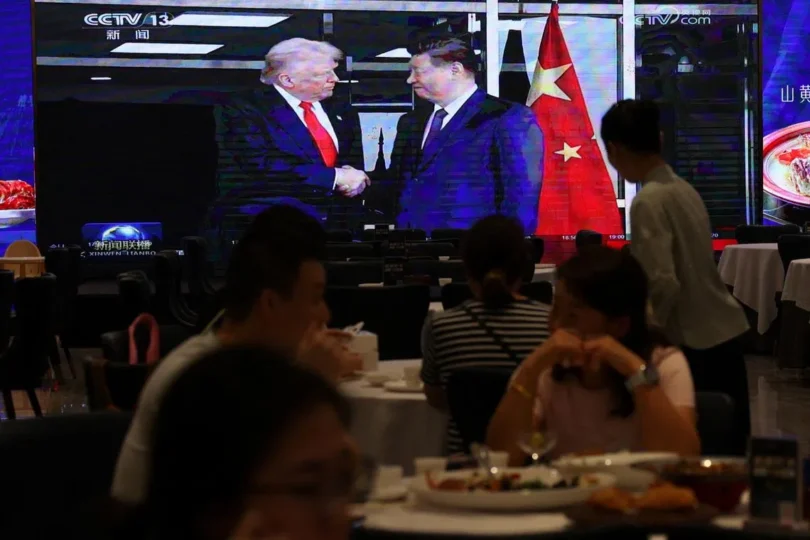
All of these deals were sealed in the past few weeks. Each one represents an attempt by middle powers to protect themselves as the conflict in Iran throttles global energy supplies, and as a high-stakes summit between US President Donald Trump and Chinese President Xi Jinping looms.
Global polls show the world has little trust in the US and China. Mr Trump and Mr Xi have both used their enormous leverage over trade and security to coerce or punish.
And in response, smaller nations are behaving as if they are stuck in the movies Godzilla or Dune – moving quietly in small groups, trying not to provoke the wrath of petulant giants.
“It’s fifty shades of hedging,” said Mr Richard Heydarian, a Filipino political scientist at Oxford University.
Or, as Dr Ja Ian Chong, a security analyst in Singapore put it: “No party wants to cross Beijing and now Washington, too.”
For countries watching from afar, dread and hope hover over the Trump-Xi meeting in Beijing, which is scheduled for this week.
In Asia, which has been hit hardest and fastest by oil shortages caused by the war and China’s tight control of oil-product exports, the mood is particularly grim.
Interviews with officials, and statements from leaders travelling the globe to secure trade and defence deals, suggest that most middle powers feel overwhelmed by the deteriorating world order.
Many believe the summit carries more potential for harm than help. And Mr Trump’s gut-driven approach to complex issues is the main source of anxiety.
For months, officials in Asia have worried that the President might be too eager to make a deal with Mr Xi, ending weapons sales to Taiwan or agreeing to softened policy language that could make it easier for China to undermine the democratic island.
“That would be the biggest nightmare,” said one Taiwanese official who spoke on condition of anonymity to discuss internal government matters. He insisted that reduced support from the US was unlikely.
But any concession on Taiwan could lead other American partners to fear abandonment. Beijing’s push for compliance on contested territory elsewhere would be bolstered, from the border with India to the South China Sea.
Vietnamese officials said that if Mr Trump makes a conciliatory gesture or flatters Mr Xi, even without bigger compromises, China will gain leeway to press harder on smaller countries.
Another concern being discussed across the region: that Mr Trump might alter long-term security plans in exchange for better economic terms with China.
Mr Trump’s decision to redirect a carrier strike group from the Pacific and munitions from South Korea for the war in Iran may have created momentum for broader redeployments.
When the Pentagon announced it would pull at least 5,000 troops from Germany after Mr Trump expressed annoyance with the German chancellor, allies in Asia were again reminded how quickly collective deterrence can be weakened.
Mr Trump has threatened in the past to make troop withdrawals from Japan, which hosts around 53,000 US military personnel – more than any other country – and South Korea, where another 24,000 Americans are stationed. If he could get something big from Mr Xi for a drawdown, would he turn down the deal?
Analysts noted that plans opposed by China, such as AUKUS, a pact between Australia, England and the US designed to counter Beijing’s influence by equipping Australia with nuclear-powered submarines and advanced technology, could also be suddenly cancelled.
“The sense that US allies have to look to one another because they can no longer look to America is very real,” said Mr Hugh White, a former Australian intelligence official who teaches strategic studies at the Australia National University.
That sentiment is much stronger than “the cautious public language” of national leaders might suggest, he added.
European and Asian officials often talk privately in frank terms about giving up their faith in America, prompting a no-turning-back effort to diversify away from the US.
In casual discussions with reporters, they can sound a lot like Prime Minister Mark Carney of Canada, who received a standing ovation in Davos, Switzerland, in 2026 for a speech that declared: “We are in the midst of a rupture, not a transition.”
But in public, they are more circumspect. Some officials admit their countries are trying to buy time and evade Mr Trump’s fits of pique, while continuing the performance of imperial fealty.
South Korean officials have simply expressed resignation over US military diversions, after making clear they felt betrayed in 2004, when former president George W. Bush announced plans to move troops from Asia to the war in Iraq.
Australia, Taiwan and Japan publicly and repeatedly stress the value of American leadership without caveats – even as US tariffs and the war Mr Trump started with Iran kneecap their economies.
No one wants to be seen stepping out of line.
Japan’s new prime minister, Ms Sanae Takaichi, has been bolder than most in trying to foster stronger relationships with other countries. Yet even as she criss-crossed the region promoting military cooperation, officials in Tokyo worried about how Washington would view her efforts.
“The Japanese don’t want Takaichi’s security cooperation and tour, especially to Australia, to be seen as a version of Mark Carney,” said Dr Michael J. Green, the author of several books on Japan, and chief executive officer of the United States Study Centre at the University of Sydney.
Others have apparently reached the same conclusion.
Mr Carney’s recent visits to India and Australia did not yield strong statements from their leaders echoing his criticism of great power rivalry or his warning that if middle powers are “not at the table, we’re on the menu”.
At the same time, many countries – including some that are benefiting from the thickening of middle-power bonds – have been careful not to anger the world’s other hegemon, China.
Nations managing their own disputes with Beijing, such as Indonesia, have done less to rally around Japan than some in Tokyo would have liked, since Ms Takaichi became embroiled in a diplomatic crisis after telling her Parliament that if China attacked Taiwan, Japan could respond militarily.
Vietnamese officials even pressed Ms Takaichi to avoid directly criticising China in her speech at a university on May 2 in Hanoi, according to diplomats who spoke on condition of anonymity to describe sensitive discussions. It is not clear if adjustments were made.
Chinese officials later condemned her diplomatic efforts as “war preparation”.
And yet, in a sign of how middle powers are still doing more while saying less, the two countries signed six cooperation agreements, including one on satellite data sharing and another to secure deliveries for Vietnam’s largest oil refinery, potentially easing shortages.
“The US has become more unreliable, so it makes sense to try to develop alternatives,” said Dr Robert O. Keohane, an international relations professor at Princeton University. Even if what has been formed so far is insufficient, he added, “having a weak alternative is better than having no alternative at all”. NYTIMES