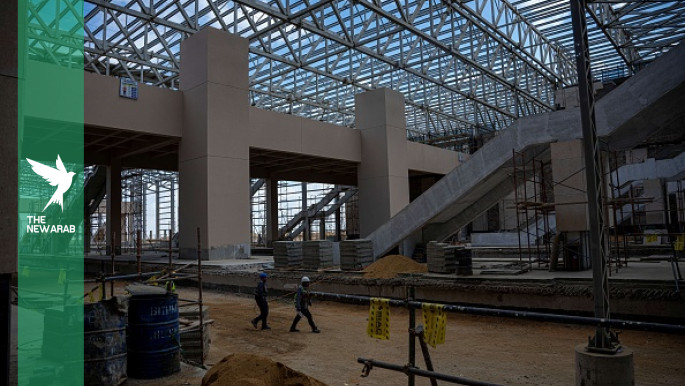
Egypt’s focus on megaprojects is seen as solely catering to the minority of rich Egyptians [Getty]
Egypt’s growing focus on luxury housing and smart-city developments is fuelling criticism over the government’s urban priorities, as millions struggle with soaring housing costs and declining purchasing power.
The debate intensified after Prime Minister Mostafa Madbouly inaugurated The Spine project, a smart-city development by Talaat Moustafa Group valued at more than 1.4 trillion Egyptian pounds ($27 billion), while many Egyptians face rising rents and property prices even within state-backed housing schemes.
The project, located inside the Madinaty real estate development east of Cairo, spans 3.9 million square metres and is backed by financing from the state-owned National Bank of Egypt amounting to roughly 24% of its value.
The launch has triggered widespread debate over whether the Egyptian state is prioritising luxury real estate investment over affordable housing in a country where independent studies estimate that more than a third of the population suffers from “urban deprivation”, including inadequate housing and poor access to services.
A study published in early May by the Alternative Policy Solutions Centre at the American University in Cairo said the state was increasingly shifting towards luxury and upper-middle-income housing projects, particularly in the New Administrative Capital and smart cities, while low-cost housing had declined relative to actual demand.
The study noted that the collapse of the Egyptian pound and persistent inflation had pushed government housing prices beyond the reach of most Egyptians, with some units rising from around two million pounds to more than 10 million pounds.
Last week, Egypt’s Housing Ministry announced plans to open both the water sector and social-housing projects to private investors under the state ownership policy framework, arguing that private companies possess greater financing flexibility and access to modern technologies.
The ministry also offered land this week for the construction of around 19,000 low-income housing units in eight new cities through subsidised mortgage financing at a declining interest rate of 8% over 20 years.
The Spine has emerged as a symbol of Egypt’s new urban-development model, joining projects such as the New Administrative Capital and New Alamein.
The development reportedly generated almost 40 billion pounds in sales during its first week, reinforcing criticism that luxury real estate is increasingly being treated as a vehicle for investment and protection against inflation rather than a response to genuine housing demand.
Economist Ahmed Badra warned that relying on property as a store of value carried long-term economic risks, saying the real economy could not be sustained through “value preservation” in non-productive real estate assets.
He warned against directing capital away from productive sectors such as industry and agriculture, arguing that excessive dependence on speculative property investment could deepen structural imbalances in the Egyptian economy over time.
Former Social Solidarity Minister and economist Gouda Abdel Khaleq also raised concerns over the spread of “empty cities” filled with closed housing units.
In comments to The New Arab, Abdel Khaleq said public anger at The Spine project reflected growing frustration with housing inequality.
While luxury units are marketed with down payments worth millions of pounds and monthly instalments exceeding 200,000 pounds, reports suggest that an average Egyptian could require 150 years of work to buy a small apartment and as long as 600 years to own a unit in one of Egypt’s smart cities.
Housing expert Mamdouh Hamza called for a “radical reassessment” of Egypt’s housing strategy.
Hamza argued that the state had gradually abandoned its social role and transformed itself into a real estate developer competing with the private sector in upper-income markets.
“Housing should be treated as a public service like education and healthcare,” Hamza told The New Arab.