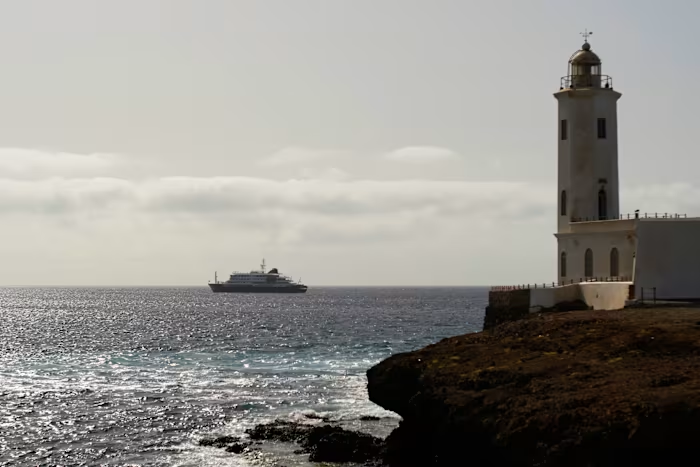
CAPE TOWN – A cruise ship with nearly 150 people aboard was waiting for help off the coast of Cape Verde in the Atlantic Ocean on Monday after three passengers died and three other people were left seriously ill in a suspected outbreak of the rare hantavirus, according to the World Health Organization and the ship’s operator.
The MV Hondius, a Dutch ship on a weekslong polar cruise from Argentina to Antarctica and several isolated islands in the South Atlantic, had requested help from local health authorities Sunday after making its way to the island of Cape Verde, off the coast of West Africa. But no one has been allowed to disembark, Netherlands-based operator Oceanwide Expeditions said.
Cape Verde’s Health Ministry said Monday that for now, it will not allow the ship to dock over public health concerns.
Hantavirus is a rodent-borne illness spread by contact with rodents or their urine, saliva or droppings. WHO says that while it is rare, hantavirus may spread between people.
It was unclear how an outbreak could have started, and the WHO said it was investigating while working to coordinate the evacuation of two sick crew members. A third sick person — a British man who was evacuated to South Africa on April 27 — is the only one to have tested positive for the virus, authorities said. He is in critical condition and isolated in intensive care, according to local health officials.
One of the passengers who died — a German — remains on the ship, according to an Oceanwide Expeditions statement. A 70-year-old Dutch man died onboard April 11, and his 69-year-old wife died later after leaving the ship, officials said.
Among the 87 remaining passengers, 17 are Americans, 19 are from the U.K. and 13 from Spain, according to the company. Sixty-one crew members, including the two who are ill, also are onboard.
Cruise operator says the sick crew members urgently need medical care
The sick crew members — one British, one Dutch — have respiratory symptoms and need urgent medical care, Oceanwide said in its statement.
Oceanwide said it was still awaiting permission Monday from local authorities in Cape Verde to evacuate passengers and crew members. The company said it would consider moving to one of the Spanish islands of Las Palmas or Tenerife if it couldn’t evacuate people in Cape Verde.
The Dutch Foreign Ministry said it was also looking into evacuating some people from the ship.
WHO said it was working with local authorities and Oceanwide to conduct a “full public health risk assessment.”
“Detailed investigations are ongoing, including further laboratory testing, and epidemiological investigations,” WHO said. “Medical care and support are being provided to passengers and crew.”
WHO said that while only one case was confirmed through tests, the other five cases — the three deaths and two ill crew members — were suspected to be hantavirus.
The weekslong cruise started in Argentina
The ship left Ushuaia in southern Argentina on April 1, according to Argentine provincial authorities, for its cruise to Antarctica, the Falkland Islands, South Georgia and other isolated islands in the South Atlantic.
While Oceanwide Expeditions didn’t specify this trip’s itinerary, the company advertises 33-night or 43-night “Atlantic Odyssey” cruises on the Hondius.
The ship has 80 cabins and a capacity of 170 passengers, and it typically travels with about 70 crew members, including a doctor, the company said.
The Dutch man was the first victim, and he presented with fever, headache, abdominal pain and diarrhea, officials said. His body was taken off the vessel nearly two weeks later on the British territory of Saint Helena, some 1,200 miles (1,900 kilometers) off the African coast, and was awaiting repatriation.
His 69-year-old wife was transferred to South Africa at the same time but collapsed at a Johannesburg airport and died at a nearby hospital, the South African Department of Health said.
The ship then sailed on to Ascension Island, an isolated Atlantic outpost about 800 miles (1,300 kilometers) to the north, where the sick British man was taken off the ship and evacuated to South Africa on April 27. He later tested positive for hantavirus.
South African officials have started contact tracing but say there’s no need to panic
Though there was no information from authorities on the possible source of the suspected outbreak, a previous hantavirus outbreak in southern Argentina in 2019 killed at least nine people. It prompted a judge to order dozens of residents of a remote town to stay in their homes for 30 days to halt the spread.
South Africa’s National Institute for Communicable Diseases was conducting contact tracing in the Johannesburg region to identify whether other people were exposed to the infected cruise ship passengers. The 69-year-old woman who died was trying to catch a flight back home to the Netherlands at Johannesburg’s main international airport, regarded as the busiest in Africa, when she collapsed.
But the country’s health department urged people not to panic, saying WHO was “coordinating a multicountry response with all affected islands and countries to contain further spread of the disease.”
Hantavirus has no specific treatment or cure, but early medical attention can increase the chance of survival.
Hantaviruses cause two serious syndromes, according to the U.S. Centers for Disease Control and Prevention: hantavirus pulmonary syndrome, affecting the lungs, and hemorrhagic fever with renal syndrome, affecting the kidneys.
“While severe in some cases, it is not easily transmitted between people,” Dr. Hans Henri P. Kluge, WHO Regional Director for Europe, said in a statement Monday. “The risk to the wider public remains low. There is no need for panic or travel restrictions.”
———
AP writers Mike Corder in The Hague, Netherlands; Michelle Gumede and Mogomotsi Magome in Johannesburg; Isabel DeBre in Buenos Aires, Argentina and Mark Banchereau in Dakar, Senegal contributed.
Copyright 2026 The Associated Press. All rights reserved. This material may not be published, broadcast, rewritten or redistributed without permission.