
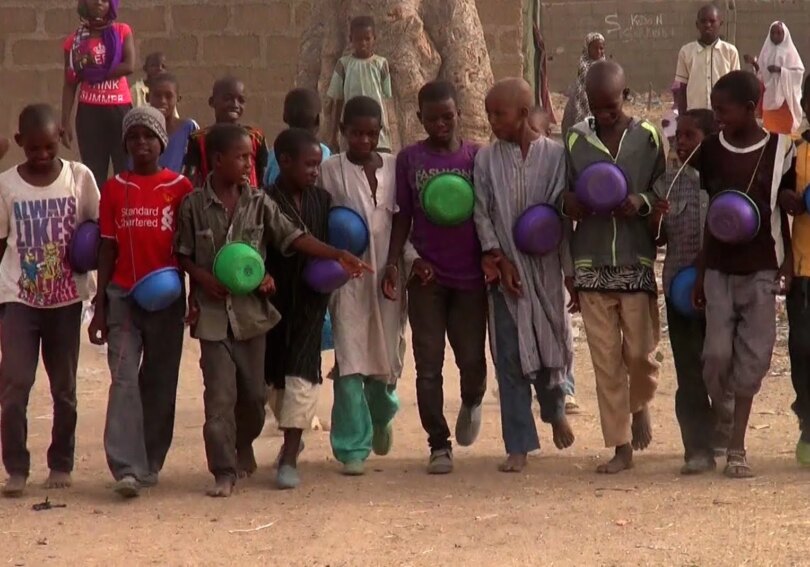
Lawan is an 8-year-old almajiri boy who roams the streets of Jos, Plateau State, daily in search of alms and food.
According to the innocent-looking boy, he hails from Katsina State and was brought to Jos by his own father, who handed him over to an Islamic scholar popularly known as Mallam to study the Quran.
In the process, Lawan has been left to fend for himself and generate funds for the teacher and his family.
Every day of the week, Lawan and other almajiris have to go out to beg for what to eat thereby exposing them to all sorts of dangers, including kidnapping, brutality, disdain, and worst of all, the danger of being knocked down by a vehicle.
He rarely takes his bath, has almost no access to medical care as evidenced by the dandruff on his head and his scruffy looks.
Lawan has no access to modern education, is exposed to the harsh conditions of the street, and is surrounded by both good and evil people.
While begging for alms with his unwashed purple plastic bowl which he uses to collect all sorts of food, Lawan gets insulted every day by his peers on their way to school.
He is forced to watch other parents taking their children to the mall/restaurants and while he cries wishing his parents could do the same for him, the society turns a blind eye to his plight and that of other kids in his situation.
An encounter with Lawan and other Almajiri children roaming the streets with no single hope of a reprieve will definitely bring tears from even the strongest man.
Past governments, especially the Goodluck Jonathan administration had tried to streamline the almajiri system into the Nigerian education system by setting up schools for the almajiri kids but those efforts were frustrated by most northern governments and the schools have either failed to take off due to poor funding or a lack of funding while prominent Islamic scholars have also frustrated such efforts.
In 2024, the federal government unveiled a roadmap for reforms in the education sector to be implemented before 2027.
The policy document was such that it was meant to reduce Nigeria’s out-of-school children by 25 percent annually, reabsorbing 15 million by 2027.
One of the objectives of the policy was to establish learning centres for accelerated basic education across the states to absorb 500,000 overage out-of-school children every year with a specialised curriculum that teachers would be trained to deploy.
It was also planned to operationalise an open school scheme to train 500,000 over-age, out-of-school children in basic skills and entrepreneurship education annually.
But without proper monitoring, the Almajiri system, which is mostly associated with extreme poverty and deprivation has seen millions of young boys, often ages 5 to 18, being sent into the streets where they practically become beggars and a menace to society.
And due to poverty, the Mallams also resort to forcing the children to beg on the streets for money and food to survive.
While narrating his experience, Lawan said his Mallam gives him and other children a daily monetary target and they must fulfill the target or they would be beaten when they get back.
DAILY POST spoke to some Islamic scholars who shed light on the system.
Alfa Ishaq Mustapha, who is the chief imam of a Mosque in Angwa Tipper, Jos had this to say:
“The Almajiri system is not what it used to be in the past. The system was meant to train young children in the rudiments of Islam and the Quran but these days, some teachers have bastardized the system by turning their disciples into slaves.
“They send these kids out into the streets to fend for themselves by begging for food and alms.
“In most cases, these children also feed the Mallam’s families. We have been preaching against these practices but no one listens to us.”
Another Islamic scholar, who is against the present-day practice of almajirinci is Sheikh Shehu Danjuma who called on the government at all levels to enact a policy that will curtail the sending of vulnerable children into the street to beg.
“On the surface, the practice of Almajirinci is not bad at all. It is meant for the young boys to learn the Quran and turn out to be good Muslims but what we have now is far from what the system was meant to be.
“Some bad teachers have turned the system upside down and have turned their students into money-making machines for them. We have been preaching against these practices but some unscrupulous teachers still refuse to do the right thing,” he said.
An Islamic scholar, who is also an educator, Dr. Abdul Aliyu tasked the government to be intentional in expanding foundational literacy and digital training for the Almajiri children so that they could compete favourably with other children in normal schools.
“We have been calling on the government at all levels to redefine what we mean by out-of-school children because the Almajiri already have a system of education with their teachers and curriculum.
“By incorporating key components like basic literacy, numeracy, and vocational skills, we can ensure they fit seamlessly into Nigeria’s formal system,” Aliyu said.
Speaking further, he said:
“The Almajiri refers to a system of Islamic education practised in northern Nigeria where a male child seeking Islamic knowledge is handed over to a Mallam to train him but what we now have is a situation where these innocent kids have been turned into beggars and destitute.
“Originally, the Almajiri system encouraged guardians to cede parental responsibilities to Islamic schools but the lack of federal and state monitoring has forced many of these children into street begging.
“We have also advocated a situation where the Almajiri system seeks to integrate Almajiri schools into the formal basic education system while incorporating foundational literacy and numeracy lessons into the curriculum of these non-formal settings,” he stated.