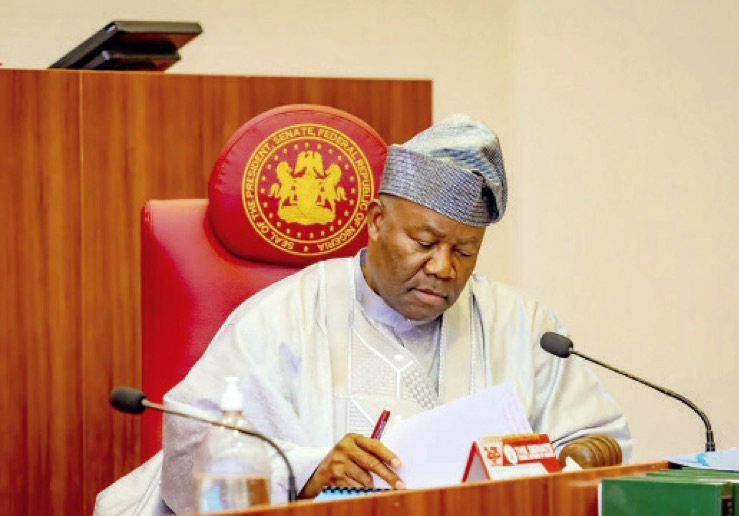
(Godswill Akpabio. Photo Credit: Sun nigeria)
Senate President Godswill Akpabio has revealed that he has never had sight of the National Assembly’s budget, despite holding the country’s third-highest political office, as senators pushed for greater transparency in how the legislature manages its finances.
Akpabio made the disclosure during Thursday’s plenary while responding to a motion seeking a review of the National Assembly’s procurement process and the establishment of an internal tenders board for the award of contracts.
The motion, sponsored by Senator Sunday Karimi (Kogi West), came amid mounting concerns over the management of the legislature’s finances, including recurring technical faults in the recently renovated chambers despite the billions of naira reportedly expended on the project.
Contributing to the debate, Akpabio said lawmakers needed to first understand how the National Assembly’s budget is prepared and managed before pursuing procurement reforms, suggesting that a small committee be set up to work with the management of both chambers, since he personally had never seen the budget of the National Assembly.
He then sought clarification from former Speaker of the House of Representatives and Senator representing Sokoto South, Aminu Tambuwal, on whether the leadership of the House had access to its budget, to which Tambuwal responded in the affirmative. Akpabio noted that this confirmed the fault lay within the Senate.
He further suggested that the Senate President plays little role in the management of the legislature’s finances, explaining that the process seemed to be treated as a closed affair in which the Senate President has no real involvement.
Calling for greater openness, Akpabio said both chambers should jointly scrutinise the legislature’s finances before pursuing any changes to procurement procedures, stressing the need to understand exactly how much comes in and where it goes.
He also questioned the timing of Karimi’s proposal, arguing that such a matter ought to have been discussed with Senate leadership, the Clerk to the National Assembly and management before being brought to the floor, describing the motion as premature given that the National Assembly first needed to put its own house in order before pushing for an internal tenders board in public glare.
Earlier, Karimi had argued that setting up an internal tenders board would strengthen the National Assembly’s constitutional autonomy by enabling it to oversee procurement and contract awards within its approved budget.
Several senators, however, opposed the proposal. Senator Binos Yaroe questioned the accountability process surrounding the National Assembly’s budget, asking who scrutinises it and which committee it is submitted to, stressing the need for clarity on these issues.
Similarly, Senator Yahaya Abdullahi argued that the legislature’s core challenge was not procurement but the absence of a functional budget and research office, noting that despite legislation passed across several assemblies, this office had still not been established.
He lamented that the National Assembly’s budget is not even presented for interrogation, and recommended that Karimi step down the motion until the House first gets its processes right.
Following the debate, Karimi agreed to withdraw the motion after Akpabio urged him to allow the Senate to first address concerns around budget transparency and internal financial management before considering broader procurement reforms.