A PREMIUM TIMES investigation found that several affected families rejected compensation payments as falling far short of what they need to relocate and rebuild their homes.
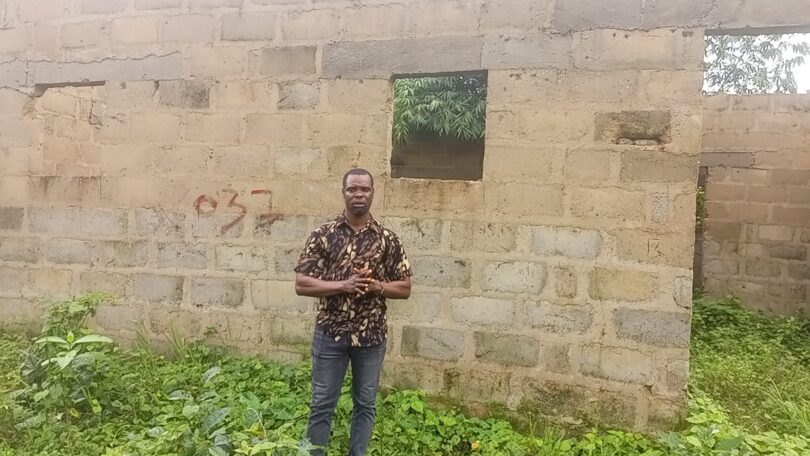
On 6 August, Nduke Pious stood beside the ruin of her three-bedroom bungalow, about 500 metres from the sprawling construction site of the Ibom Medical City project in Itak in the Ikono Local Government Area of Akwa Ibom State.
This was despite rejecting the compensation offered her after the government acquired the land for the medical city project.
She had been struggling to develop the property, which she hoped would provide a permanent abode for her family.
“My baby is only two weeks old,” she told PREMIUM TIMES. “Right now, I am living with my sister. I received a quit notice from my landlord and had to move my belongings to my sister’s house.”
Ms Pius said she spent more than N3 million raising the structure to lintel level, but officials offered her only N550,000 as compensation.
As she spoke, workers with heavy equipment focused on delivering what Governor Umo Eno has described as one of his administration’s most ambitious projects.
About 300 meters away, Sunday Okon, a mobile phone repairer and father of three, tells a similar story.
After receiving a quit notice from his previous residence during a drainage project, Mr Okon said he borrowed N3 million and added his savings to roof a three-bedroom house.
But two months after moving in, he learnt that the property had been marked for acquisition.
He said he expected to receive adequate compensation to start afresh.
Instead, the state offered him N5.6 million as compensation.
“Given the cost of building materials and the level this building has reached, the least they should offer is N16 million,” Mr Okon said.
“I’m appealing to the governor to provide adequate compensation so I can build another house for my children.”
PREMIUM TIMES found that more than a dozen property owners rejected the compensation offered by the state government as far short of what they needed to rebuild their homes.
Interviews with affected property owners, estate valuers and lawyers, supported by valuation reports, rejection letters and other documents reviewed by this newspaper, revealed lack of transparency over how compensations were determined.
Several valuers said their professional assessments were significantly higher than the figures approved by the government, raising broader questions about valuation standards and whether affected families are receiving fair compensation for one of Akwa Ibom’s most ambitious public projects.
None of the property owners interviewed by PREMIUM TIMES opposed the project.
On the contrary, they variously described it as a welcome development that could transform healthcare in Akwa Ibom.
Governor Eno unveiled the project plan and performed the groundbreaking for the Ibom International Hospital in June.
Spread across 100 hectares, the facility is expected to reduce medical tourism, create jobs and position Akwa Ibom as a leading destination for specialised healthcare.
Designed as an integrated medical hub, it will house multiple specialist centres and healthcare-related services.
“This project is not just a construction project; it is an investment in the future health and prosperity of our people,” the governor said.
At the event, the Minister of Health and Social Welfare, Muhammad Pate, described the project as a practical demonstration of Nigeria’s healthcare reform agenda.
Project Manager Teinye Isokariari said the medical city would comprise a 10-storey complex accommodating 62 medical specialties, equipped with advanced technology capable of delivering world-class healthcare services.
He described the project as “more than a hospital,” calling it “a journey” toward healthcare excellence.
The state’s financial commitment reflects the scale of that vision.
A review of the Akwa Ibom 2026 budget by PREMIUM TIMES shows that the government earmarked various amounts for different components of the project: N100 billion for the Ibom International Hospital, N10 billion for an Advanced Diagnostic Centre, N5 billion for a Mental Rehabilitation Centre and N2.5 billion for the Arise Renal Medical Centre/Dialysis Centre.
Together, the allocations amount to N117.5 billion, representing more than six per cent of the state’s N1.5 trillion 2026 budget.
For Governor Eno, the medical city is a flagship investment intended to reshape healthcare delivery in Akwa Ibom.