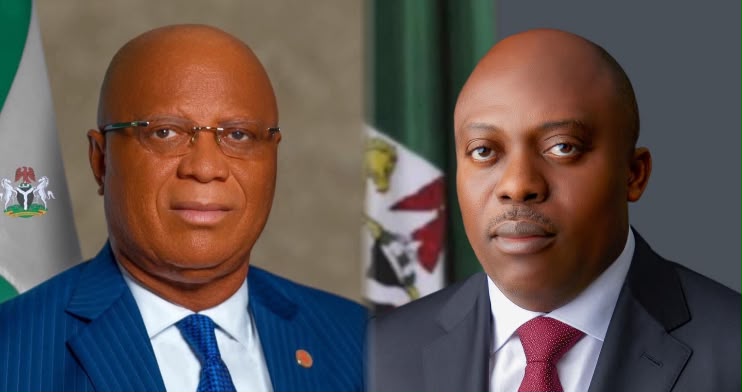
Akwa Ibom and Rivers have been shut out of BudgIT’s assessment of Nigeria’s post-subsidy state finances, exposing how gaps in fiscal disclosure are increasingly shielding billions in public revenue from independent scrutiny.
Akwa Ibom and Rivers states have been excluded from a major assessment of how Nigerian states managed the financial gains of ..-subsidy era because they failed to publish complete budget implementation records, limiting independent assessment of billions of naira in public funds.
The report assessed revenue growth, personnel costs, overheads, capital expenditure and spending on critical sectors including education, health, infrastructure and administration.
But while the finances of 34 states were subjected to comparative analysis, Akwa Ibom and Rivers were left out because they did not have complete Quarter One to Quarter Four (Q1-Q4) Budget Implementation Reports (BIRs) publicly available for the period under review.
The omission is notable because BudgIT based its analysis on actual revenues received and expenditure incurred, rather than approved budgets, which only indicate what governments plan to receive and spend.
Consequently, the absence of the two states’ complete fiscal records means their financial performance during a period of unprecedented increases in federal allocations cannot be compared with those of other states.
BudgIT found that aggregate revenue among the 34 states included in the study increased from N4.840 trillion in 2022 to N15.526 trillion in 2025, representing a nominal growth of 220.76 per cent.
Aggregate FAAC allocations rose from N3.427 trillion to N11.378 trillion during the period, an increase of 232.06 per cent, while internally generated revenue grew from N1.565 trillion to N4.147 trillion, representing a 165.01 per cent increase.
BudgIT attributed the growth mostly to increased federal transfers, currency devaluation, improved tax collection and higher oil revenues.
The report was designed to answer the question: as states received substantially more money after the removal of the petrol subsidy, what has changed in how they spent it?
But that question cannot be answered for Akwa Ibom and Rivers using the same methodology because of gaps in their publicly available fiscal records.
When contacted, BudgIT’s Country Director in Nigeria, Vahyala Kwaga, told PREMIUM TIMES that the exclusion had serious implications for public accountability.
“It means that critical measurement and analysis of those states will not happen. It means that a view of their financial situation will not happen. It also means that citizens are left with very little with which to ask questions.”
He said BudgIT wants Rivers State to resume regular publication of its BIRs and also make its Accountant-General’s reports available to the public.
According to him, the political conflict between the legislature and executive in Rivers State contributed to a situation in which important fiscal documents were not prepared or made available to the public.
Yet, BudgIT’s concern with Akwa Ibom is different.
Mr Kwaga said the organisation was concerned that Akwa Ibom, which previously produced comparatively detailed fiscal reports, had regressed in its level of disclosure.
“For Akwa Ibom, BudgIT notes with regret that a state that once produced comparatively detailed reporting simply stopped doing so for no justifiable reason,” he said.
He said the reduction in the size and detail of the state’s reports shows how quickly fiscal transparency could deteriorate.
According to him, Akwa Ibom’s BIRs previously ran to more than 20 pages but have since been reduced to no more than five pages in some instances.
BudgIT called on the Akwa Ibom State Government to return to regular publication of detailed fiscal reports.
The Akwa Ibom State Government, however, defended its decision to publish more concise budget performance reports.
The Commissioner for Budget and Economic Planning, Linus Nkan, whose ministry is responsible for budget performance reporting, told PREMIUM TIMES that the state deliberately simplified the reports to make them easier for citizens to understand.
“What we publish is more concise and easy to understand,” Mr Nkan said.
He argued that some information contained in detailed BIRs could become unwieldy and that some expenditure figures represent work that is still ongoing.
“Some information may become too bogus. Some of this information is ongoing and work in progress. When the year is completed, we publish the audited account. There you will see everything about what the state has received and done,” he said.
The commissioner described BIRs as interim documents.
“Those BIRs are interim reports and for me, they are simply in pieces,” he said.
His explanation, however, raises another question: whether interim reporting can be sufficiently detailed like other 34 states of the federation to enable citizens to track expenditure as it occurs, rather than waiting until six months after the end of the financial year for audited accounts.
This issue is important because budget implementation reports are not designed merely to provide a final account of government finances. They provide periodic information on actual revenue and expenditure during the year, allowing citizens, legislators, civil society organisations and researchers to monitor implementation while projects and programmes are ongoing.