The Federal Government has adopted Kaduna State’s household mapping model as the national framework for identifying out-of-school children, marking a major shift from estimate-based planning to data-driven interventions aimed at getting more Nigerian children back into classrooms.
Minister of Education, Dr. Maruf Olatunji Alausa, who announced the decision on Thursday, said the model would be implemented across the 36 states and the Federal Capital Territory in collaboration with the National Bureau of Statistics, NBS, enabling government to identify every out-of-school child, their location and household for targeted interventions.
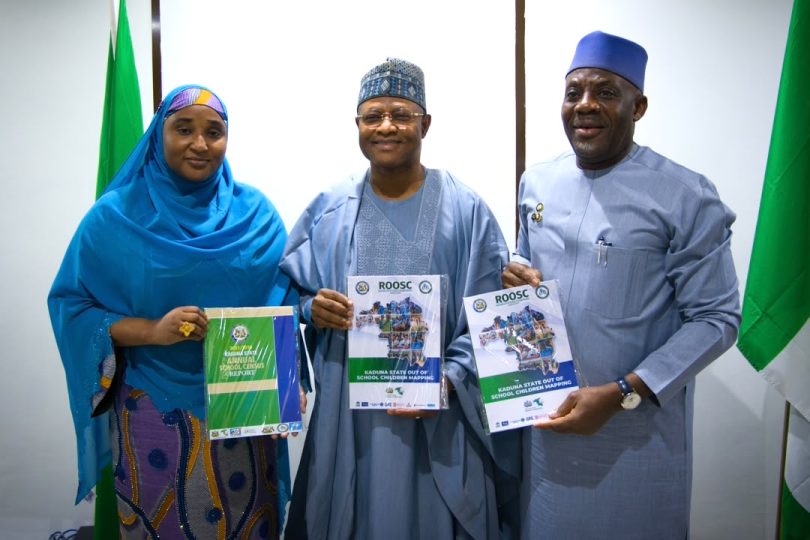
According to a statement issued on Thursday by the Minister’s Special Adviser on Media and Communications, Mr. Ikharo Attah, the minister unveiled the initiative during a meeting with Kaduna State Governor, Senator Uba Sani, describing it as a landmark step towards tackling one of Nigeria’s most pressing education challenges.
Alausa explained that for years, government planning had relied largely on projections that failed to accurately capture the true scale and distribution of out-of-school children across the country.
He said the nationwide household mapping exercise would provide verified, household-level data to support evidence-based policymaking, improve resource allocation and enhance the effectiveness of interventions.
Highlighting Kaduna State’s experience, the minister noted that previous estimates placed the number of out-of-school children in the state at about 585,000.
However, the household mapping exercise conducted by the state government revealed that the actual figure is fewer than 200,000.
“With this exercise, we now know where these children are and the households they belong to. That gives us the opportunity to work closely with the Kaduna State Government to bring them back to school,” Alausa said.
He commended Governor Uba Sani for pioneering a model that provides a clearer understanding of the challenge and demonstrates how accurate data can transform planning and service delivery in the education sector.
The minister disclosed that the Federal Ministry of Education was already working with the National Bureau of Statistics to replicate the Kaduna methodology nationwide, expressing confidence that the exercise would equip governments with reliable information to plan more effectively, deploy resources efficiently and track progress in reducing the number of out-of-school children.
Speaking at the meeting, Governor Uba Sani praised both the Minister of Education and the Minister of State for Education for the reforms being implemented in the sector, describing their leadership as inspiring and impactful.
The governor also commended President Bola Tinubu for prioritising education, saying the Federal Government’s support had created the momentum for meaningful reforms across the country.
Sani reaffirmed Kaduna State’s commitment to collaborating with the Federal Ministry of Education to expand access to quality education, stressing that education remains one of the most critical investments any government can make.
He expressed satisfaction that the state’s household mapping initiative had become the template for a nationwide programme.
Alausa assured Nigerians that the Federal Government remained committed to ensuring that no child is left behind.
He said the nationwide mapping exercise would provide the accurate data needed to strengthen collaboration with state governments and development partners, identify more out-of-school children, enrol them in school and improve retention rates in line with the Renewed Hope Agenda.