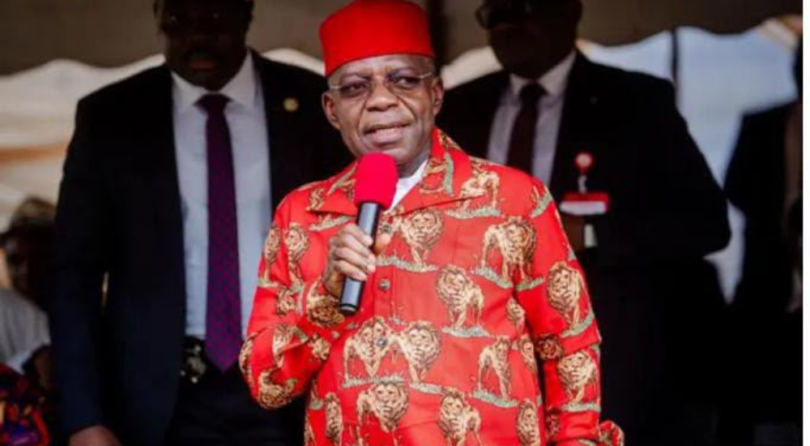
Sunday, November 1, 2026, will remain an important date in the political history of Abia State. It marked the commencement of Governor Alex Otti’s campaign to renew his mandate. The event at the Umuahia Township Stadium attracted a mammoth crowd of party faithful from across the state, alongside well-wishers and people from different walks of life.
The event began with an interdenominational church service. Governor Alex Otti read the first lesson, carefully selected from Proverbs 29:2–13, which includes the passage: “When the righteous is on the throne, the people rejoice.”
The choice of this passage was significant. It underscored the relationship between righteous leadership and the well-being of the people. Beginning the event with an act of worship also reflected the Governor’s belief that leadership is ultimately accountable to God and that, without God, no leader can accomplish anything. It was an acknowledgement of the importance of divine guidance and of God as the source of wisdom and strength in leadership.
It is remarkable to note that the spiritual foundation associated with Governor Alex Otti’s leadership was established even before he assumed office in 2023. Ahead of his inauguration, a seven-day programme of prayer, fasting and thanksgiving was organised across Abia, culminating in a rededication retreat on May 27. The exercise reflected the belief that the responsibility of governing the state should begin with seeking divine guidance.
Since assuming office, Governor Otti has repeatedly reaffirmed his belief that power ultimately belongs to God and that those entrusted with leadership have a responsibility to seek His direction. On October 18, 2026, while worshipping at the headquarters of The Lord’s Chosen Charismatic Revival Ministries in Ijesha, Lagos State, he referred to his strong Christian foundation and his late father, Pastor Lazarus Otti, saying:
“For those of us who have a very strong Christian foundation. And mark my words, VERY STRONG; why do I say so? It’s because my late father was a pastor, and he was Pastor Lazarus Otti. So you can understand, I am a Levite.”
He went on to state:
“Our foray into politics is because we believe that power belongs to God. God has spoken once, twice have I heard it, that power belongs to God. We take instructions from God; if it is not right, we will not do it; if God does not approve it, we will not do it.”
This conviction was also reflected in the Solemn Assembly and Covenant Renewal Service organised by the Abia State Government on September 24, 2026, at the JAAC Secretariat in Umuahia. Themed “Remembering the Covenant,” the gathering followed three days of state-wide fasting and prayer and was aimed at rededicating Abia to God, offering thanksgiving and seeking divine guidance for the state.
During the assembly, Governor Otti recounted how God saved his life in July 2015 when gunmen attacked the Abuja residence where he had been staying. According to his account, he was the target of the attack, and two policemen were killed. He had, however, left Abuja shortly before the incident. He recalled that there had been no apparent reason for him to leave Abuja at that particular time and attributed his departure to divine direction and protection. The incident has remained a significant part of his testimony about God’s providence and guidance in his life.
The same theme of human responsibility under divine providence was evident at his second-anniversary thanksgiving service in May 2025, when he cited 1 Corinthians 3:6–7: “I planted the seed, Apollos watered it, but God gave the increase.” The passage captures a principle that runs through his public articulation of leadership: human beings must plant and water through their effort, diligence and responsibility, but the ultimate increase belongs to God.
Taken together, these episodes provide a consistent context for understanding Governor Otti’s conception of leadership. For him, political authority is not merely an exercise of power; it is a responsibility to be exercised with a sense of divine accountability. Human effort, institutional action and good governance remain necessary, but they are pursued within a larger belief in divine guidance and providence.
The political proceedings were framed by the campaign theme, “Forward Ever, Backward Never.” The message conveys the campaign’s emphasis on sustaining the direction of development established since May 2023 and moving Abia forward. It provides the political context for Governor Otti’s request for a renewed mandate and sets the tone for the campaign’s engagement with the electorate.
Beyond the political excitement that ordinarily accompanies the commencement of an election campaign, the event represents something more consequential: a call to Abians to decide whether the direction in which the state has been moving since May 2023 should be sustained.
That decision cannot be divorced from the record of the past three and a half years. It must be considered against the changes that have taken place across the state, the reforms that have reshaped the machinery of government, the infrastructure that is transforming communities and opening new economic corridors, and the growing confidence that Abia can chart a different course of development.
Governor Otti is therefore not approaching the people with a promise to begin anew. He is asking for a renewed mandate to consolidate what has already been achieved, complete what is underway and take the state further along the path that has been established.
During the campaign launch, Governor Otti issued a public directive that opposition parties should be allowed to use public facilities, including the Umuahia Township Stadium, for their legitimate political activities, provided they obtained the necessary approvals and paid the prescribed fees.
He warned that security agencies had been directed to arrest anyone who attempted to obstruct a political group engaged in legitimate activities, irrespective of party affiliation. The directive brought an important democratic principle into focus: public facilities should remain accessible for legitimate political activities, and political competition should not be obstructed through intimidation or partisan interference.
The Governor also urged political actors to focus on issues rather than resort to personal attacks, encouraging them to present their manifestoes to the electorate. He challenged them to raise the level of political discourse in the state, declaring:
“Do not forget that in Abia, we have gone past the era of campaigning on the payment of salaries and pensions, construction of roads or urban sanitation. The hygiene issues have been dealt with. If you are unable to raise your campaign pitch to the development realities of our state, you will definitely struggle to convince any informed voter.”
He further advised political actors to conduct proper research before making public statements, reminding them that data were available to demonstrate what had been achieved.
These remarks raise an important question about the standard of political engagement Abians should expect as the election approaches. Political competition should not be reduced to personal attacks, unsubstantiated allegations or attempts to intimidate opponents. It should provide a platform for candidates and parties to present their records, articulate their ideas and offer alternative programmes for public scrutiny. Ultimately, the electorate should have the opportunity to assess competing claims and proposals on their merits.
At the campaign launch, Governor Otti unveiled his manifesto under the banner, “The New Abia: From Rescue to Consolidation.” This is distinct from the campaign theme. While “Forward Ever, Backward Never” expresses the campaign’s political message, “The New Abia: From Rescue to Consolidation” sets out the administration’s governing direction for the next phase.
The distinction between rescue and consolidation is central to the direction being proposed. Rescue speaks to the task of confronting inherited challenges and restoring confidence in governance, while consolidation concerns the institutionalisation of reforms, the strengthening of public institutions and the establishment of enduring systems capable of sustaining progress beyond individual political tenures.
Reflecting on the political journey that culminated in the 2023 transition, Governor Otti recalled the disappointments of the 2015 and 2019 elections, describing the eventual change in 2023 as the breaking of a political siege. In his words, “After the man-made disappointments of 2015 and 2019, this siege was broken in 2023.” He linked that transition to what he described as the end of a long nightmare and the emergence of a new phase of renewal, restoration and prosperity in Abia.
In explaining the purpose of his renewed mandate, Governor Otti identified three major objectives: consolidating the achievements already recorded, institutionalising excellence and accountability in public service, and positioning Abia State to take advantage of emerging economic opportunities. These objectives provide a clear picture of the direction he intends to pursue in the next phase of the New Abia project. They also reinforce the central argument for continuity: the gains already recorded must be consolidated, the standards established in public service must become enduring institutional practices, and the state’s economic prospects must be fully harnessed to create greater prosperity for its people.
In preparation for the renewed mandate, Governor Otti has also constituted campaign structures that bring together experienced politicians, party leaders and other stakeholders across Abia State. Rt. Hon. Agwu U. Agwu serves as Director-General of the Governorship Campaign Council, while former Deputy Governor of the state, Rt. Hon. Ude Oko Chukwu, chairs the Campaign Advisory Council. The Governor has also retained his deputy, Engr. Ikechukwu Emetu, as his running mate for the 2027 governorship election. Together, these arrangements provide the organisational framework for the campaign, bringing political coordination, consultation and continuity into the effort to renew the Governor’s mandate.
The breadth of support for Governor Otti’s second-term ambition is also noteworthy. Beyond the Labour Party, his re-election bid has attracted expressions of support from prominent political figures across party lines, including former Senate President Adolphus Wabara, former Minister of State for Mines and Steel Development, Dr Uchechukwu Sampson Ogah, and former Senator Emma Nwaka. Their support is particularly significant because it has come from political figures with affiliations to parties other than the Labour Party.
The traditional institution has also given its backing. On March 24, 2026, the Abia State Council of Traditional Rulers unanimously endorsed Governor Otti for a second term following a meeting with him at Nvosi, Isiala Ngwa South. The endorsement was announced by the Council’s Chairman, Eze Dr Linus Nto Mbah.
Support has equally been expressed across the two major territorial and socio-cultural blocs of the state: Old Bende and Ukwa-La-Ngwa. The Ukwa-La-Ngwa–Aba Union formally adopted Governor Otti as its sole candidate for the 2027 governorship election, while the Old Bende Progressive Union endorsed his second-term ambition at a civic reception held in his honour in October 2025.
The support extends beyond political, traditional and territorial constituencies to organised economic and occupational groups. Traders at Ariaria International Market have endorsed the Governor for a second term. Transport unions across the state, including the Cooperative Motor Union and the Abia State Tricycle Operators Union, have also declared their support. The Active Container and Cargo Truck Drivers, Abia State Unit, similarly endorsed his re-election, citing improvements in road infrastructure and the resulting ease of movement of goods and commercial traffic.
Another significant development is the decision of the Ohanaeze Ndigbo Worldwide, Abia State Chapter, to adopt a similar position in support of the Governor’s second-term ambition. The Chapter has scheduled a date in the coming weeks for its formal public pronouncement. This distinction is important: its decision has been taken, but the public declaration is still pending.
Taken together, these developments show that support for Governor Otti’s second-term ambition has been expressed across political affiliations, the traditional institution, the two major territorial blocs, and organised commercial and occupational groups. They form an important part of the political context surrounding the call for continuity in Abia State.
The First Term: Laying the Foundations; The Second: Consolidating the Gains
It is worthy of note that Governor Alex Otti’s first term has been largely devoted to laying the foundations for a new development trajectory in Abia State. The emphasis has been on confronting inherited challenges, rebuilding public institutions, introducing governance reforms and establishing the infrastructure and policy frameworks required for sustainable development.
The next phase, as envisaged in the administration’s From Rescue to Consolidation agenda, is expected to focus on four interconnected priorities: institutionalising reforms, accelerating economic transformation, deepening human capital development, and ensuring continuity with accountability. These priorities represent a shift from establishing the foundations of change to embedding them in the structures and institutions of government, expanding their economic and social benefits, and making their outcomes more enduring.