
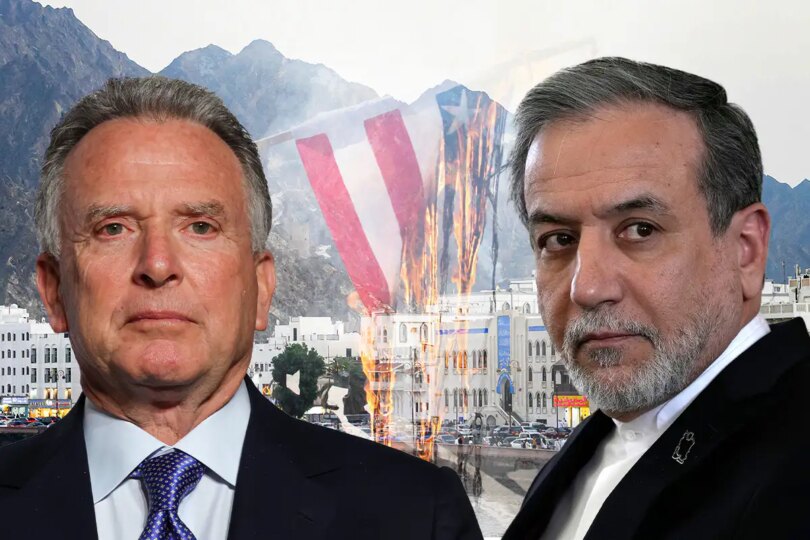
White House spokeswoman Karoline Leavitt said a new round of talks had been arranged at Iran’s request, though Tehran insists nothing has been finalized. A senior Pakistani source involved in the contacts told Reuters that Araghchi, who met Pakistan’s army chief Field Marshal Asim Munir earlier Saturday, had already conveyed Iran’s demands as well as its reservations about US positions.
“I just cancelled the trip of my representatives going to Islamabad, Pakistan, to meet with the Iranians,” Trump wrote. “Too much time wasted on traveling, too much work! Besides which, there is tremendous infighting and confusion within their “leadership.” Nobody knows who is in charge, including them. Also, we have all the cards, they have none! If they want to talk, all they have to do is call!!!”
Pro-Iranian media reported that Araghchi had already left Islamabad and would continue, as planned, to Muscat in Oman and then to Moscow.
At the center of the discussions are longstanding US demands: that Iran halt uranium enrichment, transfer its stockpile of enriched uranium to a third country, dismantle its ballistic missile program, cut support for terrorist organizations in the region, including Hezbollah and Hamas, and fully reopen the Strait of Hormuz to shipping.

Recent reports have pointed to possible compromises, including freezing enrichment for 20 years as Washington demands or five years as proposed by Tehran, partially transferring enriched uranium abroad, and releasing up to $20 billion in frozen Iranian assets in exchange. Iran, however, refuses to discuss its missile program or its backing of regional terrorist groups, describing them as non-negotiable.
For now, the main issue appears to be whether talks will resume at all. Iran has publicly refused to agree to renewed negotiations as long as a US-imposed naval blockade on its ports, put in place on April 13, remains in effect. Trump said this week the blockade would stay until a deal is signed. Iranian parliament speaker Mohammad Bagher Ghalibaf said reopening the Strait of Hormuz was “impossible” while the blockade continues.
“There is no meeting planned between Iran and the US. Iran’s comments will be conveyed to Pakistan,” Iranian Foreign Ministry spokesman Esmaeil Baghaei wrote Friday on X. The Tasnim news agency, which is affiliated with the Islamic Revolutionary Guard Corps, dismissed US media reports about a new round of talks as “false stories,” noting claims that Vice President JD Vance was en route had proven untrue. Iran’s parliament communications office also denied reports that Ghalibaf had resigned from the negotiating team.
During his visit, Araghchi met Pakistani Prime Minister Shehbaz Sharif after earlier talks with Munir. The two sides discussed “regional developments and bilateral relations.” Publicly, Iranian officials said the visit was not aimed at talks with the US but at coordinating with regional partners. Araghchi wrote on X that he was embarking on a “timely tour” of Islamabad, Muscat and Moscow to “closely coordinate with our partners on bilateral issues and consult on regional developments.” Tasnim reported that he would present Iran’s positions “to end the war.”
On the US side, officials struck a cautiously optimistic tone. Leavitt told Fox News that “the Iranians want to talk. They want to talk face to face,” adding that “we’ve seen some progress from the Iranian side in recent days.” She said the goal of Operation “Epic Rage” was to ensure Iran could not obtain nuclear weapons, and that the effort had now moved into a diplomatic phase.
Trump himself told Reuters by phone that Iran would “submit a proposal,” without elaborating.
Despite these statements, expectations appear low. The downgrade in the level of the US delegation is a clear sign. While Vance led a 300-member team in the previous round two weeks ago, holding more than 20 hours of talks, he will remain in the US “on standby.” Officials told The Washington Post the decision reflects standard diplomatic protocol, with Vance only traveling if Iran sends a counterpart of similar rank.

Another senior official said more bluntly that Vance’s absence would make it easier for the White House to “manage the public relations fallout” if Iran withdraws from talks or presents unacceptable demands. According to officials cited by the Post, Kushner and Witkoff favor including provisions important to Israel in any deal, including a complete halt to Iranian support for terrorist organizations such as Hezbollah, Hamas and the Houthis, as well as limits on the missile program, issues Tehran considers red lines.
Vance, by contrast, has positioned himself as opposing military action from the outset, in line with his isolationist views. Western media have reported that Iranian officials specifically preferred Vance to lead the US delegation, seeing him as a more acceptable interlocutor.
Pakistani Deputy Prime Minister and Foreign Minister Ishaq Dar met Araghchi on Friday alongside Munir, and later spoke with Egyptian Foreign Minister Badr Abdelatty about “the diplomatic efforts led by Pakistan.” A senior Pakistani source told Reuters that Iran’s demands and reservations had already been relayed.
Pakistan’s Foreign Ministry urged local and international media to “avoid speculative reporting and rely only on official statements,” following a wave of reports citing anonymous Pakistani officials.
Veteran Pakistani journalist Kamran Khan reported that the chances of renewing talks in Islamabad were “rapidly diminishing,” as Iran continued to refuse to meet the US delegation expected to arrive overnight from Washington while the naval blockade remains in place.
Meanwhile, tensions continue at sea. Shipping traffic through the Strait of Hormuz remains minimal. US Central Command said about 33 Iranian vessels attempting to bypass the blockade had been turned back since April 13. The US this week seized two large tankers linked to Iran, one in the Indian Ocean between Sri Lanka and the Strait of Malacca and another in the Arabian Sea.

Iran has responded in kind. On Wednesday, Revolutionary Guard forces fired on three commercial ships in the Strait of Hormuz and said they had seized two of them, MSC Francesca and Epaminondas, taking them to the port of Bandar Abbas. The Guards described the move as retaliation for the US seizure of an Iranian vessel.
Iran’s armed forces emergency command warned that “if the aggressive US military continues its blockade, plunder and piracy in the region, it should be certain it will face a response from Iran’s powerful armed forces.”