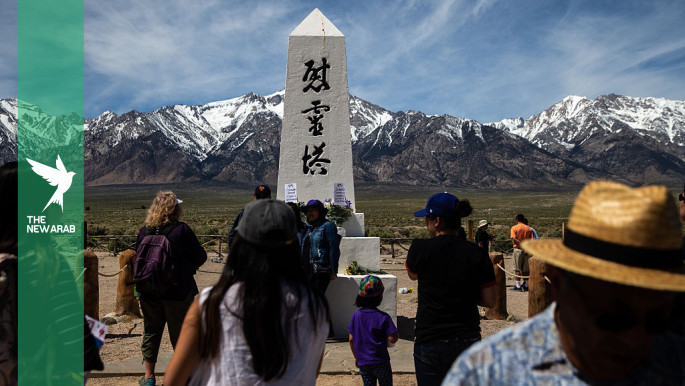
People gather in front of the iconic Manzanar cemetery monument before the start of the annual Manzanar Pilgrimage at the Manzanar War Relocation Camp. [Getty]
Over the weekend, a group of American Muslims took part in a pilgrimage to the World War II Japanese internment camp of Manzanar in California, a way to honour and remember those who endured state-sanctioned discrimination and to highlight the present-day demonisation of minorities.
The annual pilgrimage, now in its 57th year, brings together different communities to remember the 120,000 Japanese Americans (out of a population of around 127,000) who were forced from their homes, saw their property confiscated and were incarcerated between 1942 and 1946. Located in a remote area of the California desert, Manzanar was one of the largest of at least 10 such camps.
This was part of the country’s wartime policy under then-President Franklin D. Roosevelt that targeted the country’s Japanese community, the vast majority of whom were US citizens, purportedly over Japan’s role in World War II.
“The main focus was on the importance of remembering and honouring the plight of the 120,000 Japanese Americans who were unfairly targeted,” Hussam Ayloush, executive director of the California chapter of the Council on American-Islamic Relations, told The New Arab.
This year’s event held special significance due to increased crackdowns on immigrants and activists. Community leaders gathered at the former camp, which now has a museum and learning centre. During World War II, members of the Japanese community, including children, lived in military barracks, surrounded by barbed wire and armed guards.
Ayloush has been making the pilgrimage to Manzanar since shortly after the 9/11 attacks, following a conversation with the daughter of a World War II Japanese American who expressed to him her concerns about what his community would face.
“It’s important to remember that part of history when government abuse and bigotry were left unchecked and to make sure that doesn’t happen again, especially when we see the same ideology and the same types of people,” he said.
The pilgrimage brings together people of different backgrounds and faiths to raise awareness of a chapter in US history that is often overlooked in the school curriculum. Yet, advocates argue that it could serve as a cautionary tale for present-day government crackdowns. An inquiry into the camps found that the policy was the result of bigotry, war hysteria and failed leadership, which some see as echoes of today.
“For 57 years, we’ve said our story is a cautionary tale. Our families were illegally and unconstitutionally incarcerated,” Bruce Embrey, chair of the Manzanar Committee, told TNA. His mother was incarcerated at Manzanar as a teenager.
“Some of the same laws that were used against us are being used against people today,” he said, pointing to the Alien Enemy Act and the Immigration and Naturalisation Act that were used to arrest Columbia University graduate and Palestinian activist Mahmoud Khalil.
“There are laws on our books that are not reflective of our modern democracy. When we return to Manzanar, we say these laws shouldn’t be used on other communities,” said Embrey.
“It took decades for our story to percolate. Our theme on Saturday was “Lessons from Manzanar.” Vigilance is the price of democracy. We’ve done this before—this wholesale persecution is not new in this country. Every time a community is threatened, the Japanese American community needs to step up,” Embrey added.