
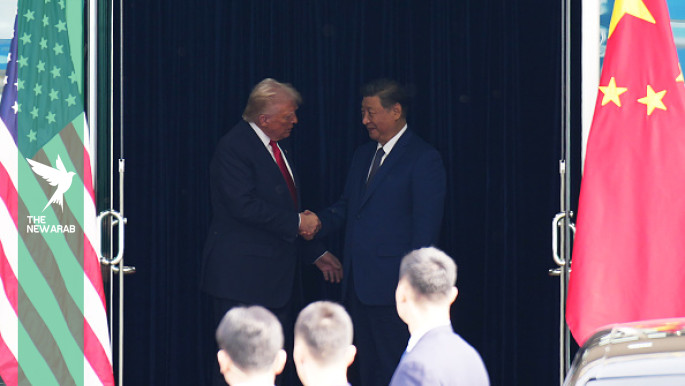
Trump doesn’t appear to be moved by growing discontent over his policies. namely war and tariffs, that many see as directly impacting their wallets. [Getty]
US President Donald Trump is scheduled to arrive in Beijing on Wednesday evening for trade and diplomacy talks with his Chinese counterpart, Xi Jinping, amid heightened tensions on the international front and low polling domestically.
As he continues to threaten Iran over their passage of oil tankers through the Strait of Hormuz, consumers around the world—including in the US—are seeing the effects of surging oil prices and tariffs with high levels of inflation.
Trump doesn’t appear to be moved by growing discontent over his policies. namely war and tariffs, that many see as directly impacting their wallets.
On Tuesday, speaking on the White House’s South Lawn before heading to China, Trump told reporters that he isn’t taking Americans’ economic hardships into consideration when going to China.
When asked, “When you’re negotiating with Iran, Mr President, to what extent is Americans’ financial situations motivating you to make a deal?” he responded without hesitation, “Not even a little bit.”
He continued by saying, “The only thing that matters when I’m talking about Iran, they can’t have a nuclear weapon. I don’t think about the Americans’ financial situation. I don’t think about anybody. I think about one thing. We cannot let Iran have a nuclear weapon, that’s all. That’s the only thing that motivates me.”
Joining him on his trip to China are at least a dozen business leaders, including Apple CEO Tim Cook, SpaceX CEO Elon Musk, Boeing’s Kelly Ortberg and BlackRock’s Larry Fink. Trump has suggested establishing a “board of investment” and a “board of trade,” with US business leaders serving on them.
Also on the trip is the director of the film, Melania, Brett Ratner—who faced allegations of sexual misconduct during the #MeToo movement—reportedly on the trip to scout for a new movie location. Melania herself will be skipping the trip to China.
This summit comes nearly a decade after Trump’s last trip in 2017 during his first term as president. In his second term, Trump started a trade war, though China has become less dependent on US trade in the past decade.
The continued closure of the Strait of Hormuz and the US-Israeli war on Iran are expected to be important points of discussion at the summit. China is Iran’s largest trading partner, accounting for nearly a third of its trade.
Since the war began in late February, China has played a cautious but important role in the conflict, continuing its support for Iran while trying to encourage a ceasefire, recently urging Pakistan to ramp up its mediation efforts. China imports approximately 80 per cent of Iran’s shipped oil, and exports to China what some in the US administration describe as dual-use components.
It’s unclear how this trip will help defuse tensions in Iran, given Trump’s self-proclaimed lack of concern for inflation in the US and China’s cautiousness in balancing its dealings with both countries.
“Nothing good will come out of this summit that will lower inflation or gas prices. Americans and Iranians will emerge as losers,” David Frank, professor of rhetoric and political communication at the University of Oregon, told The New Arab. “China will be strengthened. It has emerged as the strongest country in the world. Trump is going to China; China is not coming to the US,” he said.