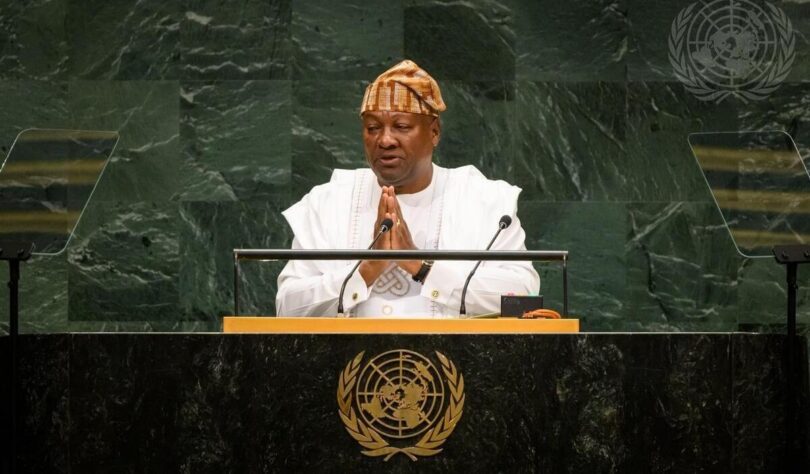
In a well-articulated, powerfully delivered address marked by clarity, conviction, and strong oratory, President John Dramani Mahama challenged the international order during his speech at the 81st United Nations General Assembly.
He punctuated several of his remarks with historical facts and, in doing so, placed Africa’s historical experience, contemporary challenges and future aspirations firmly at the centre of the emerging global conversation.
More importantly, President Mahama did not speak merely as President of Ghana. He articulated a broader African position on the restructuring of an international system whose institutions and power relationships were largely designed in another historical era.
President Mahama reminded the world that language can create a sense of kinship, irrespective of the historical complexities through which that kinship may have been forged.
Beyond language, he made the larger moral argument that no race is superior and no nation is inferior. No child’s life should be considered less valuable because of the language they speak, the faith they profess, the colour of their skin or the land of their birth.
That is fundamentally an argument for the universality of human dignity.
President Mahama confronted one of history’s most painful subjects: the transatlantic trafficking and enslavement of Africans.
He argued for reparations and compensation not as instruments for reopening old wounds, but as instruments of healing and historical justice.
He referred to the trafficking of enslaved Africans as the gravest crime against humanity. His position also reflected the broader reparatory justice process Ghana has been advancing internationally. In March 2026, the UN General Assembly adopted Resolution 80/250, with 123 member states declaring the trafficking of enslaved Africans “a gravest crime against humanity.”
The significance of this argument goes beyond compensation. It is about acknowledging historical truth, restoring dignity and confronting the continuing institutional consequences of historical exploitation.
President Mahama drew attention to what he described as a fundamental contradiction in the present international order.
Africa is home to about 1.5 billion people, representing more than 18 percent of humanity, and constitutes the largest regional voting bloc in the UN General Assembly. Yet the continent has no permanent seat on the United Nations Security Council.
That imbalance raises an important question about the structure of global power.
President Mahama therefore demanded permanent African representation on the Security Council with all the rights, responsibilities and veto powers enjoyed by existing permanent members.
His argument was unequivocal: African representation should not be treated as a favour. He described Security Council reform as essential to the legitimacy and credibility of the United Nations.
This is, fundamentally, an argument about whether the architecture of global governance should continue to reflect the geopolitical realities of 1945 or the demographic, economic and political realities of the 21st century.
The speech also confronted the inequities embedded in the international financial architecture.
Mahama argued that developing countries are frequently compelled to borrow at significantly higher interest rates than industrialised nations, while African and Caribbean countries confronting climate disasters are often forced to incur additional debt to rebuild from crises they contributed relatively little to causing.
The resulting dilemma is severe: governments can find themselves choosing between servicing expensive debt and investing adequately in human capital, infrastructure and development.
His message was therefore clear:
Africa does not need charity. Africa needs equal partnership anchored in mutual respect.
That distinction is important.
Mahama argued that Africa should no longer remain merely an exporter of raw materials while the greatest value, industrial capacity and employment opportunities generated from those resources are created elsewhere.
He stated that Africa would process its minerals at home, build industries, create dignified employment for its young population and retain a greater share of the value generated by its natural resources.
This is not simply an economic argument. It is an argument for structural transformation.
Africa cannot permanently aspire to development while exporting raw materials and importing finished products at considerably higher value.
President Mahama warned that the United Nations must not create the impression that might means right.
He condemned what he described as the selective application of international law and insisted that the same standards of sovereignty, human rights and accountability should apply regardless of the geopolitical power of the actors involved.
On the Israel-Palestine conflict, he reaffirmed Ghana’s support for a viable two-state solution in which Israel and Palestine live side by side in peace, security and with guaranteed borders. At the same time, he unequivocally condemned acts of terrorism by Hamas.
He also called for the lifting of the long-standing economic, commercial and financial embargo against Cuba, arguing that measures which impose collective hardship on ordinary citizens conflict with human dignity and international law.
One of the most striking passages of the speech was President Mahama’s declaration:
“No human civilisation deserves to be annihilated, certainly not a member state of the United Nations.”
The context is important.
Two days before Mahama’s address, President Donald Trump, speaking at the same UN General Assembly, said he faced a choice between reaching a deal with Iran and “annihilating the Islamic Republic.”
President Mahama did not directly name President Trump in that passage, but the reference appeared to speak to the contemporary Middle East crisis and the principle that no member state of the United Nations should be threatened with annihilation.