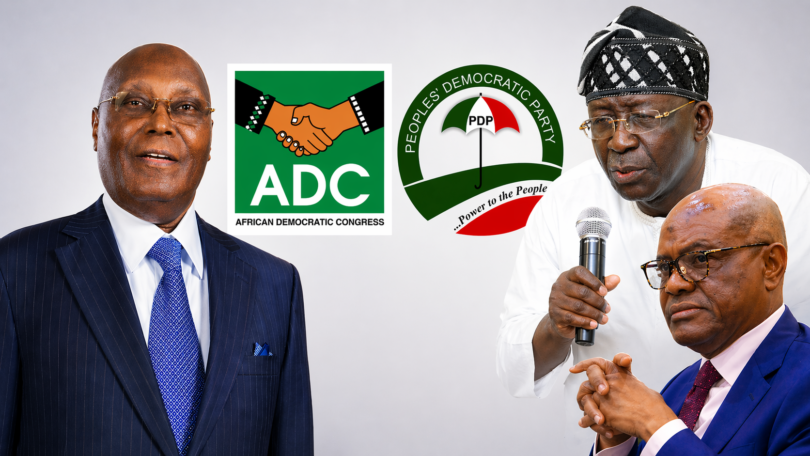
After Atiku’s presidential ambition arguably left the PDP in a bad shape, his recent indication of another presidential bid may affect the future of his new party, ADC.
Former Vice President Atiku Abubakar may have just set the tone for another round of political tension, this time outside the Peoples Democratic Party (PDP).
The party has other heavyweights and possible contenders, including former Labour Party presidential candidate and former Anambra State Governor, Peter Obi; former Minister of Transportation and former Rivers State Governor, Rotimi Amaechi; and former Kano State Governor, Rabiu Kwankwaso.
The interview revealed that the former vice president is not ready to drop his long-standing ambition, which some fear may ultimately lead to the implosion of the ADC, just as it did his former party.
Responding to a question in the Arise TV interview on whether turning 80 by the next election would influence his ambition, Atiku, who was born in November 1946, said, “Certainly yes, because the stakes are higher and I believe that will be my last outing.”
In Nigerian politics, there is an unwritten agreement that the presidency should alternate between the North and the South to ensure national stability and inclusion.
Many see Atiku’s relentless insistence on running as injurious to that delicate consensus. His decision to run in 2023 was particularly controversial because it went against the PDP constitution, which favoured a southern presidency following the eight-year tenure of Muhammadu Buhari, a northerner.
This perceived betrayal led to significant grumbling among southerners and sparked the emergence of the Nyesom Wike-led rebellion within the Peoples Democratic Party, a fracture that has driven the party to the brink of extinction.
There is now a growing fear that a similar scenario may emerge in the ADC, potentially crippling the party’s chances before the contest even begins.
Indeed, Atiku’s story in the PDP has become a classic political tragedy, in which a giant cracked the foundation of the house he helped build.
The PDP, which once described itself as the “largest party in Africa,” found itself stumbling over the very ambitions of one of its founders.
When the party was formed in 1998, it quickly became Nigeria’s dominant political force, ruling the country for 16 uninterrupted years.
Over time, however, the PDP evolved into a platform where internal power competition became intense. The party, which used to be a vibrant machine of consensus, critics say, slowly became a vehicle for a single man’s ambition. As the 2027 cycle approaches, Atiku’s recent defection to the ADC feels to many like the final abandonment of a house he helped build.
Atiku’s presidential journey did not begin with the PDP. His first attempt dates back to 1993 under the Social Democratic Party (SDP), during the military transition programme. Although he eventually stepped down for Moshood Abiola, the experience positioned him within Nigeria’s emerging democratic elite.
Upon the restoration of democracy in Nigeria, Atiku won the Adamawa governorship election on the PDP’s ticket. However, before he dropped the mandate after the PDP presidential candidate, former military ruler Olusegun Obasanjo, picked him as his running mate, thus becoming the nation’s vice president from 1999 to 2007.
During his eight years in office, he built a nationwide political structure that would later sustain his ambitions.
His first full presidential run came in 2007 after defecting to the Action Congress (AC) following a fallout with Mr Obasanjo. He lost that election to the late President Musa Yar’Adua of the PDP.
In 2011, he returned to the PDP to seek the ruling party’s ticket but was defeated in the primary election by Goodluck Jonathan, then the incumbent president.
Ahead of the 2015 elections, Atiku joined the All Progressives Congress (APC), where he lost the primaries to Muhammadu Buhari, who went on to win the presidency.
He returned to the PDP once more and secured its ticket in 2019, only to lose again to Mr Buhari in the general election.
In 2023, Atiku was once again the PDP’s presidential candidate, reinforcing both his staying power and the concerns of critics who believed the party had become locked in a cycle of familiar choices. He lost the general election to President Bola Tinubu of the APC.
However, in a fresh twist that underscores his long pattern of political movement, Atiku defected from the PDP to the ADC to run for president on the platform of his new party in 2027.
For some within the PDP, his exit provides an opportunity for an internal reset and a possible generational shift. For others, it represents yet another chapter in a long history of departures that have left the party grappling with identity and cohesion.
This long trajectory, spanning the SDP, PDP, AC, APC, and ADC, captures not just political persistence but also a pattern of movement that some party insiders interpret as destabilising.
After Atiku secured the PDP presidential ticket in May 2022, defeating several contenders, including then Rivers State Governor Nyesom Wike, the party failed to close ranks.
What followed was one of the most damaging internal rebellions in the party’s history.
A group of five influential governors, later known as the G5, refused to support Atiku’s candidacy. Their opposition was rooted in what they described as a violation of the party’s zoning principle, arguing that both the presidential candidate and the national chairman, coming from the North, upset the PDP’s internal balance.
The perception grew that Atiku’s insistence on being the candidate, even when the political climate demanded a shift to the South, was not an act of service, ultimately draining the party’s energy.
The G5, also known as the “Integrity Group,” consisted of five sitting PDP governors whose influence spanned key regions. They became the faces of a rebellion that the PDP could not suppress.
Mr Wike, the then-governor of Rivers State, emerged as the group’s leader and most vocal figure, leveraging his control of a politically strategic state.