BRUSSELS – China has maintained a low profile in the current war between Iran, the United States and Israel.
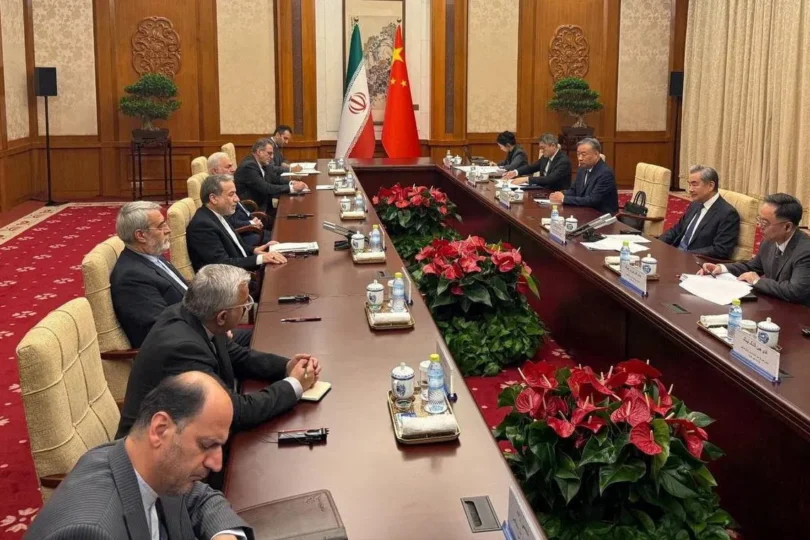
Chinese Foreign Minister Wang Yi recently used some of Beijing’s strongest language to date on the conflict, condemning what he called “warmongering by the US and Israel” after a May 6 meeting with Iranian Foreign Minister Abbas Araghchi.
However, senior Chinese officials have studiously avoided being too critical of the US, fearing this could complicate next week’s scheduled summit between US President Donald Trump and Chinese President Xi Jinping.
On the other hand, China’s relations with Israel are nosediving. And in response, some Israeli politicians are already toying with the idea of uprating links with Taiwan as a lever against Beijing.
A delegation of Israeli lawmakers was received in Taipei by Taiwanese President Lai Ching-te on May 5, prompting an instant warning from the Chinese Embassy in Tel Aviv that Israeli politicians “should not underestimate the firm resolve of the Chinese government”.
A host of other developments guarantee that relations between China and the Jewish state are unlikely to improve soon.
Since 1992, when the two countries first established formal diplomatic relations, expectations have been high on both sides. With an economy far more diversified than that of its Arab neighbours, Israel saw China as a promising new market. And the Chinese were interested in access to Israel’s high-tech industry.
The emergence of China as a major manufacturer of weapons also added a security dimension to the relationship.
Smarting from a sale of Chinese ballistic missiles to Saudi Arabia during the late 1980s, Israeli officials started arguing that the only way China could be prevented from supplying arms to Arab countries was by offering the Chinese access to Israeli military technology. The Chinese, the argument in Tel Aviv went, could be persuaded that they could gain more by keeping out of Middle Eastern weapon markets.
The idea also chimed well with the interests of Israel’s own defence industry, which at the time was looking for new commercial outlets and, at least for a while, led to a boom in secret Israeli-Chinese military links.
Military cooperation thrived. In 2005, the Israelis not only decided to sell to the Chinese know-how for the production of drones – at that time a cutting-edge technology – but also chose to lie to the US about their links with Beijing.
It was only the US threat to kick Israel out of the US-led development consortium for the F35 fighter jet that persuaded the Israelis to give up on their plans to transfer military technology to China.
And even then, some covert cooperation between Tel Aviv and Beijing continued. For instance, China’s J-10 fighter looks strikingly similar to the cancelled Israeli Lavi fighter jet project – a hardly accidental resemblance.
But as the rivalry between the US and China intensified, Israel was increasingly constrained in its relations with Beijing.
Meanwhile, China deepened its links with the Arab world, which now go beyond just the purchase of oil and natural gas. The United Arab Emirates is a major technology hub attracting Chinese companies. And Iran and other Middle Eastern states’ insatiable demands for weapon purchases meant that Chinese defence manufacturers were increasingly drawn to these markets.
Bilateral trade between China and Israel continued to expand, standing at around US$16.3 billion (S$20.6 billion) in 2024, the last year for which comparable figures are available.
Still, the two partners grew apart: China is the largest trading partner for all Gulf states but only the third-largest partner for Israel, accounting for just under 8 per cent of the Jewish state’s total trade.
And political developments have further strained ties. In 2023, US pressure led Israel to award the sale of its Mediterranean port of Haifa to an Indian consortium rather than a Chinese competitor. And when the Gaza war broke out in October 2023, China sided firmly with the Palestinians.
Beijing’s deepening strategic cooperation with Iran, including assisting in the rebuilding of Iranian military capabilities after Israeli strikes in 2024 and 2025, served only to deepen Israel’s estrangement.
And relations were further hurt in February 2026, as news emerged that Beijing labelled Israel a “high-risk area”, a move that effectively prevented new Chinese investments into the country.
The latest visit by Israeli members of the Knesset – Israel’s Parliament – to Taiwan is hardly likely to improve matters.
The Israeli delegation included only opposition MPs so, in theory, bilateral relations between the Israeli government and China remain unaffected.
Still, with a general election due by October 2026, the Israeli lawmakers received by the Taiwanese President on May 5 do have reasonable expectations of fulfilling future government positions, should Israeli Prime Minister Benjamin Netanyahu lose the vote.
Furthermore, the presence of Mrs Maya Yaron, who heads Israel’s representative office in Taipei, is indicative of Israel’s determination to upgrade links with Taiwan. She was previously the director of Israel’s entire Asia and Pacific diplomatic group, and has long-term experience in scrutinising the strategic implications of foreign investments into the Jewish state.
None of this suggests that relations between China and Israel are now beyond repair.
Still, it is clear that after decades of trying to isolate their bilateral links from the wider tensions of the Middle East, both Beijing and Tel Aviv appear to have made their choices, standing on different sides of the regional divide.