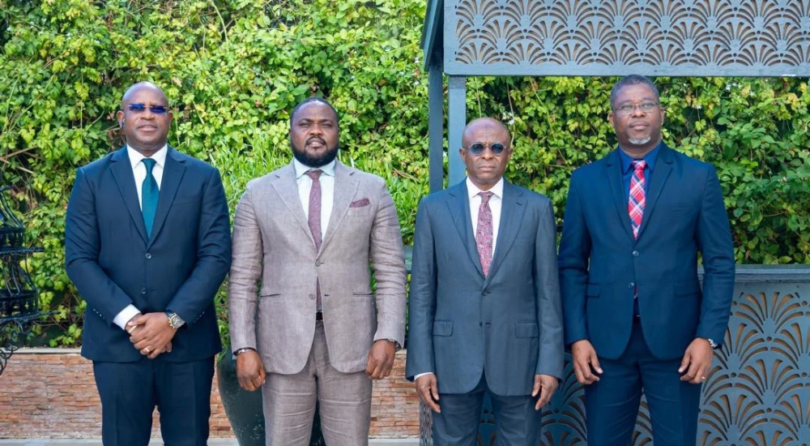
The Managing Director of the Nigerian Ports Authority (NPA), Dr Abubakar Dantsoho, has warned that rising cyberattacks pose a growing threat to port operations, international trade and economic stability across Africa.
Dantsoho called for stronger cybersecurity measures, regional intelligence sharing and common digital standards among African ports to protect critical infrastructure as the maritime industry increasingly adopts digital technologies and artificial intelligence (AI).
He spoke at the African Ports Conference in Casablanca, Morocco, on Tuesday, in his capacity as NPA managing director and President of the Port Management Association of West and Central Africa (PMAWCA).
Dantsoho said cyberattacks on port infrastructure had moved beyond information technology concerns, warning that they could disrupt cargo movement, interrupt trade and undermine maritime supply chains.
“In July 2021, a cyberattack on Transnet forced South Africa’s container terminals to declare force majeure. In 2023, cyber incidents disrupted the Port of Nagoya and DP World terminals across Australia for days. These were not merely IT problems. They were interruptions to trade,” he said.
He stressed that the growing digitalisation of port operations must be accompanied by adequate safeguards to protect operational systems, cargo information, revenue collection and data exchange among stakeholders.
“AI can help a port work more intelligently, but cybersecurity protects its ability to work at all,” he said.
The NPA chief also cautioned against digital platforms becoming single points of failure capable of disrupting entire port communities.
“A single window must not become a single point of failure,” he said.
Nigeria has introduced the National Single Window and a beta version of the Port Community System to improve coordination among Customs, terminal operators, shipping lines and regulatory agencies.
However, Dantsoho said the benefits of these platforms would depend on effective cybersecurity arrangements and the ability to sustain essential operations during disruptions.
He outlined measures for strengthening port cybersecurity, including separating operational technology from administrative networks, imposing security requirements on connected partners, testing recovery systems and training personnel to identify and report threats.
He also called for cybersecurity to be integrated into broader port security arrangements in line with relevant International Ship and Port Facility Security (ISPS) requirements and International Maritime Organization (IMO) standards.
“A recovery plan is not proven because it exists. It is proven because it works,” he said, emphasising the need for ports to test backups and rehearse recovery procedures.
Beyond cybersecurity, Dantsoho said AI could help African ports address vessel waiting times, cargo delays, inefficient truck movements, revenue leakages and equipment failures.
He said applications such as improved vessel arrival forecasts, berth planning, truck scheduling, cargo-risk assessment and predictive maintenance could improve operational efficiency and reduce costs.
However, he warned against adopting technology without clear objectives and measurable results.
“The objective is not to replace professional judgement, but to strengthen it,” he said.
Highlighting Nigeria’s experience, Dantsoho said the NPA had introduced the Eto electronic truck call-up system to address congestion around port access roads and had advanced digital coordination through the National Single Window and Port Community System.
He recalled that cargo previously remained at Lagos ports for as long as three weeks, while the Apapa access road, designed to accommodate about 2,400 trucks daily, handled more than 7,000 trucks.
According to him, Nigeria’s port reforms were yielding encouraging results, with Tin Can Island Port ranking tenth and Apapa Port twelfth among the world’s most improved ports in the World Bank’s Container Port Performance Index 2025, released in June 2026.
He added that Nigeria’s cargo throughput increased by 24.8 per cent to 129.3 million metric tonnes in 2025.
The NPA is also implementing a $1bn modernisation programme for Apapa and Tin Can Island ports, which Dantsoho said offered an opportunity to incorporate secure digital infrastructure and intelligent maintenance systems into port renewal projects.
As PMAWCA president, he called for regional cooperation, arguing that cyber threats and operational disruptions could have consequences beyond individual countries because shipping routes and cargo corridors were interconnected.
“If we modernise in isolation, we risk replacing paper-based fragmentation with digital fragmentation,” he said.
Dantsoho proposed sharing cyber threat intelligence, developing common data standards, benchmarking port performance and strengthening professional training.
He also proposed establishing a PMAWCA working group on AI and data governance, with cybersecurity and digital resilience among its responsibilities.
He urged member ports to identify high-impact AI pilot projects with measurable targets and accountable implementation teams.
Dantsoho further emphasised the need for clear rules governing port data ownership, access and protection, saying African countries should benefit from technological innovation while retaining control over how their data is managed.
“Data sovereignty does not mean isolation. It means benefiting from innovation while retaining the capacity to govern its use,” he said.
He said African ports must work together to build secure and reliable systems capable of reducing trade costs and delivering measurable economic benefits.
“The smart African port will not be imported. We will build it together,” Dantsoho said.