
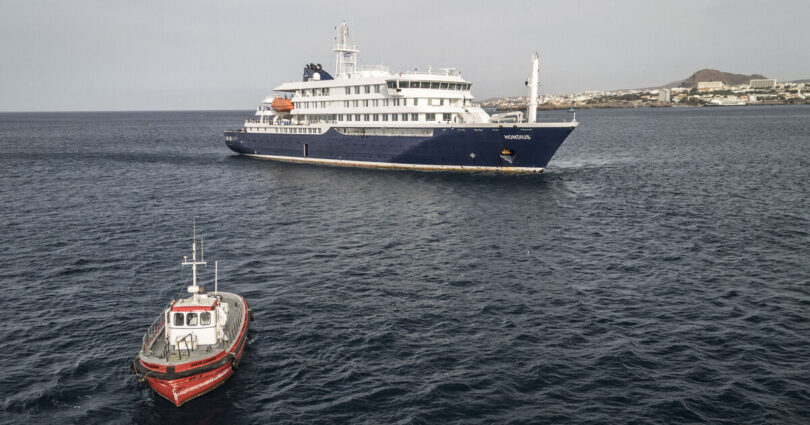
The MV Hondius has left Cape Verde and is heading to the Canary Islands (Image: Getty)
The World Health Organisation has insisted a current outbreak of a deadly contagious disease onboard a cruise ship is not the start of another covid-style pandemic. Five cases of potentially lethal hantavirus have now been confirmed on a cruise liner heading towards the Canary Islands on which three travellers have already died. The MV Hondius has now left Cape Verde after several days of medical evacuations and is now expected to reach Tenerife this weekend despite clear opposition from the Canary Islands’ government, who insists it has not been given enough information on the disease to make any decisions on public health.
Three people have died on board or after travelling onboard the ship which left Argentina about a month ago. Two Brits who left the ship at Saint Helena in April have gone back to the UK and are now self-isolating. It was confirmed on Thursday that a total of seven British nationals had left the cruise early. They are currently being contact traced.
READ MORE: Major hantavirus cruise update as more Brits confirmed to have left ship
READ MORE: Hantavirus cruise update as passengers travel the world – race against time

The cruise ship is expected to reach Tenerife this weekend (Image: Getty)
Nearly 150 passengers are still stuck on the ship, confined to their cabins. Authorities have confirmed all those onboard are currently asymptomatic.
Speaking at a hastily arranged WHO press conference, infectious disease epidemiologist Maria van Kerkhove stressed the current outbreak, though alarming, should not be compared to the beginning of 2020’s coronavirus lockdowns.
She said: “I want to be unequivocal here. This is not SARS-CoV-2. This is not the start of a Covid pandemic. This is an outbreak that we see on a ship.”
Cruise travel is highly sensitive to perceptions of onboard health risks, especially after Covid-19, and many concerned travellers have taken to social media vowing to stop cruising holidays in the wake of the incident.
One woman shared a previously filmed video of herself aboard a cruise ship saying she was sharing the video now because she will “never go on a cruise again.” In another TikTok post, a user said she would refuse to board a cruise ship even if she were paid $100,000, adding: “How many contagious viruses do we need to have on a cruise before people stop getting on the damn boat?” Another user went further, calling for cruise ships to be banned altogether.
But cruise industry expert, Stewart Chiron, also known as “The Cruise Guy”, insisted: “This is a very isolated case.
“Despite the rhetoric when stories like this come out, consumers remain extremely confident in cruising. The cruise industry is the most closely regulated vacation option by various world health organisations.”
Mr Chiron stated that modern cleaning procedures and preventive health measures mean that outbreaks of viruses or diseases are actually less common on cruise ships than on land.
In the Canary Islands, worried residents have been reliving the tough memories of the Covid pandemic.

Three people were evacuated from the ship on Wednesday (Image: Getty)
A nurse in the Canary Islands, who asked not to be identified, said there were growing fears that hospitals and health centres in Tenerife could face lockdown measures if the situation escalated. She added that the islands’ quarantine protocols for viruses, if implemented, could affect schools and healthcare centres.
She said: “It will be just like Covid. People are worried about their children, elderly relatives and the vulnerable.”
Online, some have even been calling for a protest on Plaza de España in the city of Santa Cruz de Tenerife on Friday, May 8 to protest against the docking of the ship. Another protest has been organised on Thursday, May 7 in Gran Canaria calling for the safety, integrity, and protection of the Canarian population, with slogans such as “health is not negotiable” and “our islands are not an experiment.”
The WHO said about the virus: “Human hantavirus infection is primarily acquired through contact with the urine, faeces, or saliva of infected rodents.
“It is a rare but severe disease that can be deadly. Although uncommon, limited human to human transmission has been reported in previous outbreaks of Andes virus (a specific species of hantavirus).
“WHO currently assesses the risk to the global population from this event as low and will continue to monitor the epidemiological situation and update the risk assessment.”
A spokesperson for the Cruise Line International Association told the Express: “The global cruise industry maintains comprehensive health, sanitation, and medical protocols designed to protect the health and well-being of passengers and crew, and CLIA-member cruise lines are required to adhere to policies that go well beyond regulatory requirements.
“CLIA-member cruise lines operate under strict requirements that include advanced cleaning and disinfection procedures, continuous monitoring for illness, and rapid response measures when health concerns arise. These protocols are informed by international public health guidance and are regularly reviewed and updated.
“Cruise ships are also subject to oversight and inspection by public health authorities in key jurisdictions, and CLIA-member oceangoing cruise lines are required to operate with onboard medical facilities and trained personnel equipped to manage a wide range of health situations.
“As a result of these layered measures, available public health data indicates that rates of illness on cruise ships are low and, in many cases, lower than in comparable land-based settings.”