
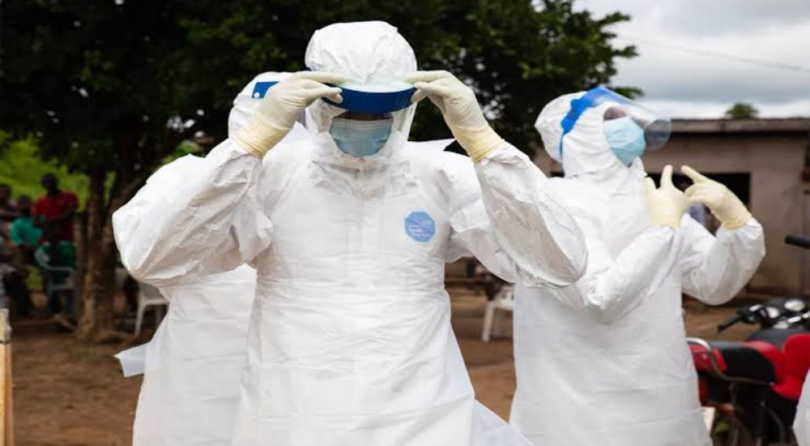
Amid the discovery of an index Ebola case in Nigeria, the country’s government listed ten states as high-risk.
The states affected include Lagos, the Federal Capital Territory (FCT), Rivers, Kano, Enugu, Borno, Akwa Ibom, Cross River, Taraba and Adamawa.
The agency attributed the risk to increasing international travel, regional population movement, porous borders, and uncertainty surrounding the full magnitude of the outbreak.
But THE WHISTLER analysis of the 2026 budgets of the high-risk states shows that disease control and management is not one of their spending priorities.
As of the time of this report, it was reported that the 42-year-old woman diagnosed with the Bundibugyo strain of Ebola virus disease was airlifted by a medical plane on Monday at about 6am from the Nnamdi Azikiwe International airport to Switzerland.
Despite this development, the Nigerian government has been actively reported to have commenced contact tracing, with 53 contacts linked to the confirmed case identified and isolated.
What Budget Documents Reveal
In 2026, Kano State budgeted N115 million for coordination of ‘communicable diseases’ at the Primary Healthcare Agency. As of half year, 2026, it spent N50 million, according to details published in budget performance documents seen by THE WHISTLER.
It budgeted a sum of N92.7 million to ‘promote an Integrated National Disease Surveillance System’ but spent nothing as of half a year, 2026.
The Kano State Centre for Disease Control and Prevention capital expenditure budget stood at N1.7bn for the 2026 fiscal year with only N72.9 million spent as of half year, 2026.
The state seemed to have prioritised routine immunisation across the state instead, budgeting N2.9bn but spending N1.5bn as of June, 2026.
According to the publication on the Adamawa State Primary Healthcare Development Agency website seen by THE WHISTLER, it was noted that one of its goals is to ‘control preventable diseases’, however despite a capital expenditure budget of N1bn, nothing was spent between January and June, 2026, by the agency.
Prior to this report, it was reported that the Enugu Public Health Emergency Operations Centre (PHEOC) which operates under the State Ministry of Health to coordinate disease surveillance, emergency preparedness and public health responses across seventeen local government areas, was put on alert over the Ebola virus discovery in Nigeria.
Analysis of budget documents published by the Enugu government shows that while N46.7bn was budgeted for its Ministry of Health, only N5.5bn was spent as of half year, 2026, representing 11.8% budget performance.
Hospitals have been said to be key and important in the management of infectious diseases such as Ebola, however budget documents show that while N17.9bn was budgeted for the capital expenditure of the ‘Hospital Management Board’, only N600 million representing 3.3% budget performance was released as of half year, 2026.
In Borno State N35 million was budgeted for research on communicable diseases with zero naira released as of half a year, 2026. The State government also budgeted N24bn for the capital expenditure of ‘Kashim Ibrahim University Teaching Hospital ‘, a facility which may be the first port of call for initial symptoms of infectious diseases like Ebola, however, nothing was released as of half year,2026.
Despite a N87.6bn capital expenditure budget for the Borno State Ministry of Health and Human Services, only N6bn was released as of June, 2026. The ministry on its website had written that one of its mandates is ‘management of disease surveillance, control and response initiatives’.
In Taraba State, a sum of N63.3 million was budgeted for procurement of six ‘disease surveillance motor cycles in the state’, however, no money was released as of June, 2026. Another N107 million was budgeted for ‘purchase motor-vehicle for disease surveillance and response’, with zero naira released as of half year, 2026.
A sum of N2.6bn was budgeted as capital expenditure for the Primary Health Care Development Agency, Jalingo, with zero naira released between January and June, 2026.
The Ministry of Health budget itself stood at N30bn, with only N4.3bn spent between January and June, 2026.
Lagos State which is widely referred to as Nigeria’s commercial capital budgeted N2.5bn for its ‘Infectious Disease Research Institute (Construction of Infectious Disease Research Institute in Mainland, Yaba),and spent N1.5bn between January and June, 2026.
Another sum of N15.2bn was budgeted for ‘construction of public health epidemics (Infectious Disease Research Institute)’, but as of the end of June, 2026, only N2.6bn was spent.
The State Ministry of Health’s capital expenditure budget for 2026 stood at N155bn with N49.5bn spent as of half a year, 2026. The Primary Healthcare Board capital expenditure stood at N3.7bn with only N805 million spent as of June, 2026.
Cross Rivers State budgeted a sum of N300 million for ‘building of disease control and partners complex’ with nothing spent as of June, 2026.
The state budgeted N350 million for ‘upgrade of abandoned Tb hospital, Obubra to Infectious Disease Hospital. However, nothing was spent as of half year, 2026.
A sum of N20 million was budgeted for ‘prevention and control of communicable diseases’ with nothing spent as of half year, 2026.
The state budgeted N35.1bn for its Ministry of Health’s capital expenditure but spent only N651 million as of half year, 2026.
The State Primary Healthcare Development Agency’s capital expenditure budget stood at N2.9bn with only N138 million spent as of half year, 2026.
Earlier, the Federal Government directed hospitals nationwide to prepare isolation beds and strengthen infection prevention measures as part of efforts to contain the Ebola outbreak, warning that 15 states are yet to update their response plans.
The Coordinating Minister of Health and Social Welfare, Prof Muhammad Pate, gave the directive in Abuja during a press briefing on the government’s response to the outbreak, saying health facilities had been instructed to make adequate provisions for suspected cases and protect frontline health workers.
Again, while briefing the National Economic Council, he said 21 states had already accelerated preparations and strengthened their capacity to respond to the possible spread of the diseases and warned the remaining 15 states to speed up their preparations.