
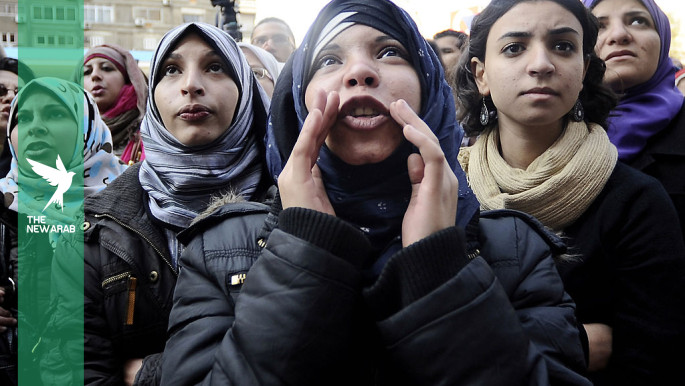
In Egypt, this conflation of criminality with disorder is particularly dangerous because it intersects with both social and legislative structures that already disadvantage survivors, writes Esra Saleh. [GETTY]
A surge of testimonies against sexual offenders was shared
Since most of the alleged perpetrators of these crimes belong to the so-called intellectual communities—writers, artists, media figures, and circles often perceived as enlightened or progressive—a troubling pattern has re-emerged in public discourse during the process of naming and shaming. They are either deliberately or unknowingly being described as “mentally ill” or “unstable,” as if mental illness were the only plausible explanation for violence against women.
At first glance, this might seem like a reasonable attempt to explain the incomprehensible acts of sexual violence. After all, if someone commits such harm, surely they must be “abnormal” in some way. But seeing this framing within a culture that normalises violence against women makes it profoundly problematic.
Alibi
When we label an offender as a “sick” person, we suggest that the environment is fine, but this one individual has a sort of “virus” that makes them commit this crime. However, the crimes of sexual violence often take place with a chilling level of logic.
Sexual violence, a term used to describe any unwanted behaviour of a sexual nature, is primarily about dominance and control rather than uncontrollable desire. According to the Association of Alberta Sexual Assault Services, it comes as a result of ‘power imbalances that stem from attitudes and beliefs about those who are valued in our society and those who are not.’ Additionally, it cannot be seen as an isolated event, but rather ‘a pattern of behaviour that is upheld by systems of oppression.’
When a sexual predator uses their status to coerce a younger peer, they are performing a calculated act of power.
Because this is a performance of power, it is a series of calculated decisions: whom to target, how to isolate them, and in some cases how to use “gaslighting” afterwards to ensure silence. When we use the word “sick”, we provide a medical alibi for a moral and legal choice. We suggest the offender is a victim of their own brain, rather than a master of their own actions.
The major problem with this approach is that it takes sexual violence from the framework of criminality and sees it as a crime related to gender power dynamics. It views the rapist or harasser as a person with a mental disorder, which evokes pity rather than holding them accountable.
This delegitimises the survivors’ experiences. When the focus is on the “instability” of the offender, the narrative shifts from the survivor’s trauma to the perpetrator’s struggle.
The medicalisation of the crime fosters a sense of fatalism that sexual violence is a product of pathology, inevitable, and beyond social or legal intervention. The conversation, then, shifts into how to “fix” them rather than how to achieve justice for the survivor.
This does not deny the possibility that some mentally ill people could be complicit in sexual abuse and violent acts. However, considering mental health disorders as the first reference for sexual violence strips out the systemic nature of gender-based violence as a primary lens for such crimes.
Furthermore, putting sexual violence with mental health disorders on the same footing reinforces the stereotype that people with mental illnesses are inherently violent or dangerous, and thus, perpetuates the stigma upon people living with actual mental health conditions.
Context matters
In Egypt, this conflation of criminality with disorder is particularly dangerous because it intersects with both social and legislative structures that already disadvantage survivors.
Egyptian society often frames women’s bodies and behaviours as spaces requiring moral surveillance, which is further backed by a restrictive political environment, as demonstrated in the crackdown on “TikTok girls,” for example. At the same time, male violence is mostly excused as an individual deviance rather than a systemic issue. Suggesting that sexual harassers are mentally ill implicitly positions them outside the social norms that should govern behaviour.
Such a framing, paradoxically, sustains a culture of impunity by making sexual violence appear exceptional and unrepresentative, rather than a pervasive and addressable societal problem.
It is also worth questioning why society prefers explanations that individualise and medicalise sexual violence. There is comfort, perhaps, in thinking that rapists are “sick” people rather than acknowledging that violence against women is normalised in many aspects of everyday life. Acknowledging systemic factors is uncomfortable because it calls for collective responsibility and structural change.
Legally speaking, a crime is generally established through three essential elements: the legal element (that the act is defined and prohibited by law), the material element (the act itself and its harmful consequence), and the moral element, often referred to as criminal intent (mens rea). Intention is therefore central to confirming that the act was committed with awareness and will, and thus to attributing responsibility.
Replacing the word “criminal” with “sick” dilutes the legal gravity of these actions. This casts a doubt on this moral element and suggests that the solution is a therapist’s couch rather than a prison cell.
This should also be seen within a broader context where survivors of sexual harassment are facing death threats for going public, like the recent case of Mariam Shawky, or husbands killing their wives, having the jury’s compassion and reduction of sentences instead of the legally stated life imprisonment.
Understanding the full context here explains how the entire culture is normalising violence against women, and the social mindset is already prepared to accept it and excuse the predator.
When the discourse pivots to the “psychological state” of an offender, it leaves survivors unprotected, as society often becomes more concerned with the perpetrator’s reputation than the survivor’s safety. As a result, cases can be dismissed or treated leniently under the guise of “mental illness”, which further reinforces weak law enforcement and a lack of accountability
Sexual violence must be recognised for what it is: a means of dominance and subjugation. As we continue to support the brave voices coming forward, we must be precise in our language. We need to acknowledge that a sexual abuser is not a patient in need of clinical curiosity. They are criminals who have committed a crime that should be addressed in court. Furthermore, accountability is not a medical matter but a social and legal obligation. To break the cycle of violence, we must stop excusing it.
Esra Saleh is an Egyptian feminist journalist and media researcher, and the producer and host of Salmon Podcast. Her work explores how gender, media, and social change intersect, combining research, storytelling, and activism. She holds a Master’s in Gender and Media from the University of Sussex, UK, and a Master’s in Journalism and New Media from the Jordan Media Institute. An experienced gender and media consultant and trainer.
Follow Esra on LinkedIn
Have questions or comments? Email us at: editorial-english@newarab.com
Opinions expressed in this article remain those of the author and do not necessarily represent those of The New Arab, its editorial board or staff.