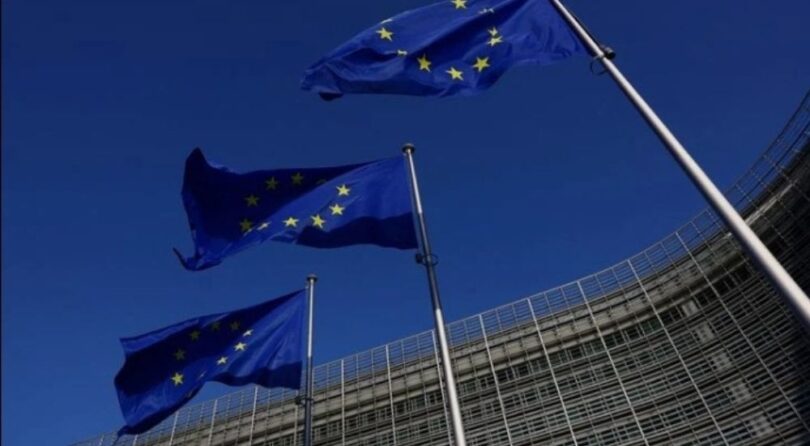
The European Union has reached a political agreement to widen its sanctions regime against Iran, specifically targeting individuals and entities responsible for obstructing freedom of navigation in the Strait of Hormuz.
According to two EU diplomats who spoke to Reuters on Monday, ambassadors approved changes to the existing Iran sanctions framework.
The new criteria will allow the EU to impose asset freezes and travel bans on those involved in blocking the vital waterway.
“There was a political agreement among ambassadors that we indeed would change the criteria in Iran’s sanctions regime so that we could also list persons and entities that are responsible for the obstruction of the freedom of navigation in the Strait of Hormuz,” one diplomat said.
The European External Action Service (EEAS) is now expected to prepare the actual listings, a process that could take several weeks.
The move comes amid the ongoing U.S.-Israel war on Iran, which began on February 28, 2026. Iran has largely blocked the Strait of Hormuz for nearly two months in response to U.S. and Israeli military actions.
The strait is a critical chokepoint through which about one-fifth of the world’s oil and liquefied natural gas (LNG) supplies normally pass. The disruption has caused significant volatility in global energy markets.
Iran briefly allowed some tankers through on April 17, but traffic remains heavily restricted, with recent reports of only a handful of ships transiting in a 12-hour period.
A fragile two-week ceasefire is currently in place but faces uncertainty following the US seizure of an Iranian cargo ship near the strait.
EU foreign policy chief Kaja Kallas
has also urged strengthening the EU’s naval mission in the Middle East.