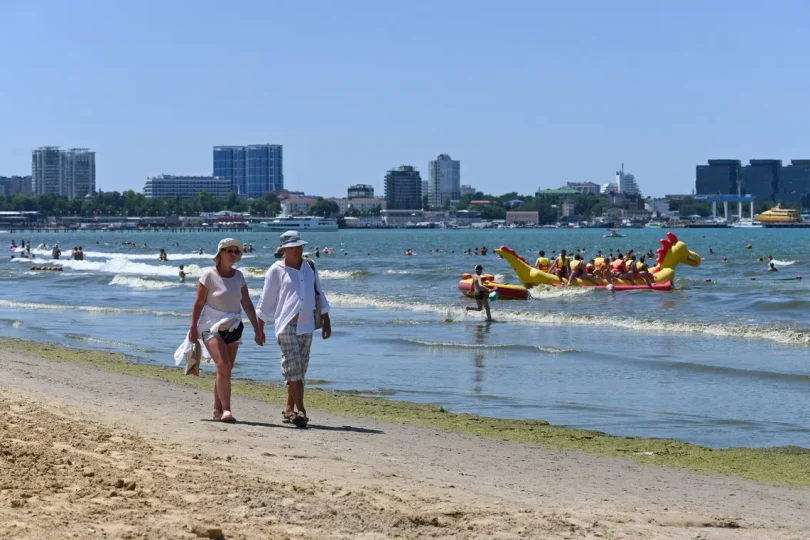
ANAPA, Russia, July 31 – Children paddle in the warm waters of the Black Sea and sunbathers crowd the beaches. But this is no ordinary holiday season in Russia.
In the fifth summer of the Ukraine war, Russians are having to contend with widespread gasoline shortages and the risk of drone attacks as they plan their annual break in the sun.
The uncertainty is taking its toll on the travel and leisure sector, according to industry data, with a million cancelled bookings to Russian-annexed Crimea as of the end of June.
Anton Sidorov, owner of the “Adrian” bistro in Anapa, southern Russia, said he had remained closed in May and June because of a lack of customers. He told Reuters this week that he had given up plans to open at all this season.
“I don’t see any point,” he said.
Tourists interviewed by Reuters in Anapa, known for its seafront promenade and long sandy beaches, said security considerations had become an integral part of holiday planning.
Elmira, a young woman from Moscow, said she and her husband had checked online to make sure that nothing “alarming” was going on in the resort.
“We decided to take the chance – we came here and we have no regrets,” she said. Still, the couple were ready in case of any air raid alert, and “we’re keeping track of where to go and what to do if something happens”.
The cautious mood is proof that the war, which many Russians long tried to ignore, has become almost impossible to escape even when they are trying their best to relax.
During a five-day visit to Russia’s Black Sea coast earlier in July, Reuters reporters received missile threat warnings on their mobile phones every day and heard air raid sirens twice. Most beachgoers barely reacted, with such alerts now common in many Russian cities.
Ukraine, whose own cities have been under repeated attack since Moscow launched its full-scale invasion in 2022, says it is “bringing the war back home to Russia” by intensifying drone strikes deep inside the country. The fuel shortages are one consequence of frequent attacks on Russian oil refineries.
TOUGH TIMES FOR HOTEL AND RESTAURANT INDUSTRY
Karina, a hotel owner who declined to give her last name, said she had only 17 guests at a time when she would normally have expected 300 to 350. “This isn’t just a bad season – it’s a collapse,” she said.
Others are faring better. Anita Kokourova, manager of the Dream Hotel Anapa, said occupancy was close to 100%, though she described the market as highly volatile.
“The booking window has shortened, and people are no longer willing to plan ahead, not only because they hope to find a cheaper vacation, but also because they do not know what tomorrow will bring,” she said.
The gasoline situation was causing some inconvenience, she said, but “fuel is not running out and gas stations are not closing, so I do not see it as a real problem”.
Kokourova said the current season was better than 2025, partly thanks to people opting to holiday in Anapa rather than nearby Crimea.
Crimea, which Russia captured from Ukraine and annexed in 2014, received 7.4 million tourists in 2025. But this year it has seen acute fuel and power outages resulting from attacks that Kyiv says are aimed at isolating the peninsula and weakening Moscow’s war effort.
Russia’s Association of Tour Operators (ATOR) said the cancellation of around one million trips to Crimea by June 30 had resulted in lost bookings worth up to 25 billion roubles ($320 million).
The association has asked the government to allow refunds to be spread out until the end of the year rather than paid immediately, calling the measure “a matter of survival for tour operators and hotels”.
More Russians are choosing to holiday abroad, according to ATOR. In package tour sales for July, Turkey was the top destination with 37.7% of sales, followed by Egypt with 21.3% and Russia on 9.6%, down from 18.4% in the same month last year.
ANAPA LOCALS TRY TO STAY CHEERFUL
In Anapa, some of those who depend on tourism were putting on a brave face.
“Yes, there are problems, just as there are for everyone else, but they can be managed. You just have to think ahead a little more and deal with the issue in advance,” said Konstantin, a tour guide.
While waiting in line at fuel stations, “you can chat with people, meet someone new, spend some time together”, he said.
Some tourists, however, acknowledged feeling uneasy.
“Yes, we’re concerned, but we’re not hiding anywhere or leaving,” said a young man from Belgorod, a Russian region that has come under frequent cross-border attack from Ukraine.
“We stay where we are and try to remain alert… Yes, we’re afraid, but we’re hoping for the best.” REUTERS