
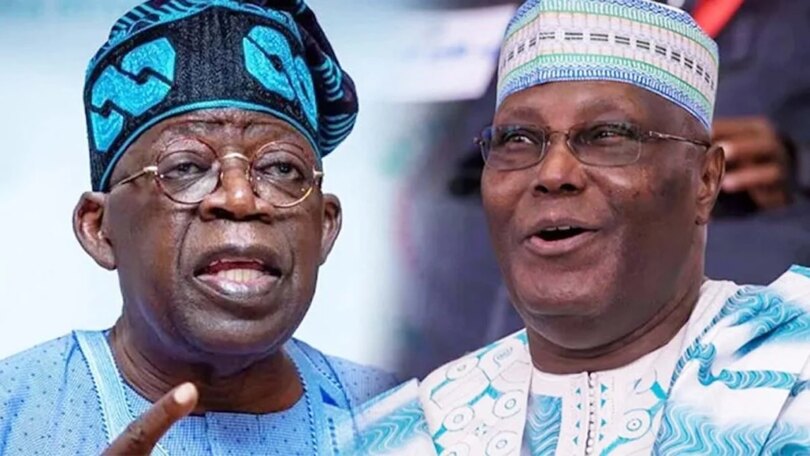
The All Progressives Congress Presidential Campaign Council (APC-PCC) has challenged the presidential candidate of the African Democratic Congress, Atiku Abubakar, to explain the legal, fiscal and operational framework behind his proposal to reintroduce a fuel subsidy.
Politics Nigeria reports that the council’s spokesperson, Dele Alake, made the demand in a statement issued on Saturday, following Atiku’s renewed call for measures to reduce the cost of petrol and diesel through support for locally refined petroleum products.
Atiku had earlier reaffirmed his commitment to restoring a targeted fuel subsidy if elected president in 2027, saying the policy would support local production, reduce energy costs and restore Nigerians’ purchasing power.
But Alake argued that the proposal raises questions about how government would legally impose conditions capable of translating production support into lower pump prices.
He cited Section 205(1) of the Petroleum Industry Act, 2021, which provides that wholesale and retail prices of petroleum products should be based on unrestricted free-market conditions.
This was just as the Nigerian Midstream and Downstream Petroleum Regulatory Authority also reiterated on Saturday that it does not fix petrol pump prices, stating that government intervention in pricing is restricted to exceptional circumstances involving formally declared market failure.
According to Alake, Atiku should therefore explain whether refineries receiving the proposed subsidy would be required to sell petrol at a government-prescribed price.
“If the answer is yes, he should identify the legal framework under which the government would impose that price condition and explain how it would operate consistently with the Petroleum Industry Act,” he said.
“If the answer is no, he should explain how public support to refiners would guarantee lower prices at filling stations.”
The APC PCC spokesperson also demanded details of the cost and funding mechanism for the proposed intervention, saying any preferential pricing of crude for domestic refineries could reduce revenue accruing to the Federation.
He said the potential cost of the proposal could run into trillions of naira annually, depending on the level of crude discount, the volume covered and whether the intervention applies to the entire crude barrel or only petrol sold domestically.
Alake listed the issues he said Atiku should clarify, including the proposed subsidy rate, annual spending ceiling, volume of crude or petrol covered, funding source, mechanism for guaranteeing lower pump prices, safeguards against diversion and smuggling, and whether amendments to the PIA would be required.
He further questioned Atiku’s current position in light of his previous support for downstream deregulation.
According to Alake, Atiku described the petrol subsidy system as fraudulent at the Lagos Business School in November 2022 and pledged to complete its removal. However, Atiku has since made clear that he intends to restore a targeted subsidy if elected.
Atiku wrote on August 25, 2026, that his position on subsidy “has not changed” and that he would restore it, arguing that Nigeria should use its resources to cushion citizens from economic hardship.
The APC PCC also linked the subsidy debate to the evolution of Nigeria’s downstream petroleum reforms, noting that diesel was deregulated in 2003 and aviation fuel subsequently moved to market pricing, while petrol remained under the subsidy regime until its removal by the Tinubu administration.
Alake contrasted Atiku’s proposal with the Tinubu administration’s focus on alternative energy, particularly compressed natural gas and electric mass transit, as measures aimed at reducing transportation costs.
He said the government had converted more than 120,000 vehicles to CNG and was expanding related infrastructure in collaboration with state governments.
The APC PCC spokesperson acknowledged the pressure caused by higher petrol prices but maintained that the administration would continue pursuing policies intended to cushion Nigerians.
He also urged Atiku to publish a detailed policy document and obtain an independent legal and fiscal assessment of the proposed subsidy.
“Every proposed intervention in the downstream sector must be lawful, transparent, properly costed and capable of delivering measurable benefits to consumers,” Alake said.
He maintained that until Atiku provides details on how the proposal would be funded and implemented within Nigeria’s existing petroleum laws, the plan remains without a clearly defined legal and operational framework.