LONDON – Andy Burnham’s return to the House of Commons means UK Prime Minister Keir Starmer is facing an unprecedented challenge to his leadership from within his Labour Party.
The premier’s position was already hanging by a thread after a series of missteps, unpopular policy decisions and disastrous local election results prompted almost a quarter of his Labour MPs to call for him to go.
Now, the Greater Manchester mayor’s ample victory over Reform in a special election in Makerfield, northern England, proves to his party that he can galvanise parts of the electorate that Starmer can no longer reach.
He won in an area where Nigel Farage’s Reform UK had secured a clean sweep of council seats in local elections just six weeks earlier.
Burnham has said he’ll join any leadership contest against Starmer, and it seems certain he has the backing of the 81 MPs he needs to do so.
But his allies have already been lobbying cabinet ministers to persuade Starmer to step down rather than contest a challenge.
Their hope is that Burnham would then stand unopposed, securing an effective coronation.
If Starmer does choose to fight – as he says he will – removing a Labour leader remains a difficult business, especially when they also hold the power of the prime minister’s office. That may explain why it’s never happened in the party’s 126-year history.
Here’s a look at the process:
Labour’s traditional rivals, the Conservatives, made a habit of swapping prime ministers in recent years, cycling through Theresa May, Boris Johnson and Liz Truss.
No Labour premier since Ramsay MacDonald entered Downing Street in 1924 has been formally challenged by his own MPs while in charge of the government.
That said, some Labour prime ministers have stepped aside in the face of overwhelming pressure from parliamentary colleagues, as was the case with Tony Blair in 2007.
The only time Labour has had a contested leadership election while in government was in 1976, following the unexpected resignation of then-Prime Minister Harold Wilson.
After less than two years in office, Starmer has logged the lowest satisfaction ratings of any prime minister for half a century.
His polling numbers plunged after a series of controversial policy moves, including tax hikes that undercut his pro-business image and spending cuts that alienated the Labour base.
A disastrous decision to appoint Peter Mandelson to be ambassador to the US – only to fire the Labour grandee after Bloomberg revealed new details about his relationship with late sex offender Jeffrey Epstein – raised new questions about Starmer’s judgment.
That’s unfolded against the backdrop of a fracturing political landscape.
In May, voters flocked to insurgent populist parties Reform and the Greens in English local council elections, and to nationalist parties in votes for the devolved assemblies of Wales and Scotland.
Many Labour backbenchers fear they could lose their seats without a leader who can better connect with voters.
Moreover, Starmer’s own role in removing former Labour leader Jeremy Corbyn from the party in 2020 has earned him the lasting enmity of some on the left.
Starmer has said he won’t quit as Labour leader. If he defies any further calls to step down, his would-be challengers such as Burnham have to overcome several hurdles. First, they must hold a seat in Parliament – hence the importance of the Makerfield contest.
They then need to secure nominations from 20 per cent of Labour members in the House of Commons, or 81 MPs, according to the party’s internal rule book.
They would also need the support of 5 per cent of constituency Labour parties – the party’s local, grassroots bodies – or at least three of Labour’s affiliated organizations, two of which must be trade unions.
Starmer would automatically be on the ballot unless he chooses instead to stand down.
In addition to Burnham, potential contenders include Wes Streeting, the ambitious former health secretary, who hails from Labour’s center-right and has said he will run, and Angela Rayner, the former deputy prime minister, who is popular on the left of the party.
Other possible candidates include Home Secretary Shabana Mahmood, ex-armed forces minister Al Carns and former Defence Secretary John Healey.
Starmer has repeatedly shown a willingness to use the power of incumbency to resist efforts to depose him.
When Burnham previously sought to run for a vacant Commons seat that would give him a platform to mount a leadership challenge, a party committee controlled by Starmer blocked him.
When the loss of that seat prompted calls for the prime minister’s resignation, he rallied the cabinet to shore up his position.
Starmer’s allies have signaled that he will appeal to the markets, where an adverse reaction could help turn back a challenge. Concerns about political instability have already been blamed for increasing the premium on UK government debt.
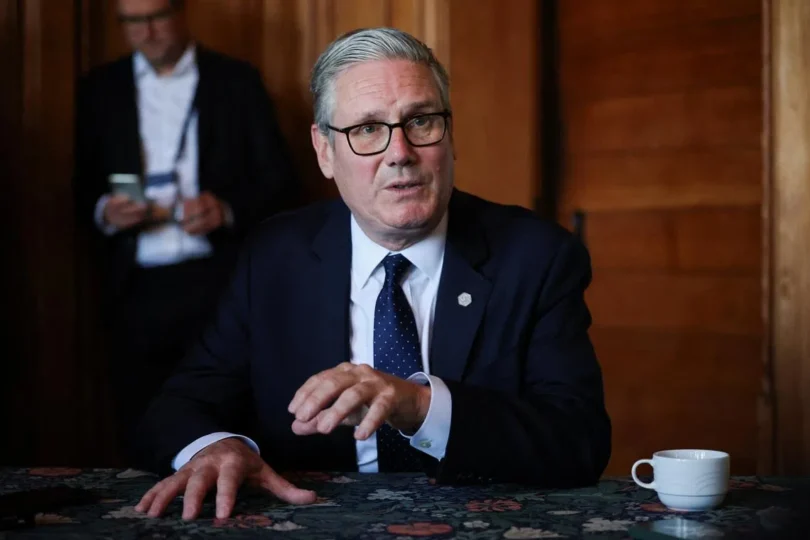
Andy Burnham’s (above) ample victory over Reform in a special election in Makerfield, northern England, proves to his party that he can galvanise parts of the electorate that British Prime Minister Keir Starmer can no longer reach.
PHOTO: AFP
Starmer and Chancellor of the Exchequer Rachel Reeves have defined their agenda by their commitment to self-imposed fiscal rules meant to reassure investors they won’t borrow too much. Speculation that Britain might be about to install a new, more left-wing government has periodically prompted surges in gilt yields in recent months.
An aspiring Labour leader could, for instance, embrace broader support to soften the impact of soaring energy prices or encourage higher defense spending by considering such outlays outside of the fiscal rules.
Grassroots Labour members and affiliated supporters, which includes members of major labor unions and various socialist societies, would have the final say.
Eligible voters need to have been members of their organisations for at least six months prior to the timetable for the vote being announced.
Each member of the party or affiliated body gets to cast a single vote, and ranks the candidates according to their preferences. If no candidate secures more than half of voters’ first preferences, the lowest-placed candidate is eliminated and their votes are redistributed until there is a winner. Ironically, a sharp decline in Labour membership under Starmer – to fewer than 250,000 from 330,000 previously – may actually help his cause in any leadership vote, as those who remain are seen as more likely to support the status quo.
The timetable for a vote would be agreed by Labour’s governing body, the National Executive Committee. When Corbyn announced he was stepping down and triggered the party’s last leadership election in December 2019, the timetable for the vote was published in January 2020. The winner – Starmer – was declared in April that year.
That suggests a similar contest, especially one where the sitting leader decides to fight, could take several months to play out. BLOOMBERG