The Federal Government, in partnership with the World Bank and the Ekiti State Government, has officially flagged off the Nigeria for Women Project Scale-Up (NFWP-SU) and the disbursement of Community Investment Funds (CIF) to Women Affinity Groups in Ekiti State.
The launch, led by the Minister of Women Affairs and Social Development, Hajiya Imaan Sulaiman-Ibrahim, marks a major expansion of the Federal Government’s women empowerment and financial inclusion agenda under the Renewed Hope framework.
Speaking during the event in Ekiti State, the Minister described the intervention as a major shift from policy conversations to practical economic impact for women and families across communities.
“There are moments in the life of a nation when policy becomes present and presence becomes impact, when government ceases to be distant and becomes wealth in homes. It becomes felt in markets, it becomes felt on farms and it becomes felt in the enterprises of the people. Today is such a moment,” she said.
The Nigeria for Women Project Scale-Up is designed to tackle structural barriers limiting women’s participation in economic activities, particularly access to finance, markets, land ownership opportunities and productive enterprise support.
According to the Minister, the first phase of the programme reached more than 450,000 women across Nigeria, while the current scale-up phase is targeting approximately five million women nationwide.
She explained that the project goes beyond direct funding and focuses on building sustainable economic systems around women through organised community structures known as Women Affinity Groups.
“This programme is designed to expand financial inclusion, to strengthen enterprise development, to build skills and to deepen community-based economic organisation through the Women Affinity Groups,” she stated.
The Minister disclosed that implementation activities in Ekiti State, which began in June 2024, have already produced close to 1,500 Women Affinity Groups involving over 25,000 women actively participating in different productive ventures and income-generating activities.
According to her, the programme is already creating visible economic outcomes at the grassroots level through savings culture, investment participation and enterprise development among women.
“These figures represent women who are earning, women who are saving, women who are investing, women who are supporting their households and strengthening local economies,” she added.
A major highlight of the initiative is the Community Investment Fund, which the Minister clarified is different from traditional grants or commercial loans.
She described the CIF as a structured community financing model directly managed by women groups themselves under transparent and collective accountability systems.
“The CIF is not a handout, not a conventional loan. It is structured community capital, disbursed directly to Women Affinity Groups, managed by them with transparency and shared responsibility,” she explained.
The Minister also linked the programme to President Bola Ahmed Tinubu’s declaration of 2026 as the Year of Families and Social Development, noting that women empowerment remains critical to economic stability, poverty reduction and community development.
According to her, strengthening women economically creates stronger households and more resilient communities.
“When women rise, a family is strengthened. When families strengthen, our communities flourish. When our communities flourish, our nation will prosper,” she said.
Ekiti State Governor Biodun Abayomi Oyebanji, who also spoke during the launch, described the event as the fulfilment of the state government’s earlier commitment towards joining the programme.
The Governor recalled that Ekiti State contributed ₦450 million in 2024 as part of the qualification requirements for participation in the initiative.
“In 2024, for us to qualify, we paid the sum of 450 million naira because that was the requirement for a state to qualify,” Oyebanji stated.
While commending the Minister for ensuring the rollout of the programme in the state, the Governor expressed dissatisfaction over earlier delays in implementation and called for improved responsiveness from development partners involved in similar intervention projects.
“Between then and now, it was a motion without movement, but I thank the Honourable Minister for making this possible,” he said.
Oyebanji also revealed that positive feedback and testimonies from beneficiaries had encouraged the state government to support a wider expansion of the initiative across all sixteen local government areas in Ekiti State.
“Whatever is going to cost us as a state to ensure that this programme goes to all the 16 local governments, we are ready to do it,” the Governor added.
Representing the World Bank Country Director, Senior Social Development Specialist and Task Team Leader, Michael Ilesanmi, said the Nigeria for Women Project was developed after studies showed that financial assistance alone could not fully solve the deep-rooted challenges affecting women’s economic participation in Nigeria.
According to him, women face several interconnected barriers ranging from social norms and economic exclusion to gender-based violence risks and leadership limitations.
“Women in Nigeria face multiple complex barriers to empowerment, and we recognise that financial support alone is not enough to address the structural barriers that women face in participating in the economy,” he said.
Ilesanmi explained that the Women Affinity Group framework was intentionally designed to combine savings mobilisation, access to credit facilities, enterprise support, leadership training and community social support systems under one structure.
He added that the project also focuses on addressing harmful social norms that continue to limit women’s economic opportunities in several communities.
“The project utilises Women Affinity Groups as platforms to build women’s human, financial and social capital. The NFWP recognises that addressing social norms, social constraints and the risks of gender-based violence are just as important as providing financial support,” he stated.
According to him, the programme is also deploying community engagement strategies involving traditional rulers, religious leaders, media campaigns and policy advocacy to strengthen institutional support for women across participating states.
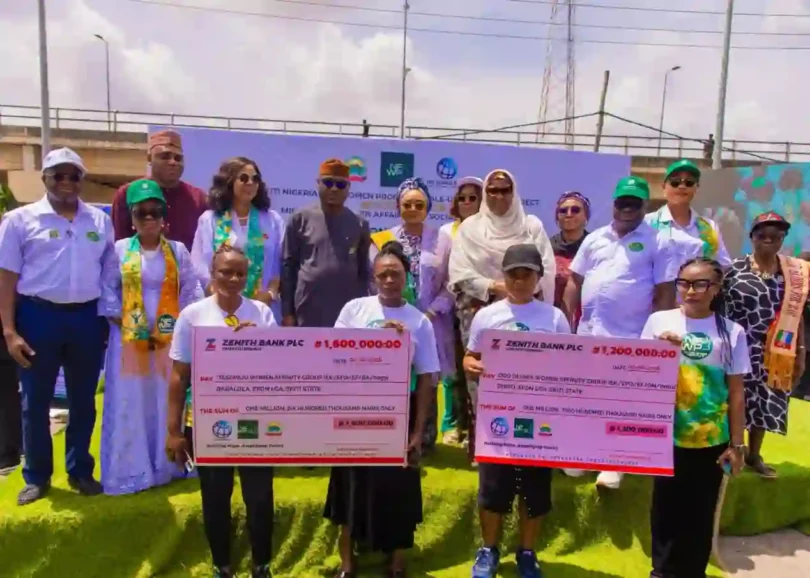
The high point of the event was the symbolic disbursement of Community Investment Funds to 142 mature Women Affinity Groups in Efon Local Government Area of Ekiti State.
For many beneficiaries, the programme represents more than financial access. It reflects a broader economic support structure focused on enterprise growth, collective savings, social inclusion and long-term family resilience.
Stakeholders at the event described the launch as an important transition from federal policy discussions to direct grassroots economic action capable of improving livelihoods for women across local communities.
The programme also aligns with the Federal Government’s broader poverty reduction and enterprise development strategy under the Renewed Hope Agenda, with women positioned as central drivers of household economic stability and local economic growth.
The Ekiti Nigeria for Women Project Scale-Up initiative operates as a tripartite partnership involving the Federal Ministry of Women Affairs and Social Development, the Ekiti State Government and the World Bank.
As implementation expands across the state, attention is expected to focus on how effectively the programme can sustain enterprise growth, deepen financial inclusion and strengthen the economic participation of women in local communities.
For the Federal Government and development partners, the long-term success of the initiative will likely be measured not only by the number of participating women groups but also by visible improvements in household income, business sustainability and stronger community economic structures across Ekiti State.