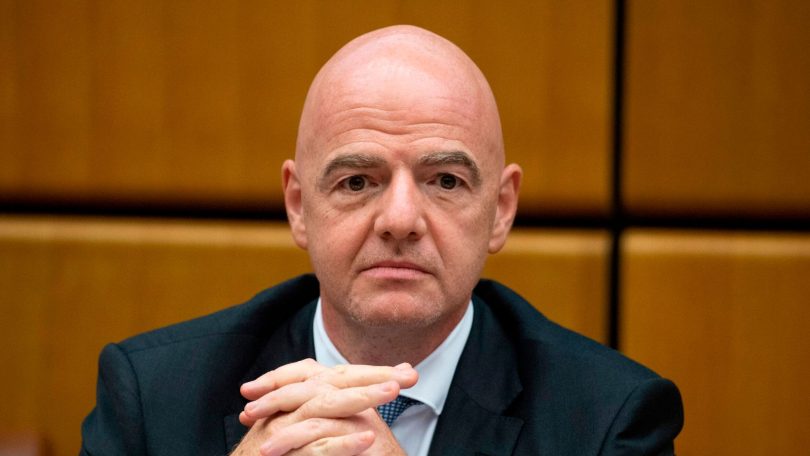
Mr Infantino says the world football body’s judicial panels operate independently and insisted he did not influence the decision to suspend the implementation of Folarin Balogun’s automatic World Cup ban
FIFA President Gianni Infantino has defended the independence of the organisation’s disciplinary process following intense criticism over the decision to suspend Folarin Balogun’s automatic World Cup ban.
Breaking his silence on one of the 2026 FIFA World Cup’s most contentious issues, Infantino confirmed he had spoken with U.S. President Donald Trump regarding Balogun’s case. However, he maintained that the final decision rested entirely with FIFA’s independent judicial bodies.
“I have seen the public comments regarding the decision of the independent FIFA Disciplinary Committee related to the suspension of Folarin Balogun, and I would like to reiterate a fundamental principle of FIFA’s governance,” MMrInfantino said in a statement.
“IFA’s judicial bodies are independent. They operate autonomously, apply the FIFA Disciplinary Code, and decide cases based on the applicable regulations and the specific facts before them.”
The FIFA president emphasised that protecting this independence is essential to the credibility of world football. “Their independence is essential to the integrity of football, and this must always be respected,” he added.
MMrInfantino’s statement comes hours after President Trump publicly admitted to asking FIFA to review the red card issued to Balogun, arguing that the U.S. striker had been treated unfairly.
Earlier, President Trump suggested that Balogun’s dismissal from Bosnia and Herzegovina resulted from an accidental collision rather than serious foul play. He confirmed that he had personally contacted a FIFA official to request a review of the incident.
Acknowledging the call, MMrInfantino stressed that no political leader can interfere with the judicial process.
“Yes, I regularly discuss matters related to the FIFA World Cup with the President of the United States,” he said. “On this matter, I did receive a call from President Donald Trump, just as I receive calls from heads of state, government officials, football stakeholders, and business executives from around the world on many different issues.”
According to MMrInfantino, he informed the U.S. president that the case was already before FIFA’s disciplinary bodies.
“During our conversation, I explained that there was an ongoing legal process involving FIFA’s independent judicial bodies and that the case would be decided in due course by the competent authorities. That is how FIFA’s system works, and it is a principle that I will always uphold.”
Balogun was shown a straight red card during the United States’ Round of 32 victory over Bosnia and Herzegovina. Under FIFA regulations, players sent off are automatically suspended for their team’s next match.
However, the Disciplinary Committee later suspended the one-match ban imposed under Article 27 of the FIFA Disciplinary Code, allowing the striker to feature against Belgium in the Round of 16.
The decision has sparked widespread criticism. UEFA accused FIFA of “crossing a red line,” arguing that automatic suspensions for red cards are a fundamental principle of the game that should not be altered during the tournament.
Belgium, the United States’ knockout opponents, also questioned the ruling. Head coach Rudi Garcia stated that his team was “defending football” by challenging the decision. Former FIFA president Sepp Blatter also weighed in on social media, warning that “political phone calls do not overturn red cards and insisting that “football must never become a playground for political power.”
The controversy has become one of the defining governance issues of the tournament, with critics questioning why Balogun was treated differently from other players who served automatic suspensions for similar infractions.
Without commenting directly on the merits of the Balogun case, MMrInfantino stated that he does not always agree with the decisions of FIFA’s disciplinary bodies but respects their autonomy.
“I read the decisions of the FIFA Disciplinary Committee when they are issued,” he said. “Sometimes I am surprised by them. Sometimes I agree with them, and sometimes I disagree.”
The FIFA president maintained that personal opinions should never override established legal processes. “What I always do, however, is respect those decisions and the autonomy of the bodies that make them. Whether we personally like a decision or not is irrelevant. Respect for independent institutions and the rule of law is what protects the integrity of our competitions and the credibility of FIFA at all times.”
While MMrInfantino’s statement seeks to reassure the football world that FIFA’s disciplinary system remains independent, the debate surrounding Balogun’s eligibility is unlikely to subside.- Would you like me to draft an accompanying email to the newsroom or an introduction for the publication?
“I read the decisions of the FIFA Disciplinary Committee when they are issued,” he said. “Sometimes I am surprised by them. Sometimes I agree with them, and sometimes I disagree.”
The FIFA president maintained that personal opinions should never override established legal processes. “What I always do, however, is respect those decisions and the autonomy of the bodies that make them. Whether we personally like a decision or not is irrelevant. Respect for independent institutions and the rule of law is what protects the integrity of our competitions and the credibility of FIFA at all times.”
While Mr Infantino’s statement seeks to reassure the football world that FIFA’s disciplinary system remains independent, the debate surrounding Balogun’s eligibility is unlikely to subside.