Argentina will face an investigation into the ugly scenes
at the end of the World Cup final, FIFA has confirmed, after members of the team and backroom staff clashed with Spain players moments after the final whistle at MetLife Stadium on Sunday.
FIFA’s disciplinary committee has appointed a disciplinary and ethics prosecutor to assess what happened, with any player or coach implicated facing possible suspension, while the Argentine Football Association (AFA) could also face a fine.
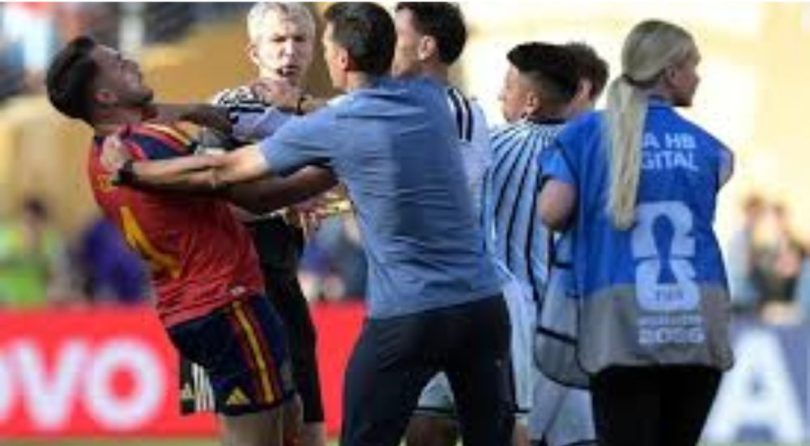
The trouble began as the final whistle blew following Spain’s 1-0 extra-time win. As Spain’s players raced across the pitch in celebration, several Argentina players – including Lionel Messi – slumped to the turf while others stood motionless.
Rodri, who had been substituted in extra time, ran from the dugout to join his teammates, and as he passed Argentina defender Nahuel Molina, Molina appeared to punch him on the arm or stomach.
This was the fuse which ignited the trouble. Rodri confronted Molina, but it was the Argentina player who thrust forward in an aggressive manner.
Eric Garcia ran over to back up his teammate, at which point Leandro Paredes got involved too, jabbing Garcia in the throat. Unused substitute Gavi tried to intervene, only to be forced to the ground by Thiago Almada.
Paredes then pushed Gavi to the floor by putting his hand in the Spaniard’s face. Roberto Ayala then looked to be holding Garcia around the throat.
He then appeared to strike Spain midfielder Dani Olmo.
It was initially reported by FIFA that Paredes had been sent off by referee Slavko Vincic after he pushed Spain’s Eric Garcia by the throat.
Paredes’ red card was removed from the record shortly afterwards and FIFA has confirmed to BBC Sport that no disciplinary action was taken at the time.
Argentina had already had one player dismissed, with Enzo Fernandez receiving a second yellow card in second-half stoppage time.
FIFA had already begun the process of potential disciplinary action against Argentina after their players held a banner in support of their country’s claims to the Falkland Islands following the 2-1 semi-final win against England.
“Paredes threw two or three haymakers into someone’s face. He went for them,” Alan Shearer said.
“There is no place or space for that. We know how much it means to them and we know how much it hurts to lose, but there is a way to lose.
“Too many times we have seen that from Argentina. The reaction after the final whistle is terrible,” Shearer added.
Joe Hart added, “The game’s done, they can have absolutely no complaints about what happened today. Disgusting behaviour.”
But Argentina boss Lionel Scaloni, who had attempted to calm the situation, appeared to play down the incidents in his post-match interview.
“We are gracious in victory, and we must be gracious in defeat,” he said.
“Today, we are showing that we know how to lose. We lost the match, and we accept it, but that doesn’t mean we stop living or forget everything we did to get here,” Scaloni added.
FIFA’s disciplinary committee has several options open to it. By appointing a disciplinary and ethics prosecutor, FIFA will look in more detail at offences rather than just potential violent conduct.
There is a greater chance of stronger punishment if players or the national association is charged and found guilty. Article 13 of the disciplinary code covers offensive behaviour and the principles of fair play.
The actions of the players and staff could be judged as “violating the basic rules of decent conduct” and “behaving in a way that brings the sport of football and/or FIFA into disrepute”.
The disciplinary and ethics prosecutor will take into account “both aggravating and mitigating circumstances”, and it has the power to enforce a ban globally.
FIFA used this clause to charge then-Spanish football federation president Luis Rubiales after kissing Jenni Hermoso on the lips after Spain’s Women’s World Cup final win against England.
Rubiales was banned from all football-related activities for three years in 2023 and lost an appeal to get it overturned.
Uruguay striker Luis Suarez was suspended from all football-related activity for four months for biting Italy defender Giorgio Chiellini at the 2014 World Cup.
It meant the Liverpool player missed the first nine games of the Premier League season. It is unlikely that Almada, Ayala, Molina and Paredes will face bans as long as this.
The AFA, however, has faced issues with the behaviour of its players in recent years. Argentina faced charges related to “offensive behaviour and violations of the principles of fair play” and “misconduct of players and officials” following the 2022 World Cup final.
The South Americans beat France on penalties but were criticised for the way they celebrated.
Aston Villa goalkeeper Emiliano Martinez made a lewd gesture with his Goalkeeper of the Tournament trophy, before being filmed in the dressing room mocking France star Kylian Mbappe.
Argentina were fined £18,300 and no action was taken against any player involved. But Martinez was banned for two games in 2024 for ‘offensive behaviour’ in World Cup qualifiers against Chile and Colombia.
Martinez repeated his infamous celebration using a replica Copa America trophy following a 3-0 win over Chile.
Four days later, he hit a camera with his gloves as a cameraman approached him on the pitch after a 2-1 defeat by Colombia.
Following Argentina’s 2024 Copa America win, Chelsea midfielder Enzo Fernandez was forced to apologise for a video he posted. The French Football Federation said the song was a “racist and discriminatory” chant.
At this World Cup, the AFA is already facing a probable fine for the banner held up after the England game. Their players celebrated while holding a cloth which read “Las Malvinas son Argentinas”, which translates as “The Falklands are Argentine”.