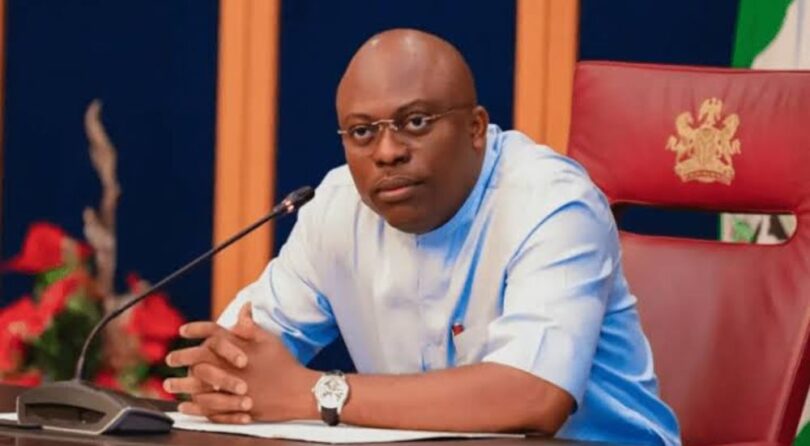
Rivers State Governor, Siminalayi Fubara, has used a high-profile gathering of traditional rulers in Port Harcourt to signal clear political alignment with President Bola Tinubu, urging support for the president’s second term while framing continuity as critical to national stability.
Speaking on Thursday at the opening of the Southern Traditional Rulers Council meeting, Fubara positioned his endorsement within a broader argument about governance consistency, warning against abrupt leadership changes amid ongoing reforms.
He told the gathering that Nigeria is “in capable hands,” emphasizing that the current administration’s economic and infrastructure initiatives require time and sustained backing to yield full results.
The event, held in Port Harcourt, brought together monarchs from across the 17 southern states, creating a politically significant platform that blends cultural authority with contemporary policy conversations.
The meeting was primarily convened to address regional concerns such as security, unity, and economic cooperation.
He pointed to ongoing federal projects, including coastal road development, as evidence of progress, and argued that policy continuity would help consolidate such gains.
Drawing on a sports analogy, the governor cautioned that “it is not ideal to change the goalpost in the middle of the game,” reinforcing his stance against political disruption.
Beyond national politics, Fubara also used the occasion to call for stronger regional cohesion.
He urged stakeholders in the South to pursue collective goals, noting that unity remains essential for long-term development and stability.
His comments come at a time when inter-state collaboration is increasingly seen as vital in addressing cross-border security challenges and economic disparities.
Chairman of the council and the Ooni of Ife, Adeyeye Enitan Ogunwusi, framed the gathering as part of an ongoing effort to strengthen peace and shared identity across the southern region.
He described the council as a reflection of Nigeria’s diversity, highlighting that over 400 dialects are spoken across the South.
According to the monarch, the Port Harcourt meeting marks the fourth in a series previously hosted in Imo, Ogun, and Lagos states, underscoring a growing institutional effort among traditional rulers to engage more actively in national discourse.
He added that the forum provides a platform to explore shared values and coordinate responses to pressing challenges.
The Ooni also indicated that discussions would include ways traditional institutions can support government efforts in tackling insecurity and economic pressures. Participation, he noted, remains voluntary but carries significant importance for shaping regional and national outcomes.
The meeting drew prominent traditional rulers from the South-South, South-East, and South-West, including co-chairman Eze Cletus Illomuanya and the Olubadan of Ibadan, Rashidi Adewolu Ladoja.
While the gathering officially centers on unity and development, Fubara’s remarks highlight how such cultural platforms are increasingly intersecting with political signaling ahead of future electoral cycles—blurring the line between traditional consensus-building and contemporary power dynamics.