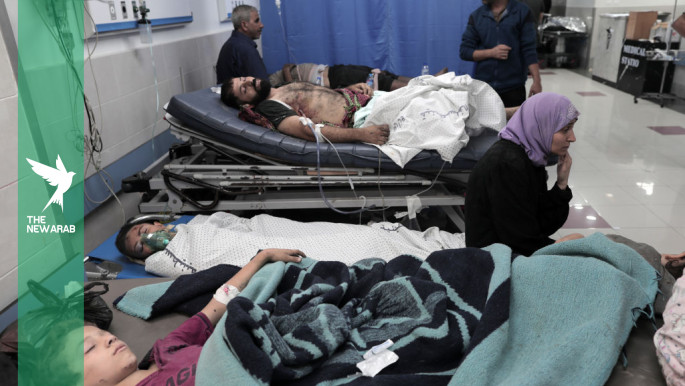
The Palestinian Ministry of Health in Gaza warned that laboratory and blood bank services are nearing systemic failure, with around 86 per cent of essential needs now unmet due to severe restrictions on the entry of medical supplies. [Getty]
In one of the dim corridors of Al-Aqsa Hospital in central Gaza, the soundscape of medicine has changed. The steady hum of laboratory machines that once guided doctors through diagnosis has faded into intermittent silence.
Inside the hospital’s laboratories, where early detection of disease is supposed to determine the line between treatment and deterioration, equipment stands idle or runs on rationed supplies.
Across the Gaza Strip, the same scene is being repeated in hospitals already stretched beyond capacity.
The Palestinian Ministry of Health in Gaza warned that laboratory and blood bank services are nearing systemic failure, with around 86 per cent of essential needs now unmet due to severe restrictions on the entry of medical supplies.
In a press statement released on Sunday, the ministry said that “86 per cent of the needs of laboratories and blood banks are at zero”, adding that “blood gas testing reagents have been completely depleted in the Al-Aqsa Hospital laboratory, while the remaining quantities in other hospitals will last only a few days”.
It also noted a wider crisis, including a 50 per cent shortage in medicines and a 57 per cent shortage of medical consumables, deepening the strain on an already fragile health system.
The collapse of diagnostic capacity is unfolding alongside physical destruction caused by Israel. According to Doctors Without Borders, around 90 per cent of Gaza’s health infrastructure has been destroyed or damaged during Israel’s genocidal war.
The organisation has warned that repeated attacks on medical facilities, combined with shortages of supplies, are pushing hospitals to the edge of functionality, with many either partially operating or completely out of service.
Diagnosis and delay
The consequences are immediate and increasingly life-threatening for patients.
52-year-old Mahmoud al-Najjar lies on a bed at Al-Aqsa Hospital, struggling to speak due to laboured breathing.
He has been hospitalised for severe respiratory complications that require continuous monitoring through blood gas analysis, a test that now depends on whether limited reagents are available.
“I used to do these tests almost every day […] Now they tell me the materials are not available, and they are prioritising only the most critical cases. I don’t even know if I fall into that category,” he told The New Arab. “Every day without a test is a risk. I feel like I am being left to fate. How can they treat a patient without knowing what is happening inside his body?”
Amna Rabah, a 34-year-old woman, waits in the hospital for a blood transfusion that has been delayed due to shortages of blood and testing supplies needed to ensure compatibility.
She has severe anaemia and reports that her condition has deteriorated during the wait.
“They told me there is a shortage in the tests needed before transfusion, and that it might be delayed”, she told TNA. “I feel dizzy most of the time. I need the transfusion urgently, but everything is uncertain now.”
“We are no longer only afraid of illness. We are afraid of the absence of treatment itself,” she added. “In Gaza, the disease is no longer the only problem […] The problem is that treatment itself is disappearing.”
Blockade, bottlenecks, and breakdown
The current breakdown cannot be separated from the broader political and logistical context. Despite the supposed ceasefire agreement reached between Israel and Hamas on 10 October 2025, the Gaza Strip remains under tight Israeli restrictions on the entry of goods, including medicines and laboratory supplies.
Palestinian health officials and international organisations say these restrictions continue to limit the flow of essential medical aid severely.
Mohammed Abu Silmiya, director of Al-Shifa Hospital in Gaza City, links the laboratory crisis directly to these constraints.
“Large-scale military operations have indeed slowed since the October 2025 agreement, but the blockade has not ended,” he told TNA. “There are still severe restrictions on medicines and medical supplies, including laboratory materials, and this has brought us to a dangerous stage.”
He added that the depletion of blood gas testing reagents is particularly alarming because of their central role in intensive care units.
“These are not optional tests. They are essential for patients in critical condition. Without them, we cannot properly assess oxygen levels, organ function, or the progression of disease,” Abu Silmiya explained.
“When supplies are delayed or denied, the health system does not simply slow down; it collapses. We consume essential materials daily without replenishment. That is not sustainable,” he stressed.
If current shortages continue, hospitals may face “near-total paralysis” in laboratory operations, with direct consequences for surgeries, emergency care, and intensive care management, according to Abu Silmiya.
Humanitarian data underscores the scale of the imbalance. Before Israel’s war, Gaza required around 500 trucks of goods per day, including food and medical supplies.
Since the ceasefire, the average has ranged from 80 to 120 trucks per day, according to UN and Palestinian health estimates.
Medical shipments represent only a small fraction of this total, with estimates suggesting just 10 to 15 trucks of medical supplies enter daily, far below operational needs for a population of more than two million people.
International health agencies have repeatedly warned that this level of aid is insufficient.
The World Health Organisation repeatedly called for the urgent removal of administrative and logistical barriers to medical entry, stressing that Gaza’s health needs are “enormous and rapidly increasing”.
At the same time, conditions in displacement camps are worsening the health burden. UNRWA reports a rise in skin infections such as scabies, alongside chickenpox and other communicable diseases, driven by overcrowding and lack of hygiene supplies.
The agency also warned of rodent infestations in several areas, including Khan Younis and northern Gaza, raising concerns over diseases such as leptospirosis and other bacterial infections.
As the crisis deepens, the Ministry of Health continues to appeal for urgent international intervention to prevent what it describes as the collapse of remaining laboratory and blood bank services.