
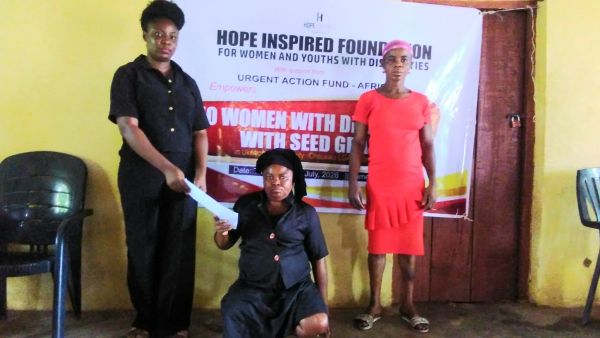
In Ukwagba and Ezillo, Ohaukwu and Ishielu Local Government Areas of Ebonyi State communities scarred by many years of communal conflicts respectively, some women with disabilities were gathered recently in their communities with a new sense of purpose.
For many of them, it was the first time they felt seen, heard, and equipped to earn a living.
The intervention came through the Hope Inspired Foundation for Women and Youth with Disabilities, HIFWYD, an Organisation of Persons with Disabilities, OPD, working across six states in Nigeria.
With support from the Urgent Action Fund Africa, the Foundation is changing the narrative for women with disabilities in two of Ebonyi’s most vulnerable LGAs: Ohaukwu and Ishielu.
Ukwagba and Ezillo Autonomous Communities have both borne the brunt of prolonged crises. In conflict, women and children are usually the most hit. Its negative impact is always doubled on women and girls with disabilities.
Oluchi Esther Nwite, Project Lead of HIFWYD on Thursday at Ukwagba raised germane questions bordering on the social importance of people with disabilities, especially women and girls: what plans are on ground to ensure that these women are reintegrated? What plans are on ground to ensure that women with disabilities are not afterthoughts?”
Move to answer those questions is the driving force behind HIFWYD’s work in Ebonyi. So far, the Foundation has built the capacity of more than 50 women in the two LGAs on financial management, entrepreneurship, and resource management.
Beyond livelihoods, the women were trained to recognize and report Gender-Based Violence, GBV, in all its forms, a reality worsened by communal conflicts.
“Now women from these two communities can recognize how GBV occurs and they can speak out,” Nwite said. “We’ve also built the referral pathway for this community, so at any point there are issues, they are able to report and get help.”
HIFWYD did not stop with the women. Recognizing that reporting means nothing without response, the Foundation trained local justice structures: vigilante groups and traditional/community leaders on disability and GBV-inclusive reporting.
“They will now be able to attend to women when they come with reports,” Nwite explained. “We also built their capacity to recognize early warning signs because this is a conflict-prone environment.”
Without doubt, the most visible impact of the HIFWYD’s project was the distribution of seed support for petty trading to 20 of the trained women with disabilities, 10 each from Ukwagba and Ezillo.
Before the grants, HIFWYD had also trained them on sexual and reproductive health rights and provided psychosocial support to help them to be able to cope with trauma from conflicts.
“When conflicts come, these women are traumatized because of their experience,” Nwite said. “So there is a psychosocial support component to ensure that no woman is left behind.”
Meanwhile, HIFWYD says the goal is not just charity, but economic inclusion. Persons with disabilities constitute about 4% of Ebonyi’s population, according to the Foundation.
“If these women are empowered with seed for independent living, they would contribute to the economic development of the state,” Nwite noted. “They will begin to pay tax, they are now employable and in turn this translates to better roads, better healthcare for us as citizens. It’s a ripple effect.”
According to her, the Foundation is already planning to scale-up their acts following requests from other LGAs. For the next six months, HIFWYD teams will be on the ground in Ohaukwu and Ishielu, going house to house to reach families with children and adults with disabilities, and building caregivers’ capacity to support them.
A consultant is also conducting accessibility audits in both communities. The report, Nwite said, will guide future interventions based on a “do no harm” approach, asking PWDs themselves how best they want to be helped.
“We are looking at these 10 women upscaling, and if they begin to do well for themselves, they could employ more hands. Who knows, they could be the next employers of labour in their communities” the Team Lead summed.
For Comrade Godwin Awoke, the President-General of Ukwagba Community, the training has given PWDs “a deep sense of belonging.”
“The visit of this organisation to my community is a welcome development, especially for the people with disabilities who we regard as special people. Together with the local justice structure already trained by HIFWYD, we will monitor to ensure that beneficiaries make progress with this grant”, the PG assured.
For the beneficiaries, the support is life-changing. Physically challenged Gloria Agbo could not hide her joy: “I pray God to bless Hope Inspired Foundation for coming to help me in this my condition.”
Chinyere Egede, a mother of two children with disabilities, said: “I’m going to use this money to open a little provision business for one of my children who is a beneficiary of this grant from HIFWYD, and I believe it will prosper. May God bless this Foundation which has remembered us today.”
In Ukwagba and Ezillo communities where conflict once defined the story, a new story is indeed being written: a story of resilience and inclusion; women with disabilities taking charge of their future through a simple but passionate push from Hope Inspired Foundation.