
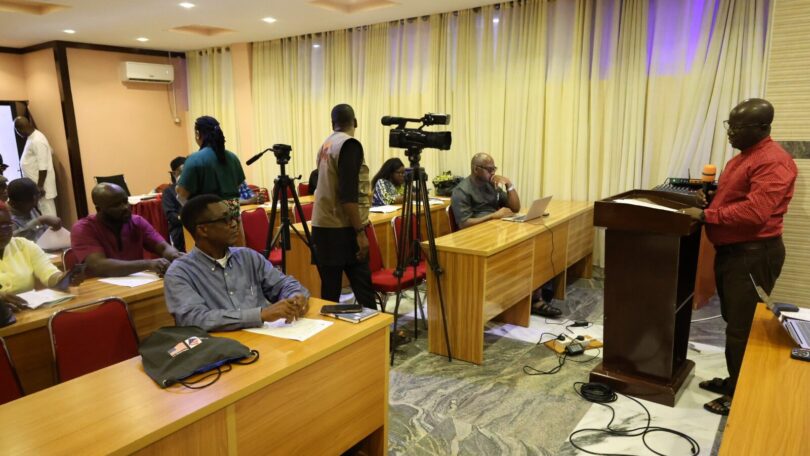
ANEEJ warns that illicit financial flows are draining Nigeria’s public resources and urges the media and civil society to intensify investigations, asset tracing and accountability efforts.
ANEEJ Executive Director, David Ugolor, said illicit funds moved out of Nigeria through fraudulent transactions had deprived the country of resources that could have been invested in critical sectors, including infrastructure, healthcare, education and job creation.
He said the consequences of IFFs were ultimately borne by ordinary Nigerians, who are left with poor public services and inadequate infrastructure despite the huge resources available to the government.
“Illicit financial flows have deprived Nigeria of resources that could have been channelled into infrastructure, healthcare, education, job creation and other critical public services,” he said.
Mr Ugolor cited the Benin-Sapele-Warri Road project as an example of how financial irregularities could translate into hardship for citizens.
He alleged that N14 billion was diverted from the project, leaving citizens to bear the consequences of its failure.
PREMIUM TIMES could not independently verify this claim.
He, however, said the persistence of illicit financial flows showed that stronger citizen participation and public scrutiny were needed to complement the work of the agencies.
He called on CSOs and the media to collaborate to investigate suspicious financial transactions, trace stolen assets, and demand accountability from public institutions.
The Operations Coordinator of the SecFin Project, Philippe Pacaud, also called for stronger collaboration with civil society organisations in tackling illicit financial flows.
Mr Pacaud warned that illicit funds moved from Nigeria and other African countries could be channelled into criminal activities, including corruption and terrorism.
Representing the NFIU Chief Executive Officer, Hafsat Bakari, Chinedum Odenyi said CSOs have important roles to play in advocacy, research, public awareness, policy engagement and community mobilisation in the fight against financial crimes.
He said the role of CSOs would become increasingly important as Nigeria prepares for its 2027 evaluation of its anti-money laundering, counter-terrorism financing and counter-proliferation financing framework.
The workshop featured presentations and interactive sessions on illicit financial flows and financial crimes in Nigeria; the country’s legal and institutional framework for combating IFFs; investigative journalism; media ethics; legal risks; source protection; and digital security.
Participants also developed investigative story ideas and reporting plans focused on illicit financial flows.
Resource persons included Mr Pacaud; Abdullahi Shehu of SecFin Africa; Taiwo Adebayo of the Institute for Security Studies; Aisha Bantam of the NFIU; Adedayo Kayode, managing consultant at Aideasbanc Consulting Limited; and the Editor-in-Chief of PREMIUM TIMES, Musikilu Mojeed, represented by Mr Adebayo.
The workshop was organised under ANEEJ’s project to strengthen the capacity of CSOs and the media to combat illicit financial flows, with support from the European Union through the SecFin Africa Project.