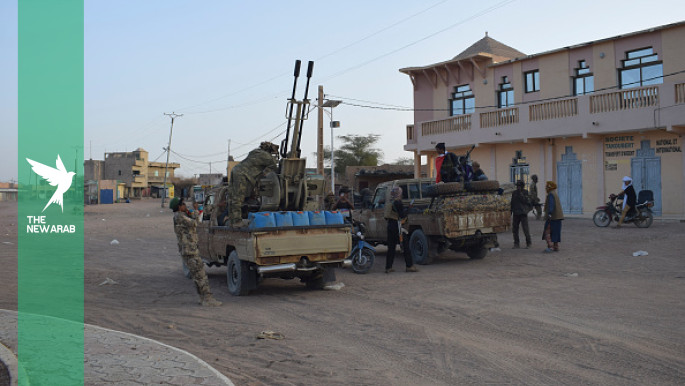
Clashes were reported in Mali over the weekend, following coordinated attacks by Tuareg separatists and Islamists against the Russian-backed junta [Getty]
Several cities in Mali, including the capital Bamako and the northern city of Kidal, were hit by a wave of attacks over the weekend, carried out by Tuareg separatist fighters from the Azawad Liberation Front (FLA) alongside Islamist militants.
The violence marks the latest escalation in the restive Sahel region, where an insurgency has persisted for nearly 14 years.
Russian forces, who have been present in Mali for years, were also involved in the fighting. However, questions have emerged over whether the Russian Africa Corps has partially remained in the country or withdrawn more broadly, after reportedly reaching an agreement with the FLA to leave Kidal.
The New Arab breaks down what happened and what it means.
Russian presence in Africa
Russian mercenaries, initially operating under the Wagner Group, have been active in Mali for at least five years, gaining prominence following the December 2021 coup that brought current junta leader Assimi Goita to power.
Amid the coup, Goita invited Russian forces to support the military administration in its fight against armed groups, after asking French troops to leave the country amid growing resentment towards the former colonial power.
Wagner, active since 2014 following Russia’s annexation of Crimea, expanded across several African countries, supporting governments aligned with Moscow. In addition to Mali, it has operated in Sudan, the Central African Republic, Niger, Libya and Mozambique, among others.
Wagner’s presence in Mali largely ended in 2025 and was replaced by the Russian Africa Corps, a paramilitary group established in 2023 following the death of Wagner leader Yevgeny Prigozhin. The group is overseen by the Russian Defence Ministry and was created to maintain Moscow’s influence, particularly as Western security forces withdrew from parts of the region.
Its role has focused on military training, combat support and participation in what authorities describe as “counterterrorism” operations, including alongside Mali’s ruling junta.
During the weekend’s attacks, reports indicated that Russian forces were involved in clashes in support of the Malian army.
However, their presence appears to have significantly diminished in Kidal, where they have confirmed their withdrawal.
Following the rebels’ rapid takeover of the city, an agreement was reached between the FLA and the Africa Corps for Russian and Malian forces to leave the area.
In a statement on Telegram, the group said: “In accordance with a joint decision by the leadership of the Republic of Mali, units of the African Corps that were stationed and engaged in combat in the town of Kidal have withdrawn from the area alongside Malian Army personnel.
“Wounded servicemen and heavy equipment were evacuated first. Personnel continue to carry out their assigned combat mission. The situation in the Republic of Mali remains difficult.”
The group later said on X that operations would continue elsewhere in the country, without providing further details.
Analyst Ruslan Trad described the withdrawal as “not a voluntary strategic repositioning, but a tactical defeat”.
“The Africa Corps, alongside Malian forces, was effectively surrounded at Camp 2 before negotiating a ‘secure withdrawal’ with the FLA. That framing matters, as you don’t negotiate your exit with the force that just pushed you out if you’re operating from a position of strength,” he told The New Arab.
He added that the loss of their base in Tessit around the same time points to a broader pattern of territorial rollback.
The group’s messaging suggested “a disorderly, not planned, exit”, he said, adding that Kidal is likely to remain under FLA and JNIM control in the near term.
Asked whether the developments signal an end to Russia’s presence in Mali, he said it would be “premature” to draw that conclusion.
“The Africa Corps explicitly stated that operations would continue in other parts of the country, and Russian war bloggers framed the withdrawal as temporary and reversible. However, that kind of messaging is partly narrative management,” he said.
A full withdrawal is unlikely given Russia’s strategic and economic interests in Mali, as well as its close ties to the ruling junta, he added.
Mahfoud Ag Adnan, a leader in the National Movement for the Liberation of Azawad (MNLA), said the agreement on Kidal could extend to other areas, including Gao.
Ag Adnan told The New Arab that negotiations were ongoing with the Russian embassy to secure the withdrawal of Russian nationals and affiliated forces from northern Mali.
He added that an understanding had been reached for Russian and Malian forces to withdraw towards the Sevare region in central Mali, after which they would fall under the authority of the government in Bamako.
Ag Adnan also said a third party, which he did not name, was involved in facilitating negotiations, and urged neighbouring Niger and Burkina Faso not to intervene.
Following the withdrawal, Moscow said it hoped Mali would return to “peace and stability as soon as possible”, although Kremlin spokesperson Dmitry Peskov declined to say whether the Africa Corps would bring the situation “under control”.
What happened in Mali?
Fighting erupted across Mali over the weekend between Tuareg separatists, Islamist militants and the military junta.
Violence broke out in Bamako and Kidal, as well as in Kati, a major military site outside the capital, while clashes were also reported in Gao and the central cities of Sevare and Mopti.
Mali’s Defence Minister Sadio Camara was killed after a vehicle-borne explosive struck his residence in Kati, a heavily fortified town home to senior military officials.
Since gaining independence from France in 1960, Mali has faced repeated instability, including coups, economic challenges and weak state institutions.
The country, like much of the Sahel, has experienced more than a decade of insurgency, led primarily by Jamaat Nusrat al-Islam wal-Muslimin (JNIM), formed from a merger of Al-Qaeda-linked groups, as well as the Islamic State Sahel Province (ISSP).
The Azawad Liberation Front (FLA) was formed in 2024 following the dissolution of the Strategic Framework for the Defense of the People of Azawad, bringing together several Tuareg separatist factions, including the MNLA.
Led by Alghabbas Ag Intalla, the group seeks an independent Azawad state in northern Mali.
Kidal, now under rebel and militant control, was previously the focus of a 2023 offensive by the Malian army and Wagner forces aimed at retaking the city.
The weekend’s events have been described as the largest coordinated attacks in years, with the last comparable joint offensive by Islamist and separatist groups dating back to the early phase of the insurgency in 2012.