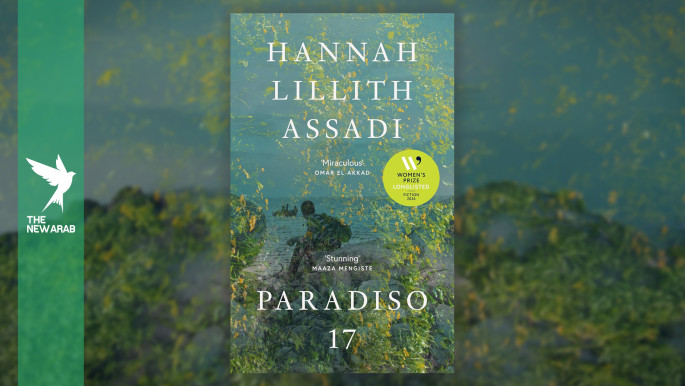
If one wants to read a tale written with striking candour and a story that will evoke those feelings obscured deep within, then one should read Hannah Lillith Assadi’s third novel, Paradiso 17.
Inspired by the life of her own refugee father, Assadi has penned a psychologically astute and poetic novel with Sufien, a Palestinian refugee, as its protagonist.
Vacillating between the final moments of Sufien’s life on his deathbed and vignettes from his past, his history slowly emerges.
From the beginning, we learn that Sufien, who is displaced from his home, will never return and will eventually die in a land familiar enough to claim as home, yet always foreign.
The intricate interplay between the need to survive and live and the hovering shadow of death underpins his story. Sufien will live a life of perpetual exile across the Middle East, Europe, and eventually America.
Assadi does not paint a portrait of a hero; rather, she writes honestly, examining the bleak realities of displacement and migration.
Sufien, as a character meant to mirror her own father, is profoundly fallible. He is neither a moral proxy nor an emblem, but a human hoping to survive and find meaning.
And his story is rife with mistakes, trauma, and dubious decisions. Death is present from the opening pages, framing Sufien’s life not as a quest for justice or consolation, but as a reckoning with unresolvable tensions between gratitude, intimacy, guilt, and love.
The impossible return home
Sufien’s story begins in the 1940s in the Palestinian village of Safad. At just five years old, a child typically knows wonder and curiosity, but Sufien is introduced to death and loss early on.
His family is uprooted from Palestine during the first Nakba, marking the start of a life filled with instability and shattered dreams.
His existence is shaped by ongoing precarity and the fluctuating hopes that are often crushed. With no home to moor him, his life is one of constant migration.
Sufien himself says, “Though he couldn’t name it, he could feel it, that losing a home is the closest approximation we have for losing our bodies. To be a refugee is to be nearly apparitional.”
First, they find themselves in a refugee camp, eventually trekking a journey to Damascus, Syria. Ultimately, his parents settled in Kuwait, as his father worked in grief over the displacement to sustain his family.
As a young man, he hopes to fulfil his father’s dream of him becoming an engineer and immigrates to Italy with his cousin. But life will take its own course, and to simply survive, his plan sours. He has many sexual exploits, befriends other Palestinian refugees, and other welcoming Italians.
A failed engineer, he runs a leather business and meets his lifelong best friend, Bernado, a wealthy Jewish American. Despite their disparate fates, they become inextricably connected, and it is Berando’s charisma that compels Sufien to yet again move, this time to New York City.
Once in New York, the two go their separate ways, yet are somehow always drawn back to each other. Eventually, he marries Sarah, a Jewish woman, and they have one daughter, Layla, and the three of them move to Arizona.
But this is not the story of a perfect victim who finds redemption with a complete and happy family. Sufien endures homelessness, bankruptcy, drug addictions, drinks, cheats, and goes to jail, and makes terrible mistakes when his daughter is young.
Despite his melodrama and impetuousness, Assadi’s portrayal of Sufien is deeply endearing, perhaps because he mirrors her own father; his humanity is a palpable force throughout the novel. She writes circularly, wavering between time and Sufien’s thoughts.
As his life moves forward, Assadi clearly captures the vertigo of time, its simultaneous inertia and acceleration. He reflects on his deathbed that, as a child, the notion of his life coming to an end was something decades away, incomprehensible.
But the reader knows that his end is inevitable. Sufien muses about all the things he thought he would have done, such as writing an op-ed in the New York Times to save Palestine or returning one day.
In reality, none of those things ever happened. Assadi writes, “Life is a plot of its own, the story always rises then descends, and unfortunately, the same purported messianic soundtrack of Sufien’s birth would not grace the ears of those who witnessed his death. He would pass away to the tune of distant police sirens.”
Writing against erasure
Like Sufien, most of us can not comprehend the end of our stories. Death is a nebulous idea meant to be contended with many years later, and the possibilities of grand achievements are endless, until time is up.
His legacy endures not through accomplishments but through his daughter, Layla, who also shares a longing for understanding and connection. Her efforts to document his tragedies evoke a universal desire for remembrance and meaning, resonating with readers who seek to find their own stories of resilience.
Through all his exploits, Sufien was never able to shake off his Palestinianess. He was never overtly political, but Palestine is inextricable from his DNA and the outcome of his life.
The conditions of exile, along with personal choices, create a complex web of identity and longing. No matter where he goes, he will always be acutely aware of Palestine.
In every place he tries to make a home, and every person he attaches to, his otherness cannot be shaken off. Even his own wife muses, “There was another fact about Sufien which Sarah had not really digested during their courtship: How Palestinian he was, how Palestinian he always would be, as if it were another organ of his.”
Sufien is not written as a symbol of hope for Palestinian freedom; he represents how the world fractures those who are forcibly displaced and how people attempt, and often fail, to repair that wound.
Knowing that Assadi wrote Sufien, inspired by her own father and by her interpretation of his life, is profound for the reader, as it blurs the lines between fiction and truth.
In the world of endless news cycles and statistics, Sufien’s narrative brings back the intimacy of human experience. He was not a freedom fighter; he was simply a broken man who longed for a home.
By narrating Sufien’s story without centring him as a hero, Assadi has shown us that storytelling in itself is a powerful act of resistance. He crossed border after border, not searching for paradise but for belonging.
How many Sufiens vanish in the false narratives of politics and death tallies, and the epic tales of champions? Stories of the oppressed toppling the empire invigorate us, but Sufien’s story is the one that reminds us of what liberation is.
Sufien wonders, “Was that all home would be from now on? A place to leave?”
This is the sentiment that would haunt Sufien for the rest of his life, and yet through all his migrations and constant leaving, he was only longing to return home.
Noshin Bokth has over six years of experience as a freelance writer. She has covered a wide range of topics and issues, including the implications of the Trump administration on Muslims, the Black Lives Matter movement, travel reviews, book reviews, and op-eds. She is the former Editor in Chief of Ramadan Legacy and the former North American Regional Editor of the Muslim Vibe