
…NALDA, NPC Recorded Highest Contract Irregularities
…Auditor-General Flags Pervasive Control Deficiencies, Institutional Lapses
…NASS Urged To Enforce Accountability, Prevent Recurrence Of Infractions
The Auditor-General for the Federation has uncovered contract irregularities amounting to N96.9bn across 44 Ministries, Departments and Agencies of the Federal Government.
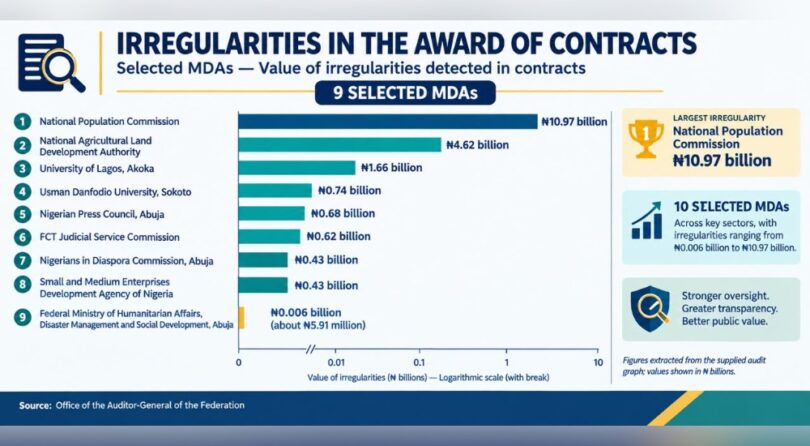
The findings, contained in the 2024 Annual Report on Non-Compliance (Volume 1) by the Office of the Auditor-General for the Federation, showed that N76.96bn was involved in irregularities in the award of contracts by 29 MDAs, while another N19.91bn represented contracts awarded in violation of procurement due process by 15 MDAs.
The audit findings analysed by THE WHISTLER raised concerns over compliance with open competitive bidding requirements and the approval processes prescribed by the Public Procurement Act.
According to the report, N76.95bn was the amount involved in irregularities in the award of contracts by the 29 MDAs.
The Auditor-General cited Paragraph 2921(1) of the Financial Regulations 2009, which provides that, except where exempted under the Procurement Act, all procurements of goods, works and services must be conducted through open competitive bidding.
The regulation states that “all contractors/suppliers shall be subjected to the same level playing ground.”
It further requires that the format for submission of bids, deadline for submission and predetermined criteria for evaluation “shall not vary from one contractor/supplier to the other; they shall be the same.”
The audit established that the irregularities cut across 29 federal institutions, with the National Population Commission (NPC), Abuja, recording the highest amount among the affected MDAs.
The report put the amount involving NPC at N10.97bn, while the Federal Ministry of Humanitarian Affairs, Disaster Management and Social Development recorded the least amount of N5.91m under the finding.
The report did not merely flag the value of the contracts involved but also drew attention to the failure of some MDAs to adhere to established procurement procedures designed to ensure fairness and transparency in the award of government contracts.
In a separate finding, the Auditor-General identified another N19.91bn in contracts awarded in violation of procurement due process by 15 MDAs.
The National Agricultural Land Development Authority (NALDA), Abuja, accounted for the highest amount under this category, with contracts valued at N14.7bn.
The Federal Ministry of Humanitarian Affairs, Disaster Management and Social Development recorded the least amount under the finding at N18.58m.
The Auditor-General based the finding on provisions of the Public Procurement Act 2007, which assigns direct responsibility to accounting officers and other officials involved in procurement.
Section 16(21) of the Act states that “the accounting officer of a procuring entity and any officer to whom responsibility is delegated are responsible and accountable for any actions taken or omitted to be taken either in compliance with or in contravention of this Act.”
The audit also cited Section 19 of the Public Procurement Act, which requires procuring entities to obtain the approval of the appropriate approving authority before making an award.
The Act provides that a procuring entity shall, in implementing its procurement plans, “obtain approval of the approving authority before making an award.”
The Auditor-General’s findings therefore point to two related areas of concern: irregularities in the conduct and award of contracts and outright breaches of the due process requirements governing public procurement.
The combined value of the two findings which totalled N96.87bn highlights the scale of procurement weaknesses identified by the federal audit authorities across the affected MDAs.
The report’s findings are particularly significant because the open competitive bidding system is intended to provide a level playing field for contractors and suppliers while allowing government to obtain value for money.
The Financial Regulations expressly require that contractors and suppliers be subjected to the same conditions during the bidding process, including identical submission requirements, deadlines and evaluation criteria.
The Auditor-General’s report also underscores the accountability obligations placed on accounting officers under the Public Procurement Act.
By making accounting officers responsible for actions taken or omitted in relation to procurement, the law places a direct obligation on officials overseeing public expenditure to ensure that government contracts comply with established rules.
The findings involving NPC and NALDA are particularly notable because the two agencies recorded the highest amounts under the separate categories examined by the Auditor-General.
While NPC had the highest value of irregularities in contract awards among the 29 MDAs cited under Issue 11, NALDA recorded the highest value of contracts awarded in violation of due process among the 15 MDAs listed under Issue 12.
The report’s findings add to concerns over the management of public funds and compliance with procurement regulations across federal institutions, particularly given the huge sums committed to government contracts annually.
The Auditor-General’s office is mandated to scrutinise government expenditure and identify instances of non-compliance, irregularities and weaknesses in financial management.
The latest findings consequently put the affected MDAs under scrutiny over their adherence to procurement laws and regulations governing the award of public contracts.
The Auditor-General for the Federation also identified recurring cases of non-compliance and systemic internal control weaknesses across multiple Federal Government Ministries, Departments and Agencies (MDAs), warning that the lapses pose significant risks to public financial management and accountability.
According to the report, the issues classified as “cross-cutting” refer to recurring cases of non-compliance and internal control weaknesses identified in at least four MDAs.
The Auditor-General said the recurring infractions were indicative of “pervasive control deficiencies and institutional lapses” that extend beyond individual government institutions.
The report noted that such weaknesses could undermine public financial management, accountability and effective service delivery.