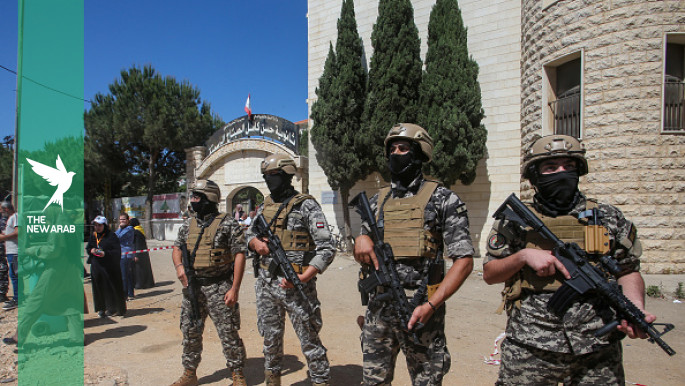
Lebanese security agencies are facing scrutiny after an Iraqi man accused of posing as a senior security official allegedly spent nearly two years cultivating ties within sensitive political and military circles before being exposed. [Getty]
A uniform, forged papers and a carefully cultivated network of contacts were all he needed to penetrate Lebanon’s security agencies.
For nearly two years, an Iraqi man identified by Lebanese security sources as “Tarek Nasrawi” allegedly moved through military and political networks in Beirut posing as a senior Iraqi security official, attending meetings, appearing at public events and building ties with figures across the country’s fragmented security establishment.
His alleged deception unravelled only after repeated attempts to secure meetings with Lebanon’s top security commanders raised suspicions among officials, eventually triggering quiet inquiries with Iraqi authorities that investigators say exposed the entire operation.
The Lebanese army announced on Sunday the arrest of an Iraqi national identified only by the initials T.N., saying he had impersonated an Iraqi security official inside Lebanon using forged documents and military attire. The army said the arrest followed weeks of “monitoring and security follow-up”.
Lebanese army sources told The New Arab the investigation was still in its early stages and was examining the suspect’s relationships with several Lebanese security figures who were believed to have been in contact with him over an extended period.
Investigators are now trying to piece together how Nasrawi established himself inside sensitive circles, whether any officials knowingly facilitated his access and whether he obtained information or influence through the relationships he cultivated.
According to the sources, Nasrawi introduced himself as Iraqi Colonel Tarek al-Husseini, appearing at meetings and social gatherings in a military uniform while claiming to represent Iraqi security institutions.
His name had become increasingly familiar within Lebanese security circles in recent months, particularly after he intensified efforts to arrange meetings with senior Lebanese commanders and officials.
Forging ties inside Lebanon’s security circles
Following his arrest last week, investigators reportedly found that Nasrawi had worked at a shop in the Khaldeh area south of Beirut, was married to a Lebanese woman and had been living in Lebanon for around seven years.
The sources stressed that he had never met either the Lebanese army commander, General Rodolphe Haykal, or the General Security chief, Major General Hassan Choucair, despite having requested appointments with both.
They confirmed he had held a single meeting around a year ago with State Security chief Major General Edgard Lawandos to congratulate him on assuming office, insisting no formal agreements or cooperation emerged from the encounter.
Investigators also reportedly discovered photographs on his phone with Lebanese officers and public figures, some of which authorities believe may have been digitally manipulated using artificial intelligence, including alleged images with Parliament Speaker Nabih Berri and Choucair.
According to the leading daily Al Akhbar, Nasrawi gradually expanded his network through Beirut’s political and social circles while presenting himself as the Iraqi embassy’s security attaché, holding the rank of colonel.
The newspaper said he had attended private gatherings, built relationships with officers and administrative figures, and attempted to position himself as an intermediary between Beirut and Baghdad on security matters, including discussions on possible coordination and assistance.
Suspicion reportedly intensified after his increasingly frequent appearances around sensitive institutions and repeated attempts to secure meetings with senior officials prompted further background checks.
The case has now been referred to the judiciary, while Lebanese army intelligence continues to investigate whether the alleged impersonation was merely an elaborate fraud or part of something more politically sensitive.
Growing questions over Lebanon’s security vetting
Nasrawi nonetheless succeeded in cultivating ties with figures linked to military intelligence in Beirut and was photographed inside official offices alongside officers and security personnel.
Rights lawyer Ali Abbas said the case had reflected deeper structural problems inside Lebanese institutions, where personal networks and appearances can sometimes outweigh formal verification procedures.
“This is the second major case in a few months,” Abbas told The New Arab, referring to the fake Saudi prince scandal that rocked the country earlier this year.
“It reveals a political and security culture that is often more concerned with proximity to foreign influence than basic institutional scrutiny,” he said.
According to Lebanese media reports, Iraqi intelligence information ultimately played a central role in exposing Nasrawi’s alleged real identity after concerns began mounting within Lebanese security circles.
The case has reinforced concerns over how someone allegedly carrying forged documents and a fabricated identity was able to move through sensitive security circles for nearly two years before being uncovered, with Lebanese officers tasked with scrutiny and vetting appearing to fall for the deception themselves.