
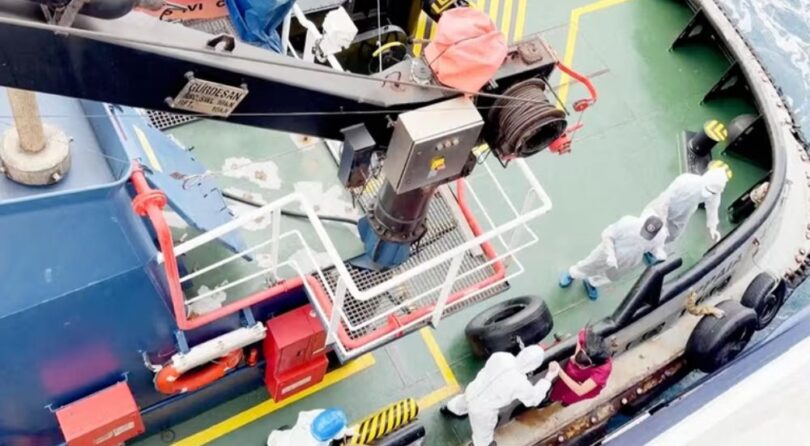
A rare hantavirus case involving a foreign traveller has triggered an international public health investigation involving the World Health Organisation (WHO), multiple countries, and cruise ship passengers travelling between continents.
A 69-year-old Dutch woman collapsed on arrival at OR Tambo International Airport in Johannesburg on April 25 after travelling on Airlink flight 4Z 132 from the British island of St Helena. She died the following day.
South African authorities confirmed on May 3 that she died of hantavirus, a rodent-borne disease rarely recorded outside the Americas, Europe, and parts of Asia.
The diagnosis, confirmed by Johannesburg’s National Institute for Communicable Diseases (NICD), prompted a multinational investigation involving the WHO, national health authorities, and the operator of the cruise vessel MV Hondius.
The woman’s 70-year-old husband had died two weeks earlier aboard the same cruise ship.
A British passenger who fell ill on board was evacuated to a private hospital in Johannesburg and remains in intensive care, though officials say his condition is improving.
Hantavirus is carried by rodents and spreads to humans through contact with infected urine, droppings, saliva, or contaminated particles in the air.
The disease is most commonly linked to parts of the Americas, Europe, and Asia where the rodent hosts are found. No sustained local transmission has been recorded in Africa.
The virus drew global attention in 1993 after deaths in the southwestern United States were traced to a strain carried by deer mice. Since then, cases have been reported in South America, particularly Argentina and Chile, and in Europe.
South African Health Minister Aaron Motsoaledi told Parliament: “Local rodents in South Africa are not known to carry hantavirus.”
He said the strain identified in the current cases, the Andes virus, originates in South America and is among the few hantavirus strains with documented, though limited, human-to-human transmission.
The Africa Centres for Disease Control and Prevention said it is monitoring the situation.
South Africa’s NICD conducted laboratory confirmation, while Institut Pasteur de Dakar is analysing additional samples from symptomatic passengers with WHO support.
Health officials have begun contact tracing involving airport staff, airline passengers, hospital workers, and cruise ship contacts. Monitoring continues because the virus can incubate for up to six weeks.
Former NICD deputy director Lucille Blumberg described the rapid identification of the virus as “like finding a needle in a haystack,” saying confirmation was achieved within 24 hours of alert.
Authorities have also traced passengers from connecting flights, including KLM services, as part of precautionary monitoring.
Health agencies have identified about seven to eight cases linked to the vessel, including at least two to three laboratory-confirmed Andes hantavirus infections.
Three deaths have been reported, while one patient remains critically ill in Johannesburg..
Symptoms include fever, headache, and gastrointestinal distress. Severe cases can progress rapidly to respiratory failure and shock.
The MV Hondius vessel, which departed Ushuaia in March on an Antarctic and Atlantic expedition, is heading toward Tenerife in Spain’s Canary Islands after anchoring off Cape Verde. Several passengers have been evacuated to hospitals in the Netherlands, Germany, and Switzerland.
The WHO said the global risk remains low, with no evidence of sustained human-to-human transmission or wider community spread.