
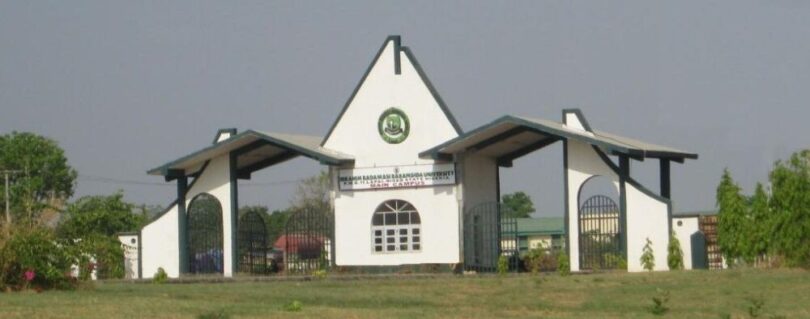
A group of students at IBBU is working to revive campus journalism on the campus
For two days in early July, dozens of student journalists gathered at the ICT Centre at Ibrahim Badamasi Babangida University (IBBU), Lapai, Niger State, for a capacity-building workshop.
But beyond notebooks, presentations, and newsroom simulations, another story was unfolding quietly.
For many of the students, the training represented something bigger than learning how to write better stories. It marked the beginning of an effort to breathe life back into the university’s Union of Campus Journalists (UCJ), a body whose activities had dwindled over the years despite a growing population of Mass Communication students.
“When I joined, there wasn’t much activity,” the UCJ president, Beauty Brendan, recalled.
“Most students focused on their academics, and the union wasn’t functioning the way it should.”
The UCJ IBBUL Chapter was created in 2020, with support from the National Union of Campus Journalists (NUCJ), then headed by Ibrahim Adeyemi. The then President of the Mass Communication Students’ Association (MACOSA), Yakubu Mohammed, invited NUCJ to conduct training and to launch UCJ on the campus.
The pioneer president of the UCJ was Zainab Abdullahi, said Mr Mohammed, now an investigative journalist with PREMIUM TIMES.
But the union has struggled to stay afloat since the first set of members left campus.
“All the presidents and vice presidents the union has had were appointed when they were in their penultimate years. This made continuity a problem, because the moment the top executives left, a vacuum set in, leaving their successors and members in some sort of confusion,” said Mr Mohammed.
Ms Brendan believes that inactivity of the UCJ has created an information vacuum on campus.
“We don’t have a reliable source of verified information,” she said. “That’s one of the reasons we’re trying to revive the union.”
Her concerns are shared by the department’s Staff Adviser, Andrew Ngele, who argues that campus journalism is far more than a student extracurricular activity.
“A university is like a small city within a larger society,” Mr Ngele said. “The role journalism plays here is no different from the role it plays outside the campus.”
According to him, a vibrant campus journalism union creates a culture of transparency by allowing students to question decisions affecting their welfare and the university community.
Mr Yakubu, one of the patrons of the university’s UCJ, said he then advised the outgoing executives to use students in the first and second years as executives so they have more time to grow the association.
He said the patrons and lecturers continue to train them as they look out for successors either in 100 or 200 level.
“We adopted a catch-them-young approach,” he said.
“That strategy started with this current set, and honestly it has been working. They now have a Substack handle, social media accounts where they share news and other content.”
Referencing Section 22 of Nigeria’s Constitution, which assigns the press the responsibility of holding the government accountable, Mr Ngele said student journalists should see themselves as contributors to accountability within the university.
“If there are issues around infrastructure, student welfare, or the use of public resources, students should be able to ask questions,” he said. “Campus journalism creates that space.”
For students like Deborah Lukman, that message resonated immediately.
Ms Lukman had stumbled on the training after seeing a registration link shared on her departmental platform. Curious, she researched the programme and decided to apply.
“I’ve always wanted to become a journalist,” she said.
By the end of the two-day clinic, she said her understanding of the profession had changed completely.
“I thought investigative journalism was like what you see in movies,” she admitted with a laugh. “Now I understand there are ethical and professional ways of gathering information and uncovering stories.”
She already has several story ideas.
“I’m naturally curious,” she said. “I enjoy asking questions and helping people become aware of what’s happening around them. Journalism is not just about writing stories; it’s about serving the public interest.”
That curiosity, however, will need more than enthusiasm to survive.
Ms Brendan acknowledges that while students are willing to rebuild the UCJ, several obstacles stand in the way.